
Besides being a frequent cause for derision from my fiance, music that falls into the “ambient-drone” category is a staple for me. It lends itself to heavy headphone affairs in which I can be completely lost in washes of synths and looped guitar distortion to a diligent companion to late night War and Peace read-a-thons with Addy. The only downside is that when I hear an amazing instrumental album I immediately get a sense of sadness once the giddiness goes away, I think, when am I going to listen to this again? When can I recapture the thrill of the first time I heard this? The good thing about bands that fall into the ambient drone camp is that they always retain a sense of “newness” at every listen, without recognizable hooks or melodies each song is a limitless resource of sounds and musical ideas that gather weight with each listen. Animal Hospital’s Good or Plenty is an album in which every song is as fresh and exciting as it was on first listen (as exciting as an ambient drone album can be). is a remarkable recording full of sunny, beautifully recorded instrumental forays into sound and texture. Kevin Micka is a masterful sound manipulator, taking seemingly standard song arrangements of guitars, drums, turntables, hand claps and the human voice and creates looping soundscapes that are rife with discovery. Never giving into the temptation to let his wanderings turn into an irrelevant wad of noise, Micka lets his instruments prop up each song giving them of a depth of a fully fleshed out pop song. His layers of shiny guitar washes over processed feedback and manipulation put him in the ranks of Aidan Baker and Christian Fennez, while his aural dexterity and dedication to creating beautiful soundscapes recall a Talk Amongst the Trees era Matthew Cooper. Good or Plenty is what I am guessing is a companion to his full length put out on the amazing Barge Records earlier this year, I’m guessing they both go in my list of favorite instrumental albums of the year.
Feature

The Orgasm Manifesto
Harry Polkinhorn
1
America hates sex in general, but it especially hates orgasms, the pinnacle of the experience. It hates that which it doesn’t understand.
2
America if nothing else is an ideological construct. But so is sex, and so especially is orgasm.
3
The value is on change, and the rapidity of it. Burn your bridges. Don’t look back. This doesn’t change the way it worked for millennia but a kind of hyper-change, or high-speed motion that moves us out of a Newtonian sociality into chaos. Orgasm then becomes a strange attractor.
4
As such attractors, orgasms undo all this. They are a mode of resistance, if viewed in these admittedly fake political terms. This is the old boring tale of subversion of desire. Romanticism, really.
5
Orgasms happen in bed (usually) just as naming happens in print or through an electronic medium (usually). Or in the streets through spontaneous linguistic intervention. What I am calling naming as a language function always is embedded. We go to bed for very few purposes: to sleep, to dream, to make love, to give birth, to be ill, and to die.

From Here to John C. Lilly & Beyond
Letter from the Editor
“In the province of the mind, what one believes to be true is true or becomes true, within certain limits to be found experientially and experimentally. These limits are further beliefs to be transcended. In the mind, there are no limits… In the province of connected minds, what the network believes to be true, either is true or becomes true within certain limits to be found experientially and experimentally. These limits are further beliefs to be transcended. In the network’s mind there are no limits,” Lilly, J. C. (1974). The Human Biocomputer. London: Abacus.
For this second Letter from the Editor, I wanted to speak about one of my favorite philosophers of the 20th Century, John C. Lilly.
Read MoreAnimal Hospital: Good or Plenty, Streets + Avenues
Ron Schepper
Good or Plenty, Streets + Avenues, the second full-length album by Boston-based musician and producer Kevin Micka (aka Animal Hospital ), presents a satisfying, forty-three-minute set of guitar-based instrumentals and electro-acoustic explorations. Not having heard his 2004 self-titled release, I can only imagine how it compares to the new material but I’m willing to bet Good or Plenty, Streets + Avenues represents a significant advance (something I’m sure we’ll also hear when Micka’s Barge recording, Memory, is released). The range of sounds he coaxes from the guitar shows he’s clearly a resourceful player, and one who, to his credit, eschews histrionics for a subtler approach. He proves equally capable of folding repeating patterns into hypnotic lattice-works (“Good or Plenty”) as he does sculpting meditations both vaporous (“What If They Are Friendly”) and shuddering (“Labor Day”), and he’s also got a nice way of using well-timed stabs to kick the material into a higher gear when necessary; hear, for example, how the otherwise polite funk workout “Barnyard Creeps” springs to life the second Micka’s guitar roar enters. Contrasts abound: a seeming septet of electric guitarists collectively threads melodic patterns into a ruminative whole during “Novel Moments” while steely tones and washes stretch across the background; waves of guitars swarm and cascade throughout “11 18 07” while a plodding rhythm keeps funereal time; and the jubilant and light-footed “March and June” drapes wordless vocals by Katharine Fisk Shields and Micka over a lightly swinging, Afro-tinged rhythm base, with acoustic guitar and a celeste-like melody adding further colour. Good or Plenty, Streets + Avenues doesn’t radically advance the guitar-based soundscaping genre but there’s still much to admire about Micka’s execution of his material and his conceptual approach (love the album cover too).

1. We Can
2. Novel Moments
3. March and June
4. 11 18 07
5. What If They Are Friendly
6. Good or Plenty
7. Define
8. Barnyard Creeps
9. Labor Day
Digital album available to stream or download now!

S**t Happens When You Party Naked
Dmitry Samarov
Dmitry Samarov is a local cab driver and artist who puts out a semi-regular blog called Hack, stories from his hours spent driving a hackney through the streets of Chicago. His most recent entry is about waiting out late-night revelers with a man who’s been driving a cab since ’73, the man’s scraggly white beard yellowed around the mouth from the nicotine who we learn, through the course of the entry, has been writing science-fiction stories on a manual typewriter for years, the latest involving a human-sized insect who’s also a detective. At the end of the post we learn that the detective has discovered ‘the remains of a person’s arm, chiseled to the sharpest point ever detected on his planet…’
Samarov was born in Moscow in 1970, emigrated to Boston in ’78 with his family, studied art at the Parsons School of Design and the Art Institute of Chicago, and has been driving cab for god only knows how long. The story of his first days as a cab driver is some of my favorite stuff, both awkward and lude, the drawings crude and poignant, full of vignettes with hookers and undergrads. Samarov is like a cross between Bukowski and Scorsese as seen through a murky watercolor-drawn world.


In the Mutableye is a segment that sometimes showcases something interesting that is happening somewhere in the world at this moment, and sometimes showcases some fad or person from the past that we here at Mutable acknowledge is still cool s**t.
For our second Is Still Cool S**t, we wanted to showcase an unknown artist & author who has been lurking in the taxi’s of Chicago and all the while recording this seedy world through words and images. Welcome to the universe of Dmitry Samarov!
Animal Hospital -- Good or Plenty, Streets + Avenues
Love and Mathematics
Originally published 02.15.2009
My favorite Brian Eno album always has been and always will be “Another Green World.” Anticipating Eno’s ambient work that soon followed in its use of meditative repetition and quiet electronics, that 1975 lp has always been more interesting to me because of its added complexity: the way, for instance, that guitars, bass, drums, and the occasional vocal allow the music to retain contact with the standard rock format even as the compositions moved far beyond. So you might call “Another Green World” an “ambient” album, but it’s much more than that; and you might call it “experimental rock,” but it’s much more than that, too.
Read More
Me Time
Scott S. Greenberger, Globe Staff
A curtain is furled under a pipe that runs just beneath the ceiling, and a spotted cat wanders in. On the makeshift stage there is a ripped couch, a battered metal file cabinet labeled “This Was Your Life,” and a swath of green shag carpet.
Sporting long sideburns and blue Chuck Taylor sneakers, Gabriel Boyer takes the stage and launches into a reading of “Dracula.” The spectators arrayed on the performer’s bed are less than comfortable: The slats beneath his mattress aren’t nailed in, so they tend to shift whenever somebody moves too much.
This is “Bedroom Theater,” freewheeling performances that take place in Boyer’s Jamaica Plain loft every eight days. Boyer, 26, is a frequent actor and the author of some of the plays and skits that have been staged in his bedroom for the past year. He and a friend have even published a guide, “Seven Short Plays for the Bedroom.”
Read More
The Manifesto of Negativity
Harry Polkinhorn
1. Prescript: I have nothing to say.
2. Nothing counts any more; nothing ever did.
3. Culture is dead. It committed suicide because it had become successful.
4. The liberation of language, a poetics of freedom of the word, the Futurists’ parole in liberta, the jouissance of schizophrenic discourse, the transrational zaum of the Russians, all fit perfectly into their preordained boxes, gagging them forever.
Read More
This is Not a Review: of George MacDonald, David Lindsay
Gabriel Boyer
We here at Mutable wanted to commemorate George MacDonald this week, and his esteemed lineage. Though he, along with several of his more interesting intellectual progeny are no longer well-known to the world at large, I would suggest that MacDonald is essential in any “secret history” of the industrial and post-industrial mind, not entirely dissimilar to Greil Marcus’ own secret history of the twentieth century, Lipstick Traces, that when we consider the history of revelation in relation to the culture industry and the prefabricated visions it has produced in the form of lighter allegorical fair such as Final Fantasy: The Spirit Within and The Matrix, what we are seeing is a similar degradation of this unacknowledged literary tradition as filtered through Alan Watts’ watered-down buddhism.
It should be obvious to anyone who has read George MacDonald why he has not retained whatever renown he had in the nineteenth century. As vivid and fabulous as the worlds he created are, the message is unabashedly Christian, and not the sort that can live in a suburban library either—like C. S. Lewis would be—a man who called George MacDonald his master. MacDonald is just a little more restrained than Blake in terms of his sometimes bizarre imagery—note the hawthorne tree as an old man in chapter four of Lilith below—and not surprisingly, because Blake was one of his key influences, as well as Novalis, and Swedenborg.
George MacDonald (10 December 1824 — 18 September 1905) may no longer be well-known in the world of fantasy, but besides being the “master” of C. S. Lewis, he was the mentor of Lewis Carroll, it being both Macdonald’s advice, as well as the hearty reception of his daughters, that convinced Lewis Carroll (the pen-name of Rev. Charles Lutwidge Dodgson) to publish his manuscript, Alice in Wonderland. MacDonald was admired by W.H. Auden, J. R. R. Tolkien, and Madeleine L’Engle. G. K. Chesterton cited MacDonald’s The Princess and the Goblin as a book that had “made a difference to my whole existence”. Even Mark Twain, who initially disliked MacDonald, eventually befriended him. (As if genius were solely dependent upon likability.)
Read More
SP Weather Station: September
Fake is the new real
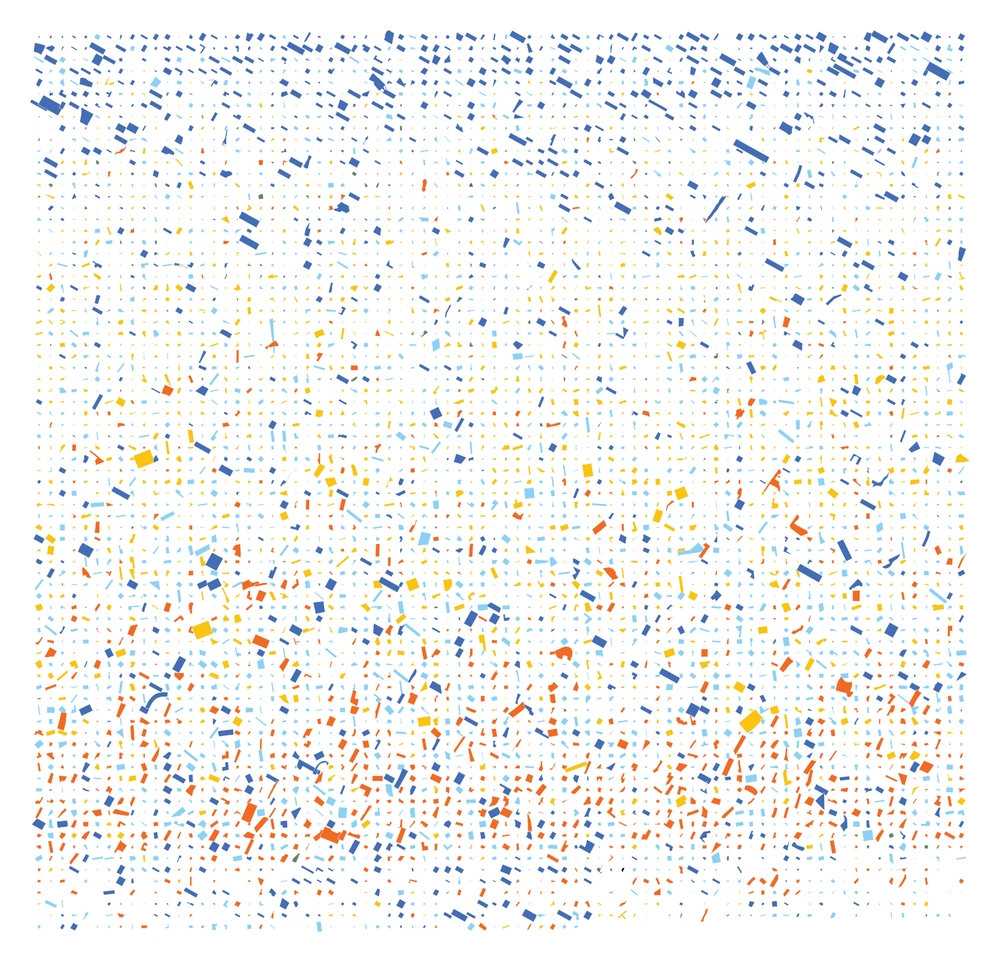
Fake is the new real contains the artwork and photographs of Neil Freeman. We just liked it, and thought others should check it out. Please do! Some samples below.
New York City block groups (median income)


Solar Alignment Walk (2011
In the Mutableye is a segment that sometimes showcases something interesting that is happening somewhere in the world at this moment, and sometimes showcases some fad or person from the past that we here at Mutable acknowledge is still cool s**t.

Josh Glenn
Friend of Mutable Sound, Joshua Glenn, has recently released a book entitled, The Idler’s Glossary, with Canadian publisher, Biblioasis, in which he explores idleness from every angle, with a comment concerning The Situationists here and Hannah Arendt there, he runs the gamut from playful to informative. Throughout, within the confines of his premise, that what he’s offering us here is an amusing glossary of arcane and everyday terms to denote the idle, he has created a very powerful critique of the work-a-day world. From Aestivate and Flazy, to Labor and Dissolute.
Glenn made his name as editor-in-chief of Hermenaut, a subversive magazine of ideas couched in readable and engaging prose. It was inspired by the teen magazine phenomenon, full of intriguing profiles and wry correspondence, and a distinctive world-view cultivated during his time at the Utne Reader. Having surrounded himself with a close circle of editors and authors often groomed by himself into maturity, Glenn went on to capture the imaginations of burgeoning elite everywhere. He rose from the zine culture of the early nineties (along with The Idler and The Baffler, among others) to achieve national reknown at the cusp of the new millenium, going on to develop the Ideas section of the Boston Globe, and continue his forays into the effluvium of culture as a freelance writer, pumping out some truly inspired pieces for N+1, a periodical itself inspired by Hermenaut. As well as continuing his cultural discourse on hermenaut.org, a blog aggregator he runs, he has put out Taking Things Seriously with Princeton Architectural Press, and of course, The Idler’s Glossary.
Mark Kingwell’s introductory essay offers a playful defence of the idler as homo superior, and it is here in this alternate universe, that Glenn has always soared. Idleness is the cornerstone from which this cultural critic has spun a collage-like discourse, his prickly critiques into everything from fake authenticity to camp, all stem from the bedrock of a simple ideology, that there is nothing more revolutionary than doing nothing. Much of his kaleidescopic learning is apparent in miniature within this book, perhaps the nicest example of which being his note about Joe Bousquet in his definition for Beautiful Loser. “My life is externally the life of a reject, and I wouldn’t want it any other way,” Bousquet is famous for saying, his own idea of the homo superior being one in which persons are excellent at what they are born to do, but failures at everything else.
Mr. Glenn paints an amusing, poignant picture, that I personally find proves more emotionally charged than Ambrose Bierce’s classic, The Devil’s Dictionary. More enlightened, less Child of the Enlightenment.