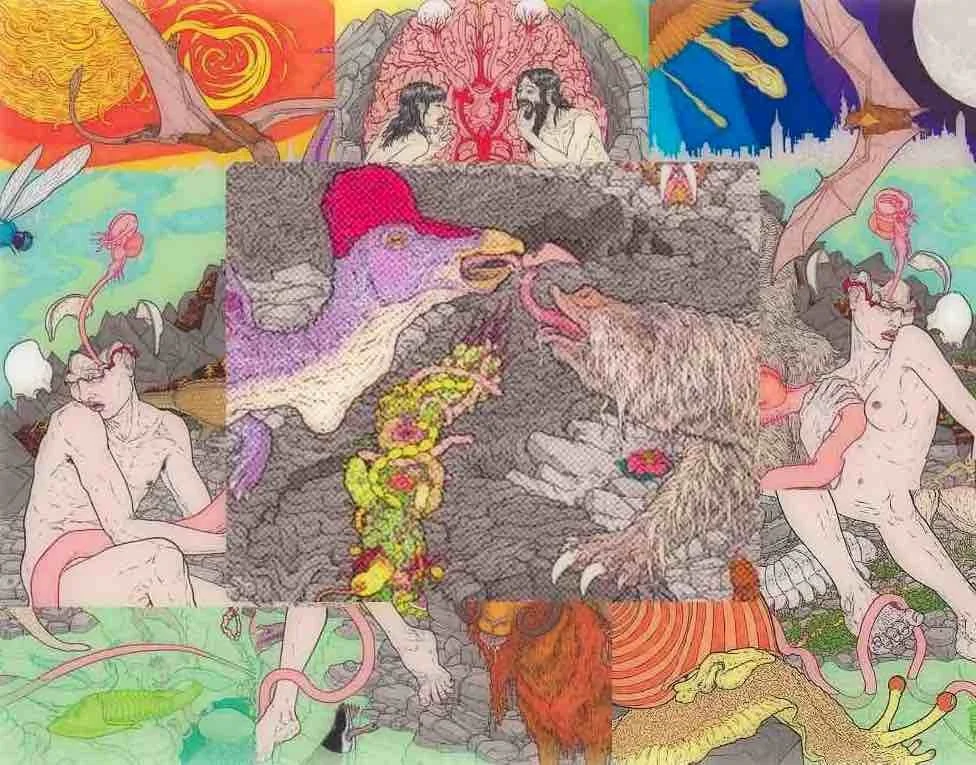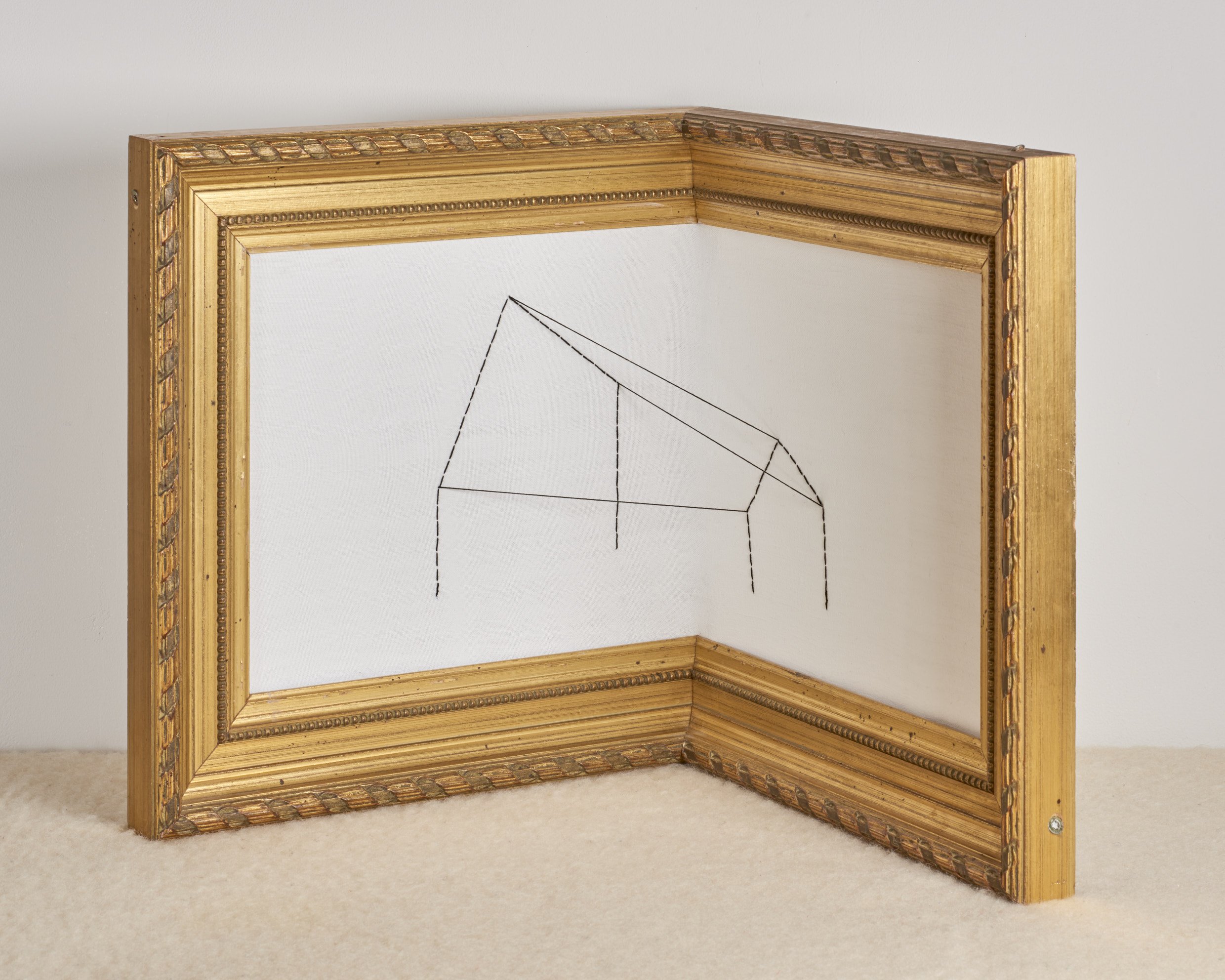
The notorious Neptune are on the road once again promoting their new album, Play Some Music. What began as a sculpture project for Jason Sanford in the 90s evolved into Boston’s perhaps most iconic art-rock group, Neptune. Guitars hacked together from soldered refrigerator doors and homemade synths—a melding of hardware store and landfill as they put it—Neptune has continued to shock and awe with their signature discordant sound, and this summer they’ll be touring the US, beginning June 10th at The Dunken Unicorn in Atlanta, GA, and ending in Minneapolis, MN, on the 28th. Full tour dates and locations can be found here. Mirror Side below is from Play Some Music.
Article
The Uses of Prejudice
It’s the Apocalypse, Stupid
[Below is the first in a series of articles exploring the space where climate crisis, apocalyptic thinking, and politics intersect. A disclaimer: the below article primarily explores racial prejudice. Later articles will continue to extrapolate upon the uses of prejudice in other contexts but due to spatial constraints, this article had to limit its scope.]
*
The opening track on Prince Paul’s 1997 hip hop masterpiece, Psychoanalysis: What Is It, repeats this refrain: “As long as I can remember / people have hated me,” and it’s this line which I am thinking of now. Perhaps because the history of prejudice winds so far into the distant recesses of civilization, with some truly astonishing actors conveying some jawdroppingly embarrassing misconceptions—and it’s through the lens of this hatred that the current potential ending of the American experiment is best understood.
Aristotle described certain persons as “slaves by nature” and the Spanish Inquisition codified limpieza de sangre or “purity of blood” statutes, marking one of the earliest bureaucratic racial ideologies, although India’s caste system is perhaps the most ancient. What makes and has always made American racism so striking is it so flagrantly contradicts its own mythology—because the uses of prejudice will always trump the illogic of it. At the time of America’s founding it was deemed a necessary evil by the North (or so the rationale goes) to keep the South on side, and in the South, it was deemed a necessary evil (or inherent good depending on who you talked to) necessary to uphold their agrarian economy and it has continued to serve its uses—in service of Nathan Bedford Forrest and his Ku Klux Klan and—in a different form and directed at a different people—in Hitler’s Germany—or apartheid South Africa—or the Belgian colonial policy that led to hardening the Hutu and Tutsi social categories, a policy that ultimately led to the Rwandan genocide. Prejudice has always been a tool and although its specific purpose may vary, it has a small set of very consistent methodologies, functions, and goals. How is it being used today?
A Passage to India is a remarkable document of a late stage colonial India and the mindset of its British ruling class. One of the book’s key villains is Ronny, a British functionary with a blatant and unconcealed distaste for his Indian subordinates, petitioners, and acquaintances, his tone reminded me very much of the constant indignation on display in people like Stephen Miller and others in high level positions in the current administration, but the space those voices occupy is very different. Ronny is an example of a low level bureaucrat in a colonial power at the tail end of its power—he exists in a world functioning within the paradigm of progress and we are meant to read him as one small villain in a world that increasingly knows better. Stephen Miller on the other hand is consciously working to reinvent that same colonial atmosphere both at home and abroad in a world where the narrative of progress has been replaced by doom scrolling and ideologies of fear, and for good reason. The weather alone is enough to give you nightmares, not to mention AI and the very real possibility of WWIII. The mindset of the colonialist is returning because the world has gone zipping off the cliff and everybody’s at a loss about what to do, so they revert to the most ancient ideology there is—the ideology of the blood, of the tribe.
Read More“Unpluggers who seek new forms of dwelling”: Ivan Illich on dwelling and the vernacular
D. Alan Dean
“To dwell is an art […] The human is the only animal who is an artist, and the art of dwelling is part of the art of living.” So says Ivan Illich in an essay called “Dwelling” that appears in In the Mirror of the Past. The modern world has rendered this art increasingly difficult. Many of us are liable to experience housing, he says, more than dwelling. Housing embeds us in a discourse of management, biology, or political economy. Housing provides a place to live in a biological sense, or in a bureaucratic one, but not a place to dwell.
Read MoreThe Indifference Engine
In the Mutableye
[For this In the Mutable Eye, we are posting a selection from The Indifference Engine, Clarke Cooper’s unpublished masterpiece on neo-totalitarianism. The full manuscript can be found on Substack here.]
*
Part I, Chapter 4: Efficient Systems
The classic totalitarianisms were evil and violent from beginning to end, but Hayek showed that a nascent totalitarianism need not begin that way and I have showed that it need not run that way. Totalitarianism is not what people think. The hallmarks of totalitarianism are not the brutality or the extravagant autocracy—those were only ancillary characteristics of a particular type of totalitarianism; side effects. The real essence of totalitarianism is the primacy of a System.
Not every system can do it, of course. Arendt noted that for a classic totalitarianism to really get going and achieve a decent approximation of totality it has to be based in a country that's big enough and powerful enough to have at least a rhetorical chance of actually taking over the world. Germany had the industrial power and just barely enough bigness; the Soviet Union had all the bigness and just barely enough power. Similarly, for a System to be effectively totalitogenic it must meet three interdependent criteria. It has to be big enough and general enough to plausibly encompass most activity. It probably has to be or promote a spontaneous order—it needs laws of its own innate physics that can determine (or equivalently, explain) the "natural" behavior of every element; this is how it can live. And it should exhibit positive feedback: any compliance should generally encourage more compliance; this is how it can grow, which it must if it's going to become properly infinite.
Read MoreFrom Robert Filliou to Mario Merz: The Contemporary Relevance of the Barabar "Caves" (India) in Light of Contemporary Art
Dominique de Varine
[The below text has been translated from the French. The original French text is at the bottom if you are so interested.]
It took the developments in painting during the 19th and early 20th centuries, from William Turner to Henri Matisse and Georges Braque, for our gaze to be freed and for us to allow ourselves to examine parietal art with an unprejudiced spirit. Similarly, certain developments in art from the twentieth century onward, particularly from its second half, are needed to approach the "caves" of Barabar in their singularity, overflowing any referential framework.
The Void and the Full, the Nothing and the Everything, the Hare and the Rifle
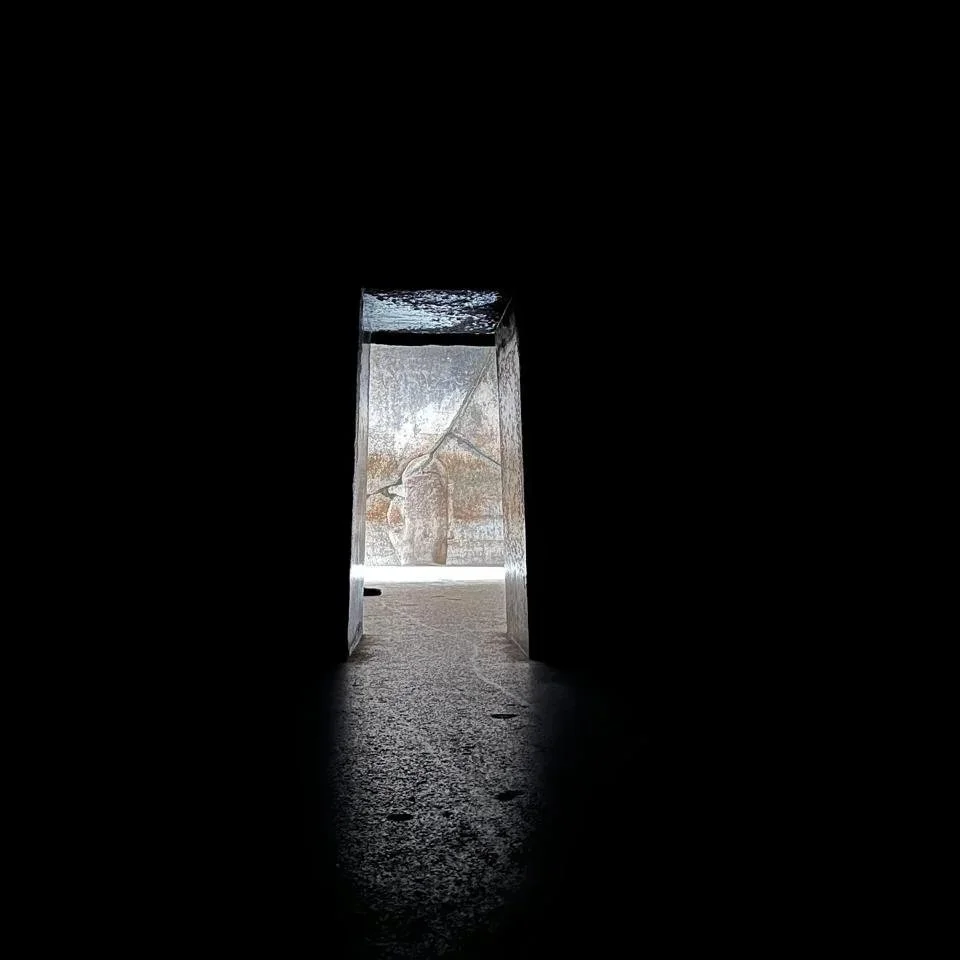
No figuration of any kind, no statuary or engraving adorns the interior volumes with their clockwork precision. Nothing but emptiness. And formal resonance.
Membrane, cocoon, receptor, chrysalis of granite polished to the micron on whose surface your body is reflected, but equally folds and gullies. The Barabar caves defy all interpretation, which remain contradictory beyond their possible assimilation to Ajivika culture (Maurya Empire, around the 5th century BCE). Therefore, this text will offer no explanation of what these caves are, their possible past role, or the reason for their creation. The technical aspects remain a mystery. But an attempt to read their formal deployment.
Read MoreInterview with Dominique de Varine
[This week we thought we’d share an interview with artist, Dominique de Varine, who calls Brittany home, but who we met in the Tibetan colonies of Northern India.]
*
Mutable: I think a good place to start our conversation is Dharma and Karma, as this was where our conversation began. What is the relationship between Dharma and Karma in your work? Has it always been this way or has their relationship evolved over time? And also, was there a time when these concepts were not important to your work and some moment when they became more so?
Dominique de Varine: Karma, Dharma, I don’t really know what it is. My ideas are fleeting, they fade with time. When I began my work on the Galipettes series, the question that series seemed to me to be answering was this issue of emptiness. Over time, the echo of fullness invited itself to the point of playing equal with emptiness, and as a dialectic. A reading is complementary to it, to be grasped from the side of reality since it is from this material that my research is ultimately made, and simultaneously to be grasped from the side of the order of the narrative, since reality only exists in relation to the form that we lend it. This narratological order can be pointed out from the opposition between engagement (narrative) and disengagement (narrative). The void, disengagement in the here and now. The fullness, engagement with all the shaping of the world. From there, Dharma and Karma.
Read MoreHome Again Home Again, Jiggity-jig
Letter from the Editor
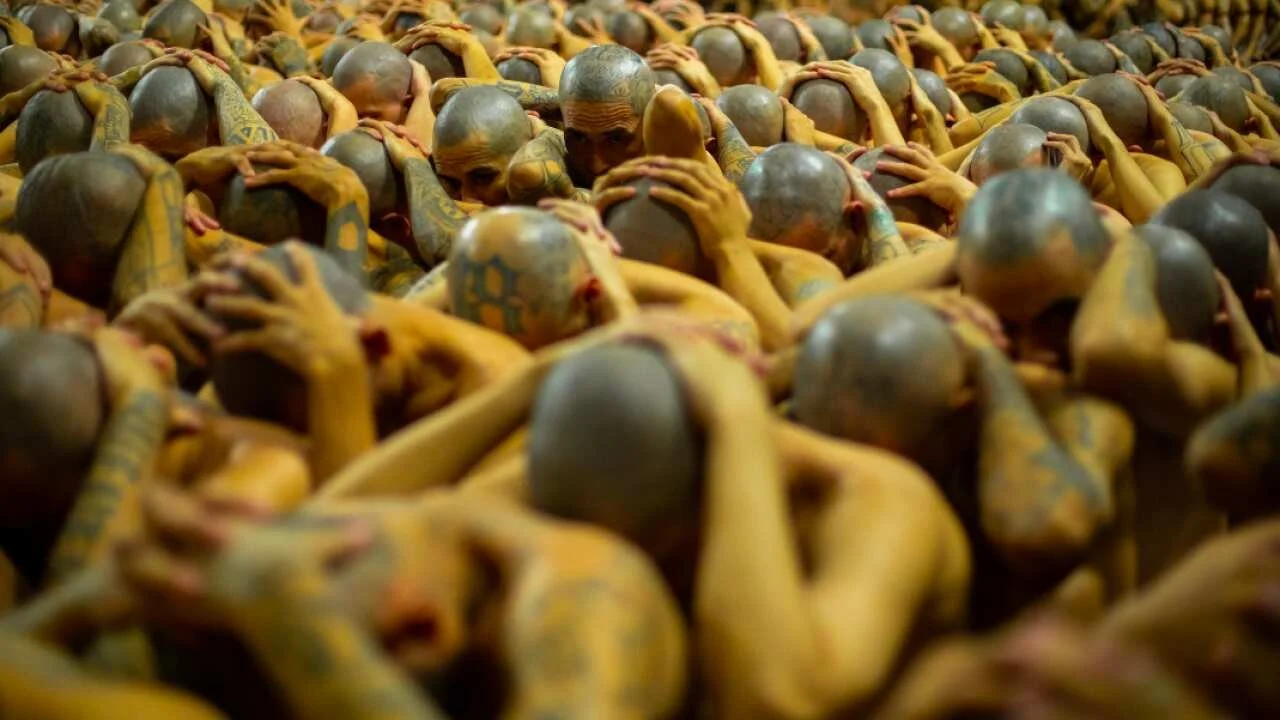
The American experiment appears to be ending in a not-so-stealthy authoritarian power grab. In fact, the current administration would like you to believe the struggle’s already over and the foxes have already secured the henhouse—as they ramp up libel laws and rule by executive fiat and deport legal asylum seekers to 21st century concentration camps in El Salvador—but these are not the most omnipotent of men, and our newscasters and historians are ringing the bell from their sound stages and social media accounts. The nation you grew up in is no more! The darkness has come and you need to wake up now if you ever want to wake up again. Look into the eyes of your children and align yourself with the light before the midnight of our homeland becomes so complete that you forget where your mouth is and your body becomes strange to you. Now is the time to panic!
But even as we watch the disenfranchised and lost being treated as dogs and less than dogs, as we witness media outlets and our most hallowed institutions of learning being coerced to bend the knee or suffer the consequences, even as the alleged leader of the free world spits bile in the face of the camera like a regular schoolyard punk, as students are disappeared and the threats have only just started threading their way into our mailboxes and through the tinkling glass of our shattered windows—still—as you turn walking wound and angels castrated of their wings—even then—there is nothing there. And there’s not even that.
Because this is how it’s always been. As you marched through the corridor of your life—its graduation ceremonies and heartbreak—from the infinite promise of adolescence and on into any given number of cardboard cut-out futures and their many alternate endings and bonus tracks—bankruptcies and biopsies—the webbing of your daydreams strung with meetings and the occasional colostomy bag—where are you in this equation? At what point are you? Because you are not the person in this corridor—this corridor that never was.
Read MoreGabriel Boyer
Throughout January, Mr. Boyer will be touring the US, visiting old haunts and singing sad sack country classics written by himself and collaborator M. Felder, as well as doing readings from What Light Becomes Me, his post-apocalyptic noir recently released by Montag Press. Dates and venues below:
12/28—Adobe Books: 7PM @ 3130 24th St, San Francisco, CA, (415) 864-3936
1/2—Recreational Psychoacoustic Lab: 7PM @ 601 NW 80th St Unit B, Seattle, WA, (206) 651-5937
1/3—The Cabin Show: By invitation only
1/9—Mutable HQ: By invitation only
1/12—The Mothership: 6 Sergeant Richard Quinn Drive, Woodstock, NY, (845) 679-3392
1/17—The Lilypad: 7PM @ 1353 Cambridge St, Cambridge, MA, (617) 955-7729
1/19—Pierce’s Hall: 7PM @ 121 East Putney Falls Rd, Putney, VT
Gabriel Boyer has been deluding himself for as long as he can remember. His latest release can be found below. You can read more about him here.
What Light Becomes Me
“Imagine an AI trained on Quentin Tarantino films, William Burroughs novels, a few bits of David Ohle's weirder surrealism, and a Pittsburgh street map is told to write a dystopian noir, and halfway through that project someone feeds in a bunch of William Gibson and Philip K. Dick, and the AI meanwhile has fleshy arms and is growing sticky and pungent and wet. And imagine this AI hands off a first draft to a wandering poet with an ear for torqued language, a lonely figure, a touch sentimental but with a bitter streak. And then this poet revises the draft while reading abstruse philosophy and accounts of mystic visions. Now speed up whatever you're imagining, such that it becomes a propulsive hyperviolent plunge through fractured layers of perception and possibilities, ends of the world without end, the impossible tortures of the post-post, the indifference of hallucination and prophecy. Perhaps this might approach Devil Everywhere I Look, but it's still unlikely you will have anticipated the bears,” Ben Segal, author of The Wes Letters and Pool Party Trap Loop
Pretty much sums it up. You can find a copy of What Light Becomes Me by Mutable regular Gabriel Boyer … here.
In the Mutableye is a segment that sometimes showcases something interesting that is happening somewhere in the world at this moment, and sometimes showcases some fad or person from the past that we here at Mutable acknowledge is still cool s**t.
My Asinine Life: Unrequited Me as Still Life
Gabriel Boyer
How do you summarize a life? How do you conclude yourself? Where are you when the boulders come bouncing down the incline? Are you at home and gazing at the glowing screen with some excitement? Are you out on a hike with your long-suffering spouse? Do you have your fingers in many pies at the moment? Have you given up on ever being anything like yourself?
Are you alone in your room and realizing that you are always going to be alone in your room from now on as you nurse your gout-ridden foot? What about that you didn’t end up here because you slid into a giant trap door in the sky or because of some other deception of the scene and the people in it but more because of the general complications of being, some of which very much have nothing to do with you and who you are, and some of which very much do—you ended up here because you just couldn’t help yourself—whatever that means in your specific case—or because you didn’t have the courage to do it differently—or maybe you did and that’s why. ‘Here’ herein meaning wherever you happen to be at the moment.
Could of been you didn’t think it through. Or you just got lonely. Or your mother got sick and someone had to take of her and it ended up being you. Or there came a point in your marriage when nothing made sense any more and now you’ve been divorced for five years and it still doesn’t make sense. This is where I am.
Read MoreAI Art, Camp, Kitsch, & the Singularity
In the Mutableye
AI art has proven both divisive and alluring, prompting Chomsky to describe AI and language learning models as, “plagiarism software because it doesn't create anything, but copies existing works of existing artists modifying them enough to escape copyright laws,” and, from Hayao Miyazaki: “I will never apply AI art to my work. The art form is an insult to life itself.” But there are those of us who can’t look away from these monstrosities, precisely because of their wrongness, their near-campiness and quasi-kitchiness.
It is in the ways that AI art fails that we are drawn to it. We chuckle knowingly at the oddly rendered hands even when we are unnerved by the humanity of the face we are looking at. We point out which actor this image was clearly based on, and how it’s just a little bit off, but we can’t stop looking at the sky behind.
As Susan Sontag says in Notes on ‘Camp’, camp sees everything in quotation marks. “It’s not a lamp, but a ‘lamp’; not a woman, but a ‘woman’” and this is exactly what AI art does to everything, but in both a more abstractified and specific way. It’s not Chris Pratt, it’s ‘Chris Pratt’. It’s not the Matrix. It’s ‘The Matrix’. It’s not a person, it’s a ‘person’. It takes units of culture and processes it into an ironic and alien counterpoint to the actual article, which is perhaps why Hayao Miyazaki sees it as an insult to life itself. Artifacts of human ingenuity are turned simulacra of themselves in a trick of computing mirrors that will always and forever render images that are somehow ‘off’, but it is precisely this offness that draws us to them, that turns them into units of camp, a kind of standardization of the so-bad-it’s-good aesthetic through the functioning of the attention transformer mechanism itself.
We here have Mutable have put together a collection of some of our favorites from the library of Abandoned Films and from TRGNY, as well as a few other examples indicative of trends in AI art as a whole.
Read MoreLa Galerie Lente 1: Denis Colin
L’œuvre de Denis Colin se développe en gambade, discrètement. La simplicité, l’humilité de son économie vous poursuivent de leur charme, de leur humour enfoui. Le plus souvent crée en regard d’un lieu, pour un lieu, un évènement, elle s’y insère et s’en libère aussitôt.
J’ai proposé à Denis Colin des images de son travail tournant autour de la question de l’habiter.
All photographs © Philippe Robin. To see more of his work go here.
Remember Yourself Ironically, False Messiah
Letter from the Editor
The truth is, I always loved you.
Oh, you false messiah, what do you have to offer our perpetually flooded, brokedown and generally speaking nonexistent universe—what platitudes and what shopping tips—and what will come of it when it comes—the suburbs turned into a no-man’s land between the scavenging riches of the liquefied and decomposing downtown and what wilds have grown beyond—the family dog murdered for its meat—an eye for an eye—and nothing but silence in between—all wrong place wrong time on account of some of us weren’t built to survive the apocalypse, but you think you’ll do just fine, don’t you?
You and me are you, my false messiah—who sit here pontificating in our cynicism, because—with the apocalypse just around the corner, all your favorite romantic comedies don’t do it for you anymore.
So—who are we? We’re the ones with our feet in two epochs, and our greatest hope is to get to the credits of this madcap comedy of a genocidal romp without being swept up in its killing fields. Many of us believe even now that the annihilation of everything and everyone will only happen on the far side of the globe from us, in the global south of our former vacation spots, but no one panics like a suburbanite, not to mention a mob of panicked suburbanites, armed with rifles and tiki torches.
Read MoreThe Early Cinema of Jamaa Fanaka
Walker Zupp
Welcome Home Brother Charles (1975) was the first film by Jamaa Fanaka (1942-2012). Fanaka was a film undergraduate at UCLA when he made the film, and it was an attempt to make use of the equipment he had access to. “They’d have these assignments called a Project 1 then a Project 2, which were usually five or ten minutes without sound,” Fanaka recalled in an interview with Jeff Brummett*. Although turning one’s “Project 2” into a movie was unheard of, Fanaka decided to “take advantage of this blessing” and started production on his first feature-length film*.
1975 was a watershed year for the United States. It saw the evacuation of American soldiers from Saigon and the takeover of Cambodia by Pol Pot and the Khmer Rouge. The American merchant vessel, Mayaguez, was also rescued after being seized by Cambodian forces. Lastly, Americans and Soviets launched their respective spacecraft—Apollo and the Soyuz—into space for a U.S.-Soviet link-up, which led to new developments in space travel. In the United States things were equally tumultuous. John N. Mitchell, H.R. Haldeman and John D. Ehrlichman were found guilty of covering up the Watergate Scandal and were sentenced to up to eight years in jail. Then Gerald Ford—who had only recently been sworn-in as president—survived two assassination attempts within seventeen days†. (Both attempts were carried out by female shooters, one of whom was a member of Charles Manson’s cult.) In short, it was the right time for Fanaka to make a film about an ex-con’s murderous genitalia. As of June 2023, however, Welcome Home Brother Charles has 4.8 out of 10 on IMDB, is generally classed as a Blaxploitation movie and is about as obscure as the pioneers of Soviet animation, the epic Polish science fiction movie, On the Silver Globe (1988), and the experimental novels of Ann Quin.
Read MoreThis is Not a Review: of Dark
Gabriel Boyer
Twin Peaks will forever be my favorite show of all time. It’s weirdness is unprecedented. It sits both at the peak of David Lynch’s career and at this perfect point in history when television was still just trash and when you consumed it, you did with the same relish that you consumed Bagel Bites or Oreo O’s. It was a time when FOX was just getting started with shows like 90210 and Married With Children, when trashiness and disgustingness were hilarious, when Jerry Springer was both a genius and a charlatan, a world of satire and deadpan comedy that will never come again.
But in the sea change that came with the coming decades, new kinds of serialized video content began being produced. There are those shows everyone talks about: The Sopranos, Breaking Bad, Game of Thrones… The first two seasons of both True Detective and Westworld were a revelation. But these were all masterful works of genre, whereas with Dark something new came into the world that for once could rival Twin Peaks with its weirdness.
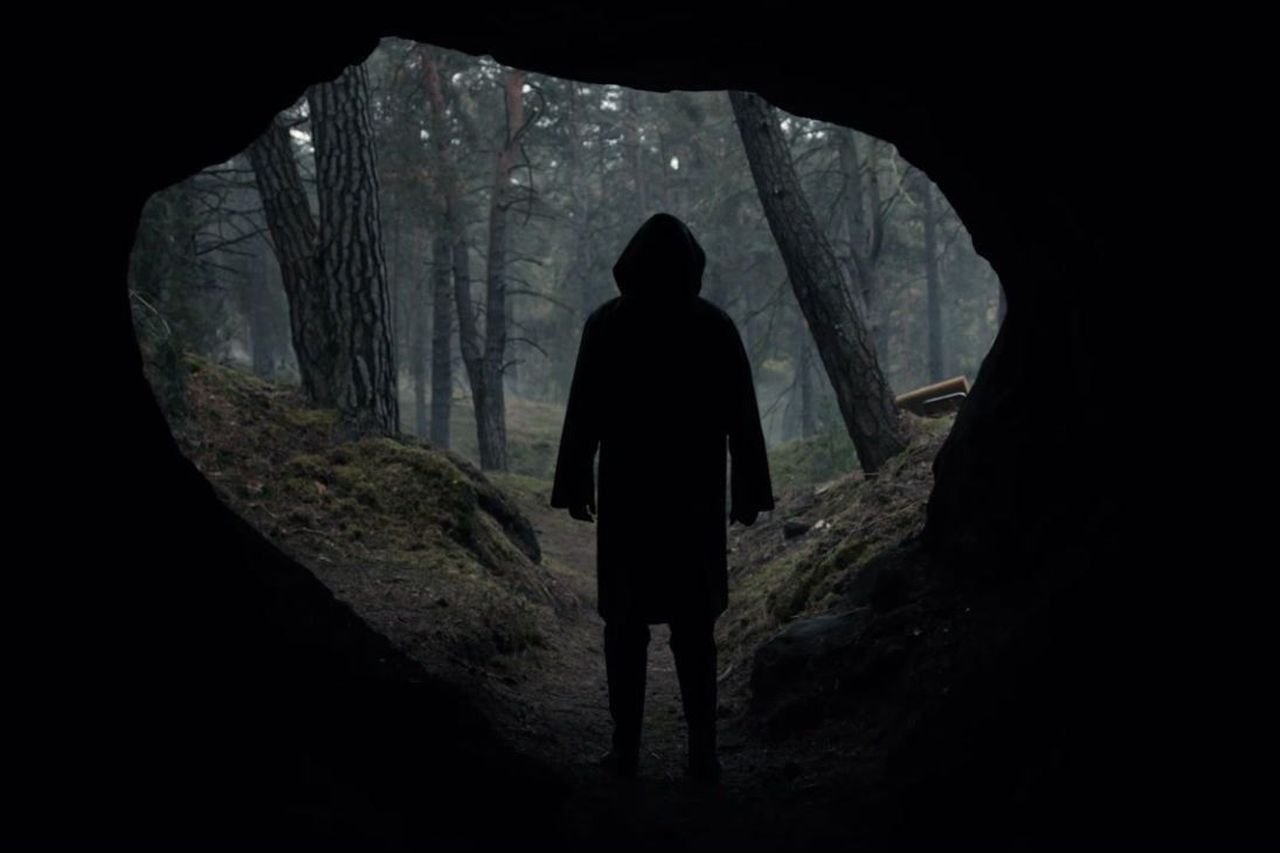
Dark raises questions of causality and plays with dichotomies like good and evil, but it also manipulates our expectations in an almost mathematical way. What is so mind-meltingly good about it isn’t the dialogue or the characters, but the puzzle of its narratological universe and the way in which this puzzle has been realized. In a streaming universe dominated by sequels and spin-offs, Dark is something of a miracle. It exists in a genre all its own, a genre that is distinct from science fiction, a kind of postmodern realism.
Read MoreColin Winnette's Users
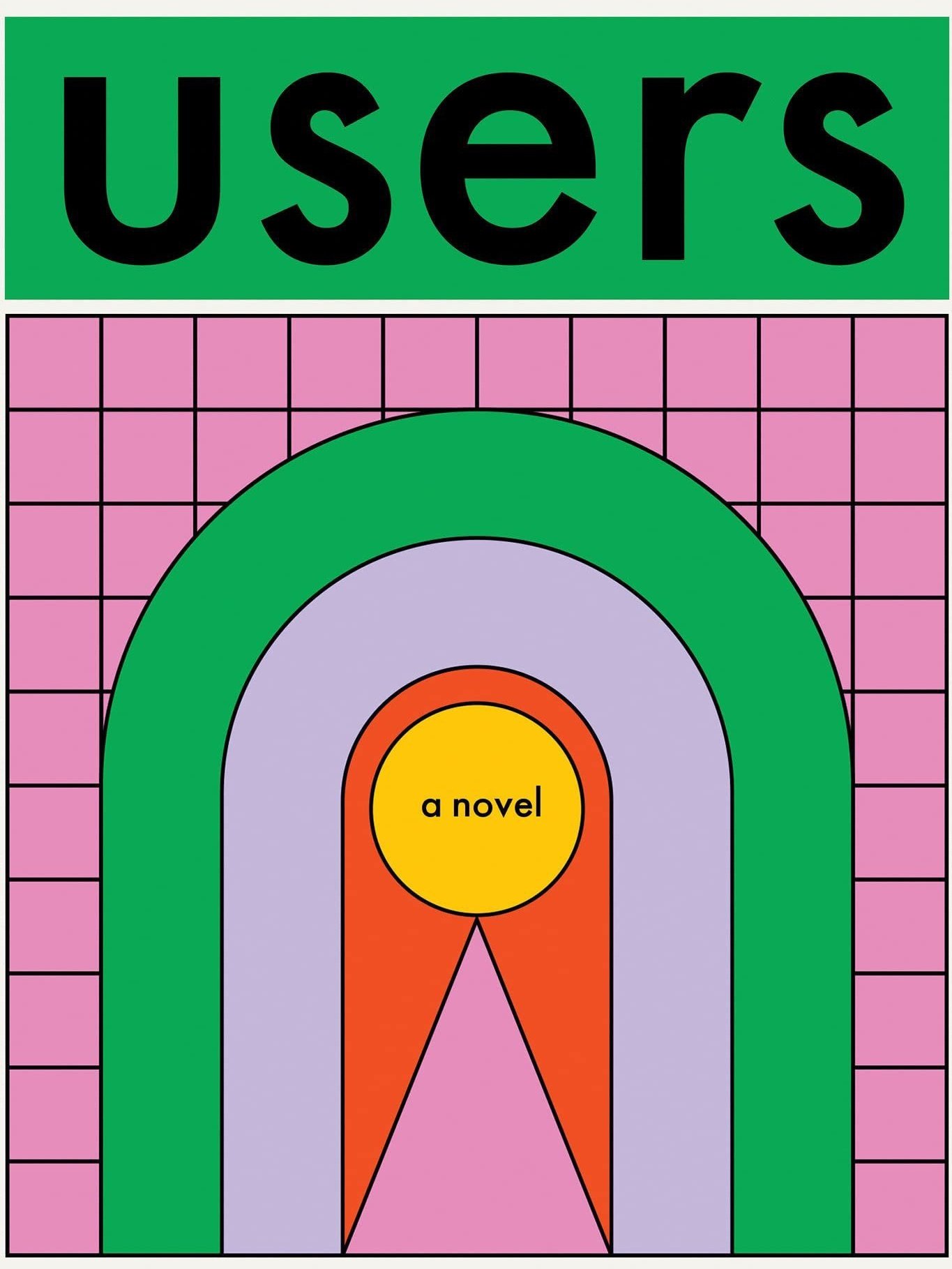
We here at Mutable first met Colin Winnette in a loft in Chicago sometime in early 2009, and have delighted in watching as his career has blossomed in the last decade-and-a-half. From the subtle allegorical realism of his debut novel, Revelation, a voice that matured with Coyote and Haint’s Stay, turned wondrously weird with The Job of Wasp, and has now founds its home with Users.
Hailed by the New York Times as “timeless”, the story also reads as very timely, centering around a tech creative and his efforts to create VR experiences from dreams, a premise which perfectly fits with Winnette’s signature dreamlike prose. From Western to sci-fi, the one constant is a kind of watery and elastic reality, a prose both biblical and sly.
You can read a sample of Users here.
In the Mutableye is a segment that sometimes showcases something interesting that is happening somewhere in the world at this moment, and sometimes showcases some fad or person from the past that we here at Mutable acknowledge is still cool s**t.
Chadha Brahmi & the Unspoken Other
In the Mutableye
Chadha Brahmi, a 23 year old architecture student from Tunisia, never considered herself an artist. She compares her artwork to her weightlifting. She is suffering to create something better and beautiful.
There are various themes in her work, but the disembodied eye is the birthplace of it all, the form from which it all sprouts, and the foundation of her uncategorizable vision. Her depictions of eyes and the accompanying disembodied beauty verges on the horrific and occasionally slips into a kind of modern-day impressionism of body horror of the silenced subject. These are artworks that can seem like sketches or illustrations and can veer into collage, peppered with found objects or cut open like a pop-up book in progress to reveal the artifice of the 2-D. They can have the extreme allure of satire and its caricatured vision of reality even when they are always awash in watercolors that give an unnerving living quality to them, and often are like blood splatters on the page.
Read MoreMy Asinine Life: The End Game
Gabriel Boyer
Hanoi is a mobius strip.
You think you are moving in one direction and then find yourself back round towards the intersection that started it all, except for somehow it’s changed in the interim. Like somehow you slipped into an alternate reality Hanoi. Or. There are parts of Hanoi that sing with remarkable birds and vegetation hangs out from every window, off of every balcony, and into these back streets, and there are parts of Hanoi that are tight walls of junk shoppery crammed with a river of angry motorbikes and their murmuring engines. Hanoi contains every possible version of Hanoi.
Or to put it another way. Hanoi is functioning as a stand-in for my mind at the moment and its many frustrations and confusions. It is what a broken mind looks like. A mind racing in many directions at once. A mind facing the inevitable end times and the games we play to avoid facing it.
We, the human race, are the greatest procrastinators. When faced with our own impending doom, our answer is always, “Not yet.” We watch the lava rolling over the lip of our front yard and think, “Maybe it’ll go away on its own.” We witness our neighbors in the furthest housing unit swept off into the sea and say, “It has nothing to do with me.” This is us.
Read MoreCreative Writing In Higher Education + Sceptical Interruptions
Walker Zupp
Creative Writing In Higher Education
The words “Creative Writing in Higher Education” fill me with dread (angst, disquietude). For the past 7 years, to varying degrees, I have studied creative writing at university level. If there was any consistent philosophy that held together the various modules I studied, it was evidently wasted on me: from the standpoint of a student there was no coherent vision for any of these modules. I have listened to creative students bemoan the courses which they cannot get their heads around and worry about whether they’re doing what they’re meant to be doing. But perhaps that is the point, the significance, the substance of these creative writing modules: that they have no “point”, as such, but instead play roulette with undiscovered talents and ignore them when they make significant headway. And there is a part of me that thinks this whole process insidious and evil: a damning summation of everything wrong with the teaching of creative writing in higher education. But, as Lars Svendsen points out in A Philosophy of Evil, the problem with many theories of evil is that they have a tendency to assume that evil wants to commit harm. (Cf. Natural evil.) And the one-sided nature of this tendency “leads us to lose sight of ourselves” which in itself can be described as evil (Svendsen 87). The whole losing-sight-of-ourselves could be prescribed to the evils committed under both Hitler and the Nazis as well as Stalin and the Communists. Thankfully, the teaching of creative writing in higher education is nothing so serious. And in many ways that is a part of the problem: it is not taken seriously enough.
It’s also a mistake to try and make people take things seriously. What often happens when this is attempted is the people for whom the lesson is being taught start cracking up; because the fact of the matter is that anyone who says they ought to be taken seriously ought not to be taken seriously at all. (E.g. Hitler and Stalin.)
Read MoreVideo: The Backrooms
A bunch of teenagers are making a horror film when their videographer stumbles and finds himself in an abstract space. He wanders, Blair-Witch-style, breathing heavily and muttering incomprehensibly when he stumbles upon some terrified scribblings upon one wall.
The Backrooms began as a photograph on 4chan and evolved into a Reddit thread. (r/CreepyPasta.) It inspired fan fiction, followed by a backlash (r/TrueBackrooms) and then… Earlier this year…
A collection of shorts about the Backrooms, produced and directed by 16-year-old Kane Pixels, can be found on Youtube. The Backrooms is a k-hole of found footage from different people who have found themselves in “the Backrooms”, whether it’s the teen videographer or scouting parties from some underground government agency. The vintage video look combined with the generic, anonymous, and occasionally and increasingly surreal space is addictive. Start below and then continue to explore. The Backrooms is a paranormal mystery and horror film presented in bits and pieces that you can explore and peruse to manufacture your own story about what is “the Backrooms”.
Enjoy!