Ben Segal
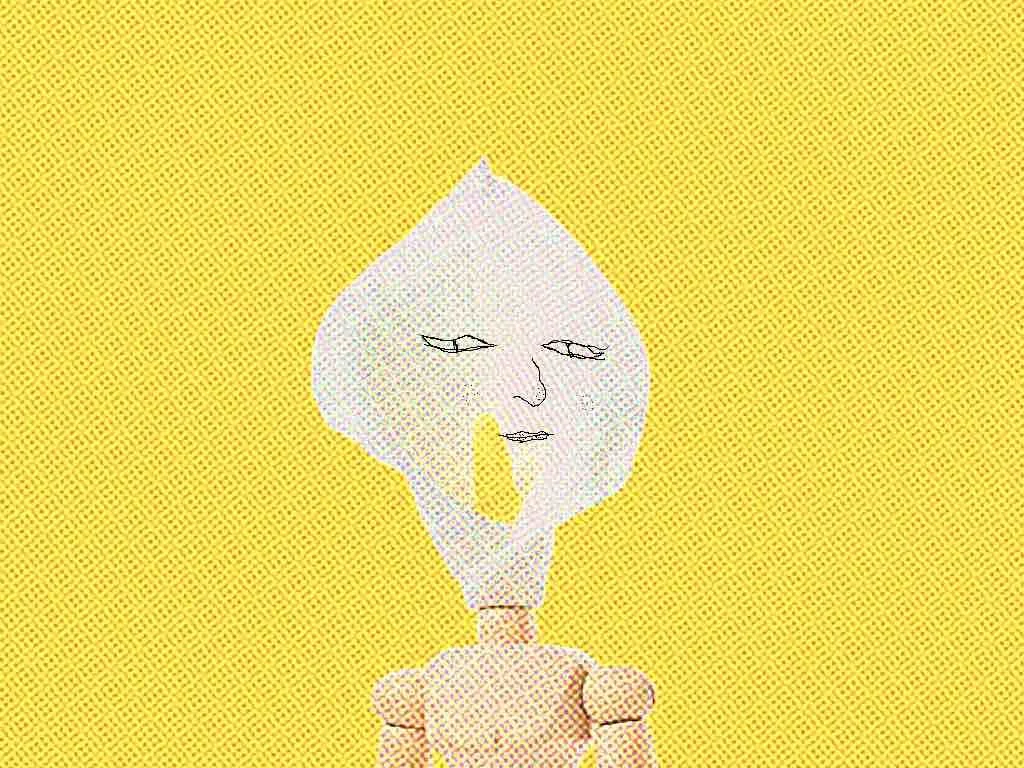
I walk around cutting off people’s heads. They grow back quickly as flowers.
Jake saws similarly, but leopards bloom in the place of the heads he severs. These are not, to be clear, leopard heads. They are full leopard torsos, with front legs and claws and heads and everything, and they are the size of ordinary leopards.
The people Jake cuts have difficulty balancing after. They are awkward creatures, stumbling, unwieldy.
The flowers I make are more or less head-sized, well-proportioned to the neck, with large and colorful petals like in the paintings of Henri Rousseau. They’re not particularly pleasant smelling, but they emit an intriguing odor for which sophisticated individuals have cultivated a taste.
The floral-headed often sell extracts for extra cash. They thank me for this, via email, once their braille develops.
The leoparded drag their human parts into trees and hide those halves in the foliage.
It’s Sunday and Jake and I are brunching at that Greek spot he likes. We have coffee, refills, feta omelettes. I tip the waitress so the total comes to a round number.
Then we behead.
The street is bustling. The church crowd’s out, and the hungover are emerging to sun. Jake and I stroll through and cut. It isn’t easy. A neck has a toughness to—muscles and spine—but our work is fast and clean and joyful.
Ours is a scene of blood fountains, gushing necks and viscera, brain parts and fluids leaking from smashed discarded skulls. Everything is mess and terror and desire. The beheaded fall and then, when their new parts sprout, they run wildly to shelter. We cut until the street is empty, then we bag the heads in burlap and drag them to Jake’s waiting pickup, cart them off to our repository meadow.
This is normal. This is every week or so, a massacre, the head pile. Leopards and flowers. For years it continues. The floral learn braille, the leoparded type and sign. We read their letters. At least as many are grateful as are angry. We cut and read. During the week I analyze data for an insurance concern. Jake handles marketing for a regional law firm. Our head pits colonize acres of park land. Blood seep contaminates a river. Medical students sneak in for the skulls.
A decade of this. Longer.
And then the emails start to change. For the first time, I start getting requests. Folks want to be floral, especially vegans, who have realized that my decapitated no longer need to eat. They take in water and transform sunlight into energy. This is the dream-state of the anti-cruel, especially in light of recent work on plant communication. I oblige the letter writers, and the desire only grows and spreads. I find the would-be-floral lining my stoop, stretching down the block. My arms tire. My blades need constant sharpening. The neighbors complain of rot and splatter, of dark stains patterning our public sidewalk.
To be made floral takes on, for many, a kind of religious aspect. They understand such figuring as achievement of an elevated state. Various essayists propose that this relates to the spiritual connotations of fasting, or the crown-like shape of the flowering head. I have my own, stranger, theories.
Whatever the reason, the beheading requests flood in. I can’t handle them all, so I start to charge. My clients pay handsomely for their cuts. I quit my job and move to a rural Georgian manor where the skulls and tissue create fewer problems and the lines of clients don’t interfere with local pedestrians.
I invite Jake to move with me to the country, but he refuses. He must maintain his job. No one wants an adult leopard’s body slumping weirdly from their neck. No one pays for a life of dragging their shredded knees and stomach into trees. No longer do we go out Sundays cutting; Jake threshes alone then, and I keep regular hours.
Coyotes and vultures throng the decomposing parts on my estate. I hire a boy to shave each head and weave the hair into enormous nets. In this way I catch fish and birds and rarely need to leave for food.
Years pass, as they did before, and Jake and I age accordingly. Our cutting grows more difficult. We lack the energy of the old days. I consider retiring, but the crowds at my door would not allow it, so I carry on.
And then an email comes from a man I beheaded back in the city days. What would happen, he asked, if I cut off his flower? He was on his way to find out.
I had wondered the same thing, of course, but had never acted on it. Perhaps a new flower would grow, or something else entirely, an arm, a slime mold. Perhaps the person would simply die. I hadn’t wanted to take the chance, but now someone was requesting it, and he had not wanted to be floral in the first place, so I felt I owed him the service. I readied a set of oversized shears.
When he came, he lay his flower on my table. I plucked a petal then gripped the flower’s base with my shears, yet no matter the pressure I applied, his neck-stem remained strong and unmarked.
I telephoned Jake and he drove over that evening. He watched as my shears failed, then a saw, a sword, an axe. The client did not want Jake to try. Perhaps burning would work? No, he did not want that either. All night I failed, until the client walked off without explanation.
In the morning, the sun rose.
Bees buzzed from client to client in the field.
Later that fall I would gather the honey.