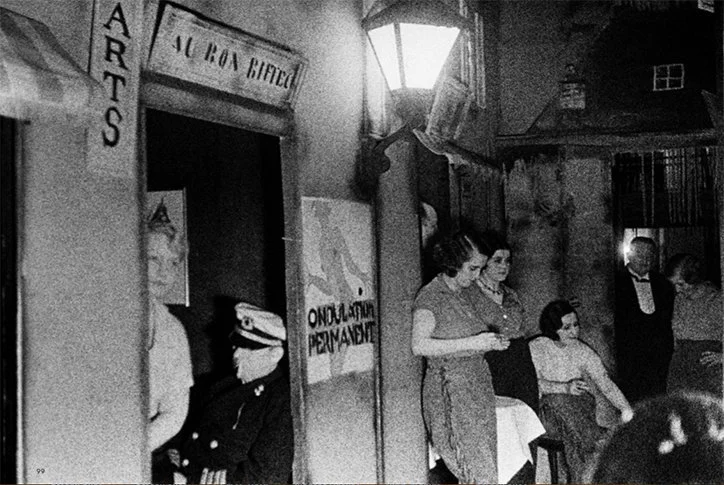
Lavinia’s cold when she wakes up. Head reeling like a German trade union dispute. And given the General German Trade-Union Federation, the German Trade-Union Federation and the Hirsch-Duncker Federation of German Labour Associations—those three mutually hostile Spitzenverbände—are about as friendly as a kick in the teeth, she must have the mother-of-all-headaches: which sounds like an opera. But she’s not singing this morning: not with that throat of hers. A bout of morning sickness pushes her over clutching her stomach. And when she observes the room the results are terrible. Dishes piled high, the acrid stench of rot and bioengineered hand towels, broken glass under the only window, and freezing air filling the putrid apartment—beyond which a dank alleyway echoes with prostitutes and urchins. Before she can wince at the brown stains on the mattress supporting her tired body the door bangs open. In walks a Marlene Dietrich rip-off complete with penciled eyebrows, a John-Waters-esque moustache, a top hat cocked at an angle. Must’ve been a decent wife-cum-agent before the Great War. Before the Weimar Republic. Before inflation and prostitution went hand in hand. “Decided to wake up, huh?”
“Where’s Foost?” Lavinia asks.
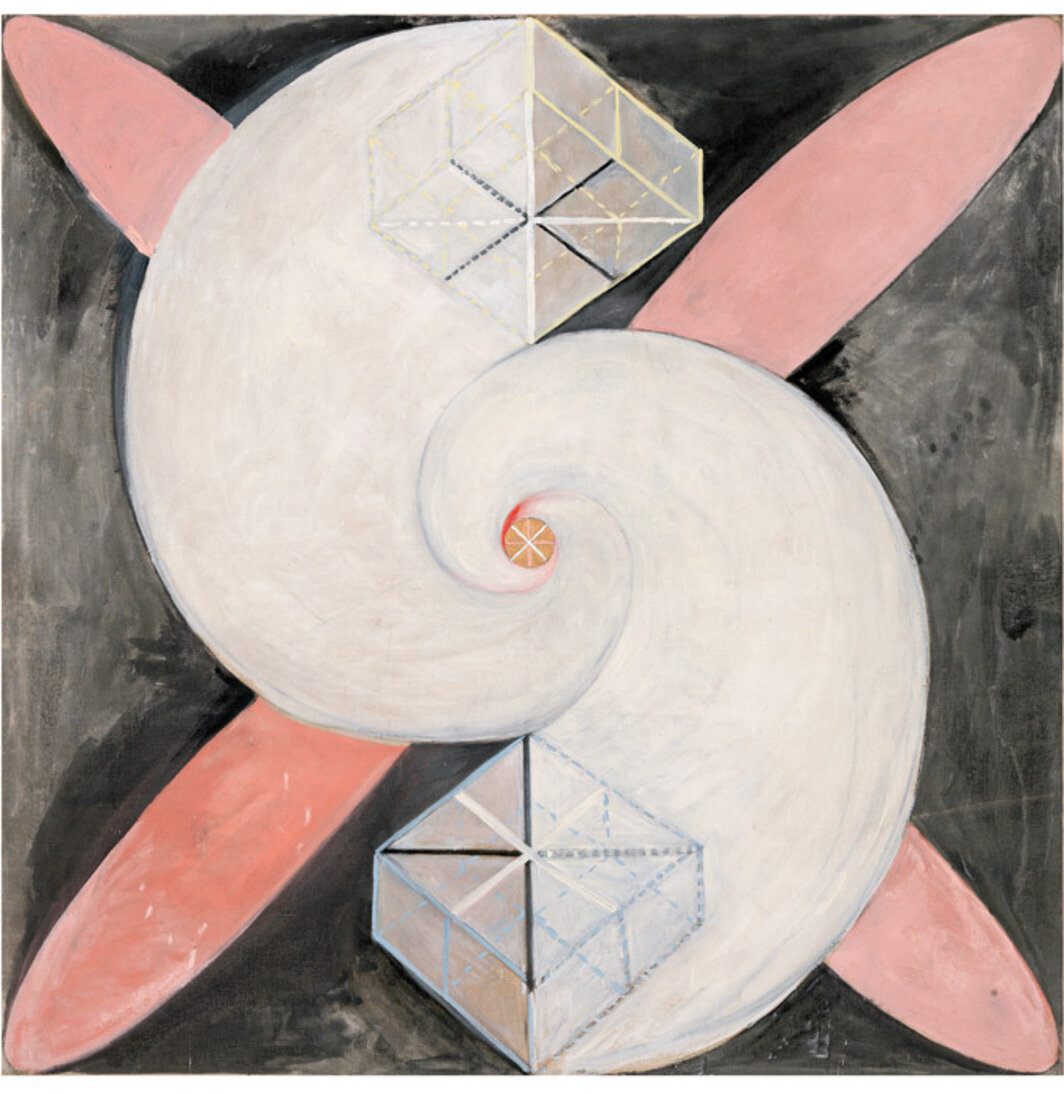
“Only God knows. But I’m Agnes. And this is my daughter Barbara.” Pointing to the corner: looking like a rejected set from the film The Cabinet of Doctor Caligari. Amongst an architectural zone where lines and shapes go nowhere and everywhere, a shivering girl’s sitting there with dyed ginger hair wearing a German alpine hat with frayed string and block stockings made traitorously by a Swiss cheese factory.
“Nice to…meet you,” Lavinia unable to offer anything but her profession, “I’m a singer.”
The top hat practically sliding onto the side of Agnes’s head, “You’re a singer, I’m a singer, Barbara can sing—blah, blah, blah. We can’t all be Brünnhilde,” smashing a plate on the filthy floorboards.
“Where—Where am I?” starting to breathe heavily. “I’m sorry you had to put me up—I, um-um, don’t know how I got here.”
“This is my home. Pfft,” snapping her fingers and watching Barbara make a pot of coffee, “some bureaucrats dropped you off. Suppose they thought it was the Foreign Office or something. If you saw what they did to Barbara you’d lose faith in these government departments. Ain’t that right Barbara? And close your legs when I’m talking, Barbara, business hours are over.”
“I don’t know,” Barbara says.
“You got that right. Pour that coffee slow. As for you Lady Foreigner,” passing a mug of coffee to the Quotidian, “your mouth smells like a rat’s anus. Take a drink before you start telling me your sob-story.”
Drinking the coffee. “I came with Foost. Everyone knows Foost. Have you seen him anywhere?”
“Worried about a baby? Doesn’t happen that quick.”
“No no. We were together for a long time. We were going to marry…I think…but he took me—he took me to the President’s house.”
“Merry Christmas: we’ve all been there Barbara.”
“I don’t know,” Barbara says.
“Word on the street’s that Foost left Berlin this morning. Not coming back anytime soon. Men like him never do: they think they have an advantage over women. Pfft. You know something Lavatory—or whatever your name is—when I saw Foost I knew what kind of man he was instantly. A total pooch.”
“Wait—you saw him.”
“Came with the bureaucrats. One heck of a shnozzer: a big Wagnerian nose. And he had these girly eyeballs,” downing her coffee as though it were schnapps distilled by Frederick the Great himself.
“That’s not Foost,” Lavinia says hopelessly.
“That’s not Foost, this ain’t Foost—blah, blah, blah.” Now she’s raising penciled eyebrows to the ugly dawn beyond the broken window. “Gonna be a long day girls. Gonna be a lot of hip surgeries today.” Starts philosophizing about hyperinflation.
Agnes and Barbara and the family were wealthy property developers before the Kaiser Reich increased the money supply whilst failing to cover its war expenditures through taxation. Reparations with the Versailles Treaty, the fiscal policies of 1919-1923 and the Ruhr Occupation led to Germany’s economic collapse. Savings were crushed, rents devalued, then two-hundred billion marks equaled one American cent.
“Puts a real pinch on your pennies. That’s when I stopped being a mother to Barbara,” pointy-pointy, “and started being her guardian. I’ll be your guardian too sweetheart. You’re a long way from home. An exotic girl like you can fetch a good price…”
“I can’t,” Lavinia pleads, “I’m gonna have a child.”
“Nobody’s perfect. Barbara’s been squirting them out for years. Look at her: in the peak of health.”
“I don’t know,” Barbara says.
Agnes deploying her coup-de-grâce: “Don’t want to get deported do you.” When Lavinia jumps up she’s grabbing her arms and barring her exit. “Don’t want to get deported to the wrong country either. Germans make mistakes too. Capitalism’s on the way out: traditional immigration too. Drinking champagne with Hindenburg and Foost one day: then you’re on a boat to Africa. It’d be a real shame.”
This Agnes here’s a proper blue bleeder sponge. Yank her out of her natural environment and she starts bleeding a blue liquid: selling the bodies of young women—for sex, for musical performances, collecting coins in the cold—so that she can try and reclaim the aristocratic crannies of her inner reefs. This top-hatted lothario’s happy to stay indoors counting the cash and spending it on absinthe and twee holiday cards with German folkloric characters to distract her from hyperinflation and her ugly soul. Especially when businessmen drag Barbara through the door complaining: “You can’t pawn this twerp on me—her face is hyperinflated: someone must have punched her this morning.” Or when politicians push the increasingly-pregnant Lavinia through the door moaning: “This negro is hyperinflated: look at her stomach. I can’t screw hyperinflated negros—and to think I sold my house for this.” Or when Agnes shoves a bashful accountant or three between her legs and they look up and say: “I don’t know Agnes: that looks hyperinflated to me. I’m no gynecologist, but I don’t think it’s supposed to look like that. You told me this would be a Kaiser Reich experience. But from where I’m pinned it’s got hyperinflation written all over it—in big Teutonic letters—and I’m very depressed…”
This whole time it’s like Lavinia’s singing in an opera about limestone-formation. Sediments eroded by the hydraulic action of Weimar Germany’s discontent. Rocky remains hurtling back and forth in waves generated by the deteriorating mental health of Agnes and the physical decrepitude of Barbara. The natural life-process of a German produces acid. The country’s digested by biochemical erosion. Ending with Franz von Papen persuading that old anchovy Hindenburg to appoint Hitler as Chancellor. But that frying pan of the future is miles off: frustrated still by the present sous-chef.
Now Autumn’s here. A veritable Pauli Wolfgang of a season. Full of exclusion-principle-shaped hedgerows, electron-buzzed leaves descending in frugal cascades and skeletal remains of trees so well-versed in Einstein’s relativity theory that death is simply accepted like late-running trains or bad cafés. Wolfgang’s inquiry into Bohr’s quantum theory looks just like the evening light on the River Spree—memories of Foost and Lavinia skidding around its frozen surface are so distant—and the oranges and auburns, the reds and quasi-greens, of all this good death not only endorses quantum physics but also the Wolfgang-scented clouds of stench rising from roads and municipalities covered in decaying leaves. “What a mess! What a mess!” echoes through the dank alleyway leading up to the broken window. It’s those loonies in No. 6 again: a veritable threesome of Pauli-Wolfgang-loquats if you ask me.
Look closer now. The lights are off and the stench of death if heavy. “What happened. Got tired of crossing your legs didn’t you,” picking up the newborn baby: half-surveying its sunset-clam of a body, “let’s have a look now—definitely a little girl.” Trying to pawn the child off on Barbara who isn’t moving. “All that shagging made you lazy Barbara. Take the baby. Take the damn thing Barbara. You stupid girl.” Unable to accept that Barbara has been dead—under a mountain of unwashed duvets—for a week now. Lavinia knows this: but giving birth in these conditions has left her exhausted. Blinking rapidly and passing out never to regain consciousness again. She needs an orange-backed squid to carry her back to Quotida: and those lighted vessels the squid enjoys floating around aren’t vessels but other souls: but there’s no squid coming to rescue to her. Her body’s in Berlin: and her soul? Who knows where that is.
The baby’s crying. But Agnes doesn’t notice because—looking through her broken window—a small army of green-uniformed Sicherheitpolizei are pushing kids, hookers and accountants out of their way.
“Get up,” kicking the dead Lavinia, “we’ve got visitors.”
They break the door down and grab the newborn from Agnes. Observing the dead mother—not to mention the dead body under the duvets: a dead common octopus blowing peacefully in the current.
Agnes cocking her top hat, “That child is mine.”
An officer stretches out his hand as if to say, “Don’t be ridiculous,” and tells the others to take Lavinia to the nearest hospital.
“Financial aid wouldn’t be out of the question,” Agnes says. But she’s cut off by Sicherheitpolizei who clap her in irons, drag her downstairs and toss her into a police van—and that—in the words of Karl Valentin—is how the Kraftfahrzeug-Haftpflichtversicherung goes. One of those witty German jokes about the impotence of common people—and the inescapable hubris of motor vehicle liability insurance.
Agnes was sentenced to five years in a women’s prison. When she re-entered Germany—now called the Third Reich—she got bored pretty quickly of the Leni Riefenstahl movies, the parades of the Hitler Youth and all the new rules saying she couldn’t dress like a man or fuck a handsome Jewish accountant. After she got arrested the second time she was sentenced to death. Her execution was overseen by Erwin Rommel’s less talented brother, Unwin Rommel, who instead of saying, “Fire,” played with some rabbits. Not that German firing squads need encouragement: and Agnes subsequently fell down with a fist-sized hole in her chest as children on the next street over sang a rendition of that Brahams ditty “Wiegenlied.”
A tall lugubrious man smoking in the orphanage office. Staring through a lady-high window at babies. Casually scrutinizing secretaries, nurses, independently sourced pediatricians scuttling around like ants. The man’s a Knight of the Order of Shliebelkermächt—don’t make a note of this: he’ll just remind you—and when it comes to his cinema of public morals, children sit in the front row chewing on sweet licorice. He’s a good—if somewhat aristocratically stiff—man. “I’m a Knight of the Order of Shliebelkermächt.” Case-and-point.
Now the door’s opening permitting a tight-suited man to interrupt the Knight’s perambulating daydreams of lemon-scented morality. “Good morning Herr von Shliebelkermächt.” What a mouthful.
“The operation was a success,” the lugubrious knight answers, “well done inspector.”
Nodding smugly, “Thank you sir,” lighting a ridiculous pipe, “but none of this would’ve been possible without your charity. You don’t fancy a puff on my Lindauerli pipe by any chance do you?”
“Me? A Knight of the Order of Shliebelkermächt? Smoking that Swiss garbage?”
“I only ask cuz it’s nice pipe sir—and a lovely rough shag—and the morning was a success—”
“Let us assume the position.”
“What.”
“The position we’re going to take on that child,” pointing through the window at the mixed-race newborn opening-and-closing-its-mouth like those blue parrotfishes she can only see in another life…
“Very good sir,” the inspector puffing on his pipe. But sort of hiding it all the same. “Tricky matter.”
Meanwhile Herr von S. strikes up a ludicrous Biedermeier pipe whose bowl is an excellent likeness of Frederick the Great. “So the mother of this—what was it, Quotidian?—child has passed away then.”
“Loss of blood sir. It’s not surprising given the neglect she’d endured.”
“Anyone…” puffing liberally on Frederick’s head, “…going to claim this child?”
“The child’s racial makeup will raise a few eyebrows. Either that or she’s Mexican.”
Cue those perambulating daydreams of lemon-scented morality. “I found myself at the Berlin State Opera the other night watching a pitiful performance of Beethoven’s Fidelio. And the Mexicans in the front rows—whether homegrown Mexicans or otherwise—raised their eyebrows at the poor quality too. In fact we all together raised our eyebrows. The audience became a dense bush of erect disappointment. But the core feeling, inspector, was one of concern. And concern is always crucial when raising a child.”
“Interesting logic.”
“Infallible inspector.”
“Very well,” the inspector standing at attention, “I shall rally a team of men to assess these discerning Mexicans and their knowledge of German opera. Then we shall assess their suitability to adopt this—”
But Frederick the Great is being waved around the policeman’s face. “Nonsense inspector,” the lugubrious knight assures him, “I will adopt the child. I’ve had every intention of adopting the child.”
The Swiss pipe practically falling out of his mouth, “Is that wise?”
“My father was a Knight of the Order of Shliebelkermächt,” the lecture oft-quoted by Herr von S. appears now: about the twisting of fate buckling the trousers of justice, “the same for his father—and his father before him.”
The inspector counting his fingers, “Okay so that makes—”
“We fought wars inspector. We saved lives. We murdered Catholics.” Sympathetic nodding. I won’t forget my heritage inspector. Because when the twisting of fate buckles the trousers of justice—and we remember that the sausage is the only thing with two ends—we go back to Goethe’s wisdom and remember that knowing is not enough—we must apply. And that willing is not enough—we must do.”
Inspector Really-Good-Listener just went to see Murnau’s Faust and what a hoot that was. That Swede playing the title role instead of a decent German actor. And that fairy, Murnau, skipping off to America. And that great German, Goethe, is skipping around the inspector’s cultural hive brain: and what a jackass Goethe was: what a social-climbing, humourless, big-headed Biedermeier-pipe-of-an-asswipe-bonehead. “But that Herr von S.,” thinking now, “he’s right on the money—and man-o-man I got out of that one.” Cuz adopting a child’s not really on the inspector’s mind. He just bought Han Luther’s comic novel about a sexy Reichsbank President becoming the German ambassador to Washington. So doing anything helpful—like raising someone else’s child—is just out of the question for this upstanding civil servant.
The child of Lavinia and Foost is taken to the Shliebelkermächt Estate. The Princedom of Shliebelkermächt’s been a beacon of beautiful gardens, tasteful décor and beer for hundreds of years—even if it’s just an “estate” these days. The centuries-old family spends their time building opera houses and schools and funding singing competitions and academic music programs. The estate itself is comprised of four-hundred acres of what German Christians—increasingly averse to democracies—call prime real estate. And this prime real estate’s a frequent target for satirists like Erich Weinert who—after ripping apart the Republic’s unfinished revolutions, starvation, rampant inflation and incomplete counterrevolutions—enjoys writing disrespectful songs about Herr von Shliebelkermächt’s estate. Herr von S. doesn’t talk about Comrade Weinert in public. But privately he’s puffing on the Biedermeier pipe in his study—some time after dinner thinking when he-and-the-Missus-last-did-the-nasty—drawing scrupulous illustrations of Weinert with big silly hands and comically big shoes making a fool of himself in a Communist alehouse—even though the philosophical kernel of beer is that in order for people to be drunk other people must be sober—and tapping his Mickey-Mouse feet to the following insulting ditty:
That wily Shliebelkermächt
Wouldn’t pass with the German Wermacht
Cuz a silly wee Erich Weinert
Ought to stay with his books in the dirt!
It’s a pleasant position with no intuition,
Of an Herr von S. child decision,
When we mention his son we all like to cough—
Cuz the boy’s in Klinikum am Weissenhof!
So much for the estate—Weinert’s gone straight for the jugular: the invisible-and-probably-crazy son. Herr von S. wincing at these private nuggets entering the public digestive system. The hand of his wife—the inimitable Clara—gripping his shoulder and squeezing him back into that lemon-scented morality. And together they remember the night their son—Johann Sebastian—was busted out of the funny farm.
“We did the right thing,” Herr von S. observing Clara’s knuckles, “stealing him from those silly men in their white coats.”
“Yes dear,” recalling their debates about whether locking up their son had been the right thing. And even longer debates about whether they should steal him back: and the fallout from such an operation. But they decided they’d made a mistake—Johann should be crazy with his family: not with strangers.
“Only the finest Germans will agree to this,” Herr von S. said.
“And only the finest shall be recruited,” Clara agreed.
The two men spearheading the heist were Walter von Keudell and Hermann Graf Keyserling. Walter was a devout nationalist and Protestant—in that order—who ate iron shavings in his breakfast granola. Meanwhile Hermann was a conservative elitist and philosopher born in Estonia who’d escaped the Russian Revolution and set up shop in Germany where he read Houston Stewart Chamberlain’s polemics over agrarian lunches of frog-spawn and emphasized “becoming-a-German” over “being-a-German”. Ideal men to kidnap a mental patient. After sending homing pigeons to the Evangelical Sisterhood of Mary in Darmstadt, they also acquired ten Lutheran nuns who’d serve as foot soldiers in their enterprise. It was Sister Ignatia who suggested that—on the night in question—everyone should dress up like Goethe: with cerulean-blue coats, neckerchiefs, and receding hairlines bordered by brutish hair.
“The Goethe costumes were a wonderful addition,” Clara remembers.
“Twenty Goethes appearing on the horizon would strike fear into any German,” squeezing her hand, “and you in your Dracula-wagon: whipping the mules and striking fear into the doctors and nurses.”
“Sister Ignatia planted the dynamite.”
“She certainly did. I was suddenly transported back to the Battle of Leuthen.”
“There was that wonderful moment,” Clara chuckles, “when Johann ran back to fetch his wig. And he was determined—”
“Like any Shliebelkermächt—”
“He was determined to have his powdered wig,” filled with pride now, “and you in your scuba suit.”
“What German—employed by clinic or not—would expect a diver to appear in the countryside? Walter von Keudell hatched the idea during breakfast. He said to me: ‘Rudolf—wear a damn scuba suit.’” He and his wife grinning like a pair of common sage bushes on the Quotidian coast. Their oval-shaped leaves flapping across one another: scalloped edges equipped in their search for similarities, and the reddish-purple flowers keen to please, and the oceanic turbulence a mere distraction in the background. The Herr and his wife are always annoyed when people ask what aristocrats have to worry about. They are faced with deaths in the family, children in mental asylums—now the pressure of raising an orphan.
“What should we call our little girl?” Clara asks.
“Germania.”
Politely refusing to call her daughter Germania. Patting the lugubrious knight on his shoulders. “What about Lyssa.”
“Oh that’s a lovely name. Much better than Germania.”
Kissing the greying hair, “My feelings exactly,” and pulling him towards the bedroom…
Lyssa’s a proper little girl now. Well-accustomed to Berliner field trips to operas by Weber, Wagner, Schumann, Handel, Lindpainter. Enjoying the private cinema built by Herr von S. in the old nursery: bouncing on the knight’s knee watching Eyes Open, Harry! and The Captain from Köpenick and The Copper. Then sitting through private lessons with Clara: perusing hardback editions of The Sorrows of Young Werther and Hyperion and Effi Briest and Buddenbrooks and Debt and Credit as they eat a selection of cakes. But Lyssa’s longing for something different to this German landscape. Feeling like a mourning dove searching for its partner. Pining for the hard wood of mahoganies, the catkin-like flowers of mulberries, the edible fruit from papayas, the prop roots of red mangroves, the red flowers of royal poincianas. But these names are anonymous in Lyssa’s brain-vocabulary. Pictures without the little brass nameplates. Sheets of operatic composition lacking the calligraphic motifs that make musicologists say things like, “Beethoven probably composed this late at night,” or, “Schumann must’ve caught the clap that day…”
Now she’s imagining green chimney sponges—that Foostian invertebrate—staring into the courtyard through a grand bay window. But her spongey peregrinations are put-to-bed by a strange man skipping through the courtyard wearing a Mozartian wig and pink suspenders: frolicking over the damp pebbles like the Foreign Minister, Julius Curtius, when he spoke to Austria about forming a customs union.
“Who’s that guy?” Lyssa asks.
Herr von S. relaxes his teeth on his outrageous Biedermeier pipe to the extent that Frederick the Great’s head falls onto the Persian carpet and starts a small fire. The aristocrat’s stamping the floor with all his might. Cursing between breaths and looking at his wife as if to say, “Go on woman—explain everything to our daughter,” and composing himself: “Uh-uh, things to write in the fourth study on the third floor—terrible debts, no-no, we’re fine for money. But we have charities to run Lyssa. For goodness sake, money doesn’t go on trees. Neither does paper—no-no-no—of course it does,” collecting his pipe and waving goodbye to his wife, stepping out of the big room so that he can slam the door behind him.
Clara’s most unimpressed.
Turning to Lyssa, “That’s your brother sweetie.”
“I have a brother,” blinking in disbelief, “why didn’t you say?”
“Because we thought,” lifting the immensity of their mistake, “it wouldn’t do you any good. If you met him before you were old enough.”
“Am I old enough now?”
“Yes.”
“Is that why he’s in the courtyard? Running around? Because you wanted to show me?”
“Oh absolutely. Absolutely yes.” More likely a butler called Hans forgot the lock the door.
“Why’s he running around?”
Trying to be honest now, “I don’t know sweetie. We’ve asked lots of people the same question,” clearing her throat, “the point is: your brother Johann won’t ever be able to live in the real world.”
“This isn’t the real world?”
The motherly sigh, “Lyssa—the real world is Berlin. And Trebbin and Beelitz. And all those places we’ve been to see the opera.”
“So the opera’s the real—”
“No no—the estate where we all live. That’s not the real world. Everywhere else is the real world. But the estate isn’t the real world. Oh goodness—it’s all terribly confusing isn’t it. But—But if you’re confused, you can imagine how confused your brother is. Except he has confusion-of-a-higher-order. Confusion-about-confusion,” struggling to make all this worthwhile, “I’m sure you understand.”
Lyssa nods like a juniper aphid uncomprehending a brief account of J. Robert Oppenheimer’s assignment to separate fissionable uranium 235 from natural uranium in order to create an atomic bomb.
“So you see: Johann has to live here forever,” Clara says.
“And ever?”
“And ever.”
“And ever and ever?”
“Uh,” checking her pocket watch, “yea.”
“Can I see my brother? Can I show him my room?” jumping up and down excitedly.
“I don’t see why not sweetie.” Clearing her throat. “I’ll go and—tell your father.”
Watch Lyssa bolting out of the room down the high-ceilinged corridors, skipping down the marble staircase into the vast lobby, vaulting over the pebbly garden path to find her brother.
“Excuse me,” she’s looking up at him, “I’m your sister.”
The bewigged man puts and end to his frolicking—looking the girl up and down—and kneels on the pebbles plucking his pink suspenders. “Tell you what pilgrim: did you ever meet that Can-of-Soup?”
“What.”
“That Can-of-Soup born near Portsmouth. Felt like a foreigner in England after studying in Germany. And this Can-of-Soup—now a wily paranoid Can-of-Soup—comes up with the idea of Soup Supremacy. Starts telling people that soups—the bigger the tin, the better—are superior to everything on this Earth. Starts telling people the Great War’s a crime against soup. Now that’s partly because the soup in the trenches was so appalling. But the Versailles Treaty and the reparations are totally anti-soup: that’s what Can-of-Soup would say. He wrote a book too: Foundations of German Soup. A real corker,” cupping his ear and plucking a pink suspender, “best to enjoy that book with a cup of soup and some crackers. MEEP.”
“That sounds tasty.”
Johann’s staring around sampling the under-whistle of the surrounding acreage and the distant rumbling of natural processes: falling leaves, deer scrambling, squirrels rustling in the overgrowth. The girl’s in front of him: she’s not afraid of him like the others. He can say what he really thinks: “You know I used to live in a castle. I lived there for several months. Can-of-Soup put me there you see. Because he didn’t like me eating all that tinned bullshit. But then,” hands on his sister’s shoulders, “everything changed when Goethe showed up. All twenty of him. Performing all manner of Kung Fu and Ju-Jitsu. They busted me out of that dreadful castle and brought me home.” Before Lyssa can tell him what she thinks of The Sorrows of Young Werther, “When not one; not two; but twenty Goethes rescue you from certain life—you know Germany loves you. Germany shall overcome Cup-of-Soup and all his machinations. Wants to put Germans in castles and throw away the key. He’ll be coming for you next.”
“I’ll fight him off.”
“Who are you again,” Johann asks.
“I’m your sister.”
“Can-of-Soup didn’t tell me that. But that’s exactly what Can-of-Soup would do,” blinking rapidly, “you know the castle was staffed entirely by frogs.”
“Really?”
“They made fun of me. The amphibian bastards. If you go up to one of those webbed fellows what can you expect them to say except: ‘You’re a bloody idiot,’ and ‘You can’t do anything right you dolt.’”
“But frogs like flies. Didn’t they talk about that?”
“I’d rather a fly any day to a moth. Moths are the most boring conversationalists. PFFT PFFT PFFT. That’s what the moths are saying. All Financial Times, Foreign Affairs and National Review.” Remembering where he is: a courtyard free from neoliberal magazines. “You’re my sister. So you must have a name.”
“My name’s Lyssa.”
“That’s a strange name for a Moon Chicken.”
“I’m not a Moon Chicken,” stamping her foot, “I’m a girl.”
“PFFT PFFT PFFT—be quiet you tempters of the air. You muddled moths. PFFT PFFT PFFT,” fighting invisible moths attacking his newfound sister, “So you’re a human child called Lyssa. Great to meet you. I’m the Fourth Pope of the Feng-Shu Dynasty. But you can call me Johann. Or just Larry on Sundays.”
“Well,” confused by all this confusion, “do you want to play?”
“I performed King Lear with Gösta Ekman. The man was a turd but he cooked the best omelets. I’ll put this girl on my head,” heaving Lyssa onto his shoulders, “and we’ll defeat the Swedish Theatre.” Wearing Lyssa like a crown he’s crunching up and down the pebbly paths. Chasing outlines chalked by Karl Barth and his Protestant resistance against Nazification. Chasing outlines chalked by Walter Benjamin with his monuments to barbarism and civility. The almost-truth of Johann is decades ahead: the madman-approach-to-international-relations pioneered by Richard Nixon, for example, where you project an irrationality that frightens your opponents: foreign governments, members of parliament, congressmen, lunch-ladies. But if Johann’s being irrational-with-intent—who’s the intended victim? His family? German society? The wider Western Tradition and its permutations across the world? Maybe there’s nothing to this. Maybe Johann’s just nuttier than a cashew curry. But Lyssa—in that child-like state unsullied by utility bills and hopelessly open to investigation—can’t help but think these things…
Cue the remilitarization of the Rhineland in 1936. Watch the Oompa Bands wearing stahlhelms and speakers blasting the baritone voice of Hans Hotter who—though he isn’t a Nazi member and frequently makes fun of Hitler during parties with his infamous black-square-of-paper routine that makes the noted conductor Herbert von Karajan puke up on one occasion—is given key positions within the Reich. And the Rhineland—rich in natural resources—turns German resentments into musical notes and soon we’re hearing that musicians who happen to be loyal Nazis are guaranteed jobs; that crap musicians who happen to be Nazis are not guaranteed jobs—giving hope to those in Czechoslovakia—and that any musical genius who happens to be non-Jewish with a Reichsmusikammer membership—like good old Richard Strauss—can work a bit and pay the bills. Dance of the Seven Veils paints him as an out-and-out Nazi but that—in the words of Karl Valentin—is how the Kraftfahrzeug-Haftpflichtversicherung goes. One of those witty German jokes about the impotence of filmmakers—or was it actually car insurance? And all this for some Beethoven resurgence: the Fidelio-enthusiast Herr von S. is very pleased about this. Sitting on the Shliebelkermächt Estate and joining the Nazi Party and penning a new melody for Hans Hotter: the first great task given to Herr von S. by Adolf Hitler and his band of mentally unstable bullies.
Germans aren’t impartial to a bit of smoke,
When they do the hokey-pokey and they puff the toke!
THE JEWISH RACE WILL HAVE TO ADAPT ITSELF
TO SOUND CONSTRUCTIVE ACTIVITY
AS OTHER NATIONS DO.
Give your auntie and your uncle some German ammunition,
So when we roll through your town we don’t need intuition!
IN THE COURSE OF MY LIFE
I HAVE VERY OFTEN BEEN A PROPHET
AND HAVE USUALLY BEEN RIDICULED FOR IT.
Give your Deutsche nephew some chewing tobacco,
Cuz in the Rhineland—in your time, man—we’ll be greasing elbows!
Christmas on the Shliebelkermächt Estate. Dark forests creaking with snowfall, pastures packed with snow made blue by the moonlight, elephantine ponds studded with icicles instead of pond-flora: and the warm windows of the Shliebelkermächt mansion murmur security amidst Germany’s changing tides. We’re inside now: servants and staff and the resident family scuttle in yuletide circuits ingesting mulled wine, pan-steamed yeast dumplings, roasted chestnuts, potato pancakes smothered in applesauce, mushroom skillets served in bread bowls, cheese fondue, deep-fried Hungarian flatbreads. And Herr von S. musing over a plume of smoke from Frederick the Great’s head, “These things will be free when we start running Hungary,” turning and stroking Lyssa’s hair like the loving patriarch he always was.
Lyssa’s struggling with her filet of carp. She prefers the cheese fondue and the pan-steamed yeast dumplings: Quotidian at heart and always chasing memories of a half-foreign place she doesn’t possess.
Johann’s stopped muttering about those damn frogs—little green icicles now—and keeps writing “Goethe” in his sauerkraut.
Lyssa whispers something at Johann across the table. And the two giggle privately.
The matriarch Clara pulling her fork through uncooperative red cabbage. Furious and disturbed. Cuz her husband’s wearing a Nazi uniform at dinner. That balloon-actor Emil Jannings—the chubby Mephistopheles in Murnau’s Faust—may have been modest enough to simply wear a swastika pin. But Herr von S. looks like a seaweed beetle with the baggy trousers, the high-waisted belt, the red armband, the swastika badge, the Cross-of-Iron, the black tie, the eagle-cum-human-skull cap with silver brocades. Who’s he going to attack with his clubbed antennae when he finishes his carp and starts marching about?
Clara remembering her husband’s high school photo. The little quote underneath: “Most likely to join a club for dorks.”
And she’s looking at her children: fearing what Herr von S. might do with real power. “Darling,” admiring her toneless polity, “my darling,” finally taking him away from his carp and red cabbage.
“Yes darling.”
“Do you have to wear that at the table.”
The knife and fork are quickly traded for that lemon-scented morality: a little Nazi air-freshener dangling in the patriarch’s Mercedes-Benz as he drives down the autobahn of demented logic. “Darling,” banging the pipe against the table, “My father was a Knight of the Order of Shliebelkermächt. The same for his father—and his father before him.”
Smacking her lips, “I never knew that,” rolling her eyes afterwards.
“Let me finish darling. We fought wars darling. We saved lives. We murdered Catholics.”
Sympathetic nodding.
“I won’t forget my heritage darling. Cuz when the twisting of fate buckles the trousers of justice—and we remember that the sausage is the only thing with two ends—we go back to Goethe’s wisdom and remember that knowing is not enough—we must apply. And that willing is not enough—we must do.”
Delicately lifting carp to her mouth. “Goethe was a social climber.”
And Herr von S. wants to be neutral like Yugoslavia. Except the Nazi uniform—buttoned and belted from asshole to beak—sort of fucks up the neutrality. “Don’t talk with your mouth full,” he says.
“You’re smoking your pipe,” she retorts.
“I suppose he was a social climber,” he agrees, “but you need that to work for government.”
“But you have a choice darling,” staring at her husband, “you don’t have to be like Goethe. Let me tell you the problem with that uniform. You’ve got four pots of stew—but you only have three lids. All those new Nazi friends you have: you don’t have anything in common with them. They’re low Rudi. And you know they’re low. You’re being insincere with them when you drink beer and devour pretzels. They don’t have the right heritage you need to be a good German. Whether you’re a peasant or a knight. A Knight of the Order of Shliebelkermächt shouldn’t take orders from a failed chicken farmer.” Referring to Heinrich Himmler who sold fertilizer and farmed chickens whilst he joined far-right organizations. Always a dangerous combination. “Your father wouldn’t have done this in the nineteenth century. And there’s no reason why you should do it in the twentieth. I think your ancestors would’ve been appalled.”
Herr von S. sighs. “I know what this is about. You don’t like the skull on my hat.”
“It’s a bit of a deal-breaker. Yes.”
“Darling—”
“I don’t like what the uniform stands for. And yes: the Great War was a moral crime against Germany. But if we need Englishmen to tell us that—with a bunch of racial ideas straight out of science fiction—then we don’t deserve to be German. And what do you think your friends will say about our children? Is there a place for Lyssa? Is there a place for Johann? How long do think they’ll put up with our daughter’s beautiful skin? Or Johann talking to Goethe when the turkey’s been dead for decades. Maybe they won’t just shove him back in Klinikum am Weissenhof? Maybe they’re cooking up things you can’t begin to comprehend. Because you’re too busy shining your swastikas and your boots. You have the ignorance to wear that clown suit in front of our children. Where’s your brain Rudi? What happened?”
“Germany is weak. We can make it strong again.”
“Why can’t you be strong Rudi.” Now the meal has stopped entirely. The manifold-Hans dotted around the dining room telepathically place bets on who will start throwing bits of carp. “You were strong when we found out about Johann. You were strong when we busted him out of the asylum. You were strong when we brought Lyssa into our lives,” taking the hands of Lyssa and Johann into her own, “you were strong darling. But now—you think polishing your boots will save the nation. But it won’t.”
Herr von S. descends his cutlery. Acknowledging the butlers who return horrified glances. Standing up—admiring his son writing “Goethe” in his sauerkraut—and staring at Lyssa mouthing, “…Papa…” Scanning the room for security and finding none: Herr von S. rests his cutlery and napkin on the table. “Lyssa—sweetie—I’m going to the cinema. You like the pictures with horses and carriages don’t you? We can watch The Old and the Young King—that’s right up our street, isn’t it? Emil Jannings is wonderful. Then,” realizing he’s not getting permission from Clara’s eyes, “we can watch whatever you want Lyssa.”
“Lyssa and Johann,” Clara intervening, “will stay and finish their meal. That’s what a German would do.”
Herr von S. curls like a roly-poly—those isopod crustaceans roaming Quotida’s leaf-litter like miniature armadillos—and shuffles out of the dining room. Looking for tender roots to nibble on: those articles on Richard Wagner, for example, penned by Houston Stewart Chamberlain who out-loonys Johann Sebastian by several magnitudes—and here’s Herr von S. shaking his head: accepting the words are blisteringly wrong but knowing that if he repeats the right ceremonies—like an ancient Roman—the gods will protect him and his family. And the gods will protect Hitler and Himmler and other oddities.
Now the typically-mixed Christmas celebrations are over. Lyssa and Johann are tucked into bed by their mother, and the children slip into sleep. And Lyssa’s dreaming about an island she doesn’t know. Questions impregnate the odd images: Will she end up like Werther? Will she grow into a Valkyrie? Will she outshine Wotan—assuming Herr von S. is Wotan: oh-boy-oh-boy—and his inescapable flaws? But it’s all too much for a little girl. She wakes up crying because her parents are unhappy: is it her fault?
Here’s Johann leaping to the rescue like one of his froggy enemies. Snuggling down with Lyssa: explaining that if they shut their eyes and make a sincere Germanic wish…Goethe will come. All twenty of him. And the Goethes will kiss them better. Making the tears stop and the moon brighten.
Good night, fair sister
Thrice good night to thee
I hope before tomorrow
Your bright face to see.
Good night, brave sister
Twice good night to thee
I hope before tomorrow
Your good soul to see.
Good night, strong sister
Once good night to thee
I hope before tomorrow
Your good health to see.
Good night, fair sister
The dark is so safe
But the sun’s almost dawning
On your hopeful face.