
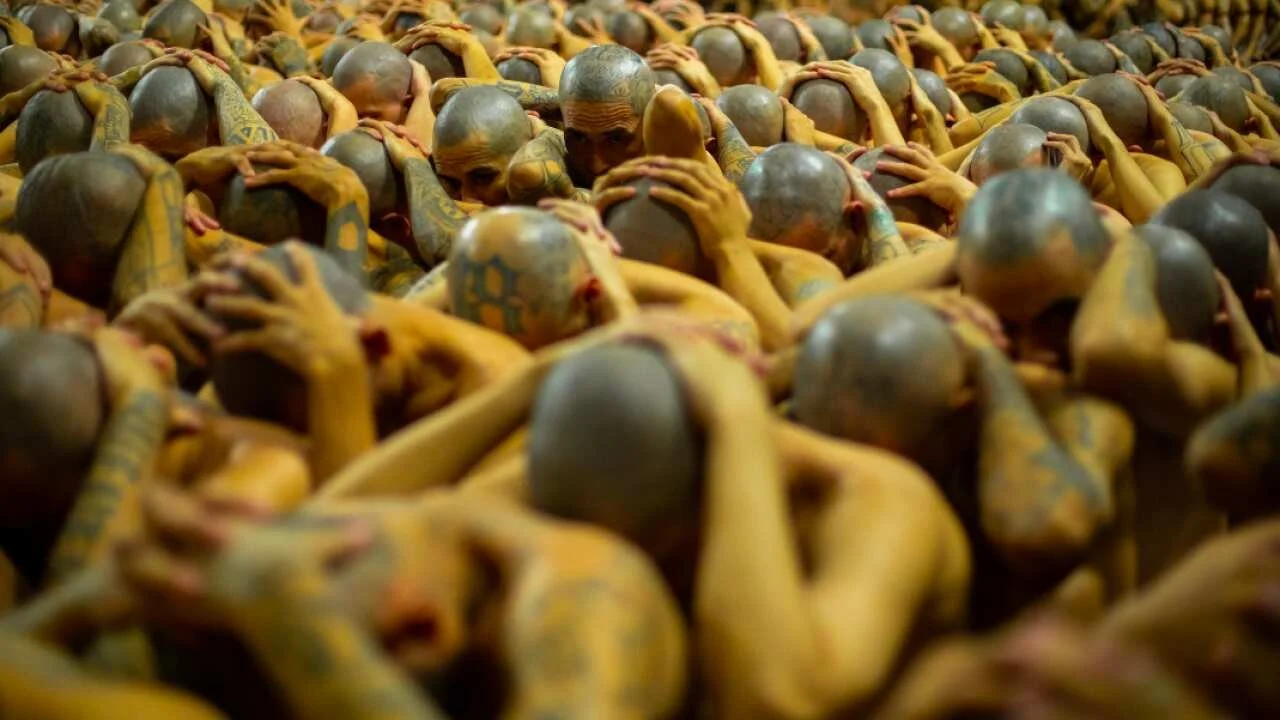
It’s the Apocalypse, Stupid
[Below is the first in a series of articles exploring the space where climate crisis, apocalyptic thinking, and politics intersect. A disclaimer: the below article primarily explores racial prejudice. Later articles will continue to extrapolate upon the uses of prejudice in other contexts but due to spatial constraints, this article had to limit its scope.]
*
The opening track on Prince Paul’s 1997 hip hop masterpiece, Psychoanalysis: What Is It, repeats this refrain: “As long as I can remember / people have hated me,” and it’s this line which I am thinking of now. Perhaps because the history of prejudice winds so far into the distant recesses of civilization, with some truly astonishing actors conveying some jawdroppingly embarrassing misconceptions—and it’s through the lens of this hatred that the current potential ending of the American experiment is best understood.
Aristotle described certain persons as “slaves by nature” and the Spanish Inquisition codified limpieza de sangre or “purity of blood” statutes, marking one of the earliest bureaucratic racial ideologies, although India’s caste system is perhaps the most ancient. What makes and has always made American racism so striking is it so flagrantly contradicts its own mythology—because the uses of prejudice will always trump the illogic of it. At the time of America’s founding it was deemed a necessary evil by the North (or so the rationale goes) to keep the South on side, and in the South, it was deemed a necessary evil (or inherent good depending on who you talked to) necessary to uphold their agrarian economy and it has continued to serve its uses—in service of Nathan Bedford Forrest and his Ku Klux Klan and—in a different form and directed at a different people—in Hitler’s Germany—or apartheid South Africa—or the Belgian colonial policy that led to hardening the Hutu and Tutsi social categories, a policy that ultimately led to the Rwandan genocide. Prejudice has always been a tool and although its specific purpose may vary, it has a small set of very consistent methodologies, functions, and goals. How is it being used today?
A Passage to India is a remarkable document of a late stage colonial India and the mindset of its British ruling class. One of the book’s key villains is Ronny, a British functionary with a blatant and unconcealed distaste for his Indian subordinates, petitioners, and acquaintances, his tone reminded me very much of the constant indignation on display in people like Stephen Miller and others in high level positions in the current administration, but the space those voices occupy is very different. Ronny is an example of a low level bureaucrat in a colonial power at the tail end of its power—he exists in a world functioning within the paradigm of progress and we are meant to read him as one small villain in a world that increasingly knows better. Stephen Miller on the other hand is consciously working to reinvent that same colonial atmosphere both at home and abroad in a world where the narrative of progress has been replaced by doom scrolling and ideologies of fear, and for good reason. The weather alone is enough to give you nightmares, not to mention AI and the very real possibility of WWIII. The mindset of the colonialist is returning because the world has gone zipping off the cliff and everybody’s at a loss about what to do, so they revert to the most ancient ideology there is—the ideology of the blood, of the tribe.
“Ronny was tempted to retort; he knew the type; he knew all the types, and this was the spoilt westernized … Aziz was provocative. Everything he said had an impertinent flavour or jarred. His wings were failing, but he refused to fall without a struggle,” [1]. I read this and I envision Pete Hegseth railing against the media’s unfair coverage of the Iran War. To Mr. Hegseth, the room was full of such impertinent “types.”
But this is happening in a world that elected Barack Obama, a world that seemed almost to assume that with the collapse of the Soviet Union, decency, equality, and democracy were inevitable, which has Hillary Clinton saying of China in relation to the Arab Spring and its pro-democracy uprisings, “They’re [China] worried, and they are trying to stop history, which is a fool’s errand. They cannot do it, but they’re going to hold it off as long as possible,” [2]. The feeling that democracy was the logical outcome of history, that we were living at the “end of history” as Francis Fukuyama famously claimed, and a kind of static global peace would now be increasingly the norm, all of it tied into a similar sentiment that prejudice would increasingly be a thing of the past, and already very much was in the most advanced nations on the planet.
In 2007, Chief Justice Roberts had stated in an opinion, “The way to stop discrimination on the basis of race is to stop discriminating on the basis of race,” i.e. the only way to stop racism is to stop legislating about race. This mindset was very much behind the 2013 Shelby County v. Holder decision, in which Chief Justice John Roberts argued that the so-called preclearance provisions—requiring certain states with histories of voter suppression to get federal approval before changing voting laws—were no longer necessary because conditions had “changed dramatically.”
This could be considered a watershed moment. In the wake of this decision—in some cases literally hours after the decision was passed—laws were put on the books in places like North Carolina, Texas, and Georgia to name a few. This could be argued that “post-racial” America reawakened as racist America. And with Louisiana v. Callais states—Alabama, Louisiana, and Tennessee so far—are rushing into legislative special sessions to eliminate majority-Black districts that had been protected under Section 2 of the Voting Rights Act.
In her opinion, Supreme Court Justice Elena Kagan wrote, “The Voting Rights Act ushered in awe-inspiring change, bringing this Nation closer to fulfilling the ideals of democracy and racial equality. And it has been repeatedly, and overwhelmingly, reauthorized by the people's representatives in Congress. Only they have the right to say it is no longer needed—not the Members of this Court. I dissent, then, from this latest chapter in the majority's now-completed demolition of the Voting Rights Act.”
William Rehnquist, the chief justice Roberts clerked for in the early 1980s said of the Voting Rights Act. “The enforcement provisions of the Civil War Amendments were not premised on the notion that Congress could empower a later generation of blacks to ‘get even’ for wrongs inflicted on their forebears.” This is the end of a 40-year project based on a view of the Voting Rights Act as “getting even” rather than basic racial equality, [3].
In comparison to this specific and focused attack, the prejudice of Trump is all-encompassing. You could argue it is indeed color blind because it contains us all. It is saying to us, Your protections are gone. Your government is not yours, it’s mine. Your country is a house for the rich and you’re just squatters here. Of course, Trump is also racist in the traditional sense, as in, he has throughout said and done things that show contempt, disgust, stereotyping and discrimination of black and brown peoples, but this is only part of a larger more all-encompassing prejudice of the narcissist—the simple thought that anything that is not Trump is bad and anything connected to Trump is good. This goes for his set in general, who have adopted his ontology, not as something accidental but as an intentional choice, an ontology that encompasses anyone who is a ‘them’ and the ‘them’ can truly be anybody, including former insiders. The lazy prejudice of our forefathers has evolved into a kind of universal prejudice big enough to swallow the world.
*
What happened to our dream of progress? As in, that quote—originating with abolitionist Theodore Parker—but more famously made by Dr. Martin Luther King Jr: “The arc of the moral universe is long, but it bends towards justice.” Perhaps it’s overarching trajectory is still intact but the general consensus is that these days—regardless of any general tendencies of the moral universe—at the moment it’s trending downwards. Why?
As I’ve said elsewhere, the 21st century can best be understood as the ‘Apocalyptic Age,’ as in the moment when it all comes crashing down. How far down has yet to be seen but we are already partially along a general apocalyptic timeline, which perhaps began in the 80s with the rise of Reagan and Thatcher and the official acknowledgment of climate change, or ‘global warming’ as it was called then. Reading Dr. James E Hansen’s statement from June 23rd, 1988, that, “It is time to stop waffling so much and say that the evidence is pretty strong that the greenhouse effect is here,” [4] the feeling of living in a hijacked timeline is almost overpowering. If the world had heeded his warning and begun to transition away from fossil fuels radically and immediately perhaps we would still be talking about the end of history and writing op-eds about “post-racial” America, but we know how this goes.
One of the fallacies of the climate crisis is that the payment will come due at some future moment when Earth suddenly becomes uninhabitable or weather becomes too extreme to function. This way of thinking does not take into account people, who can see this future and seeing this future affects how they act in the present. It also doesn’t take into account that societies that have no future also have no incentive to protect their future interests or provide welfare or maintain institutional integrity. Instead what we find are ‘suckers’ like Ezra Klein—and his seemingly endless optimism and faith in the system—and ‘conmen’ like Trump and his cult of MAGA-sphere influencers. (To be 100% clear, both sides of the political spectrum have their distinct ‘suckers’ and ‘conmen’ and whereas the left would conflate ‘conman’ Trump with his exploited ‘sucker’ MAGA base, the right conflates ‘conman’ democratic elites with ‘sucker’ idealists, of which Ezra Klein could certainly be lumped and would more than likely lump himself.)
Society begins to degrade the moment it becomes cognizant of its coming end. Our world is built upon a house of cards and it is only our faith in its durability that allows it to continue. The effort it would take to mitigate any coming climate crisis compounds every year we continue to expand production. As we proceed to barrel unthinkingly over the cliff, the rocks below become ever longer and ever sharper, and the sense of hopelessness paralyzes us to act and emboldens the conmen to steal the brakes out from under us, and instead of trying to collectively stop ourselves from tumbling to the rocks below, we bicker over who gets the back seat on our soon-to-be-exploded planet.
In June of 1988, the US Congress chose to side with the oil industry over the scientists, and this was just the first in a long list of increasingly more anti-democratic slides, which eventually led to the current political crisis. The first thing that goes is always politics. From the death of politics as usual comes economic collapse, which we are in the middle of. This will then be followed by ecological apocalypse. And along the way the four horsemen of pestilence (COVID), war (Ukraine, Gaza, Iran), and famine—coming soon to a third world country near you as a result of the closure of the Strait of Hormuz.
When did the apocalypse begin? With 9/11? With the passing of the Patriot Act? With the housing crisis of 2008? With the election of Donald Trump? With COVID? With the invasion of Iran and the end of Pax Americana? How about all of the above and more.
The apocalypse is no longer a future fantasy but a present reality. The question is how we handle that reality. We could be stuck in a doom loop of progressive daydreaming like Ezra Klein, or cling to fantasies of corporate ethno-fascism, or we can embrace apocalyptic thinking in the best possible way, which is to say, rather than trusting in our institutions to right themselves, we move beyond them. The true heroes of the moment are the ones we saw in Minnesota and Hong Kong, the ones who came out in defense of their neighbors and their fellow citizens against impossible odds and faced harm and murder at the hands of the state as a result. Expect more of this.
Which also explains why the ruling elite have deemed prejudice necessary. They have declared war on their own citizenry and they must dehumanize them to properly and effectively wage this war against their own people. Also, they more than likely have always been racist and it’s oh so freeing to be able to openly express your disgusting ideas without all the backtracking and endless apologizing. This is what they resent more than anything, that the marketplace of ideas dared to declare their racism lesser and not worthy of it.
*
At the moment, I am strolling through Ayutthaya, the capital of the long dead Siam empire sacked by the Burmese on April 7th, 1767. I am walking among the ruins of its Buddhist temples, peering at a Buddha’s head nestled in among the roots of a banyan tree, and examining the disembodied hands of a scorched Buddha sat in a line of mutilated and scorched Buddhas. These temples were not destroyed by conquering Christians but by other Theravada Buddhists. This is one people turned upon their very near compatriots to the East and deciding to annihilate everything down to the dirt, to indiscriminately slaughter a fellow people, plunder and burn down all buildings including palaces and the temples of their shared religion. It was an apocalypse for Siam. This is America today.
The traditional uses of prejudice have been theft, control, division, and extermination. The words are a way to legitimate what would otherwise be unacceptable. Words like ‘cockroach’ and ‘blood purity’ are used to denote an outsider who can then be used and exterminated at will.
We are offended by what seems to be a flagrant attack on the most fundamental enlightenment ideal that all are equal and declare that those who practice it on the “wrong side of history” but our current taskmasters are suggesting that our understanding of history is wrong. History is written by the winners and they are currently winning so it’s their privilege to rewrite history in their favor.
And our understanding of history is wrong.
In The Dawn of Everything, Graeber and Wengrow introduce the figure of Kondiaronk, also known as Le Rat, chief of the Wendat people, of whom Jesuit historian Father Pierre François Xavier de Charlevoix wrote that “it was the general opinion that no Indian had ever possessed greater merit, a finer mind, more valor, prudence or discernment in understanding those with whom he had to deal.” His arguments as reported by the Baron de Lahontan were published in Curious Dialogues with a Savage of Good Sense Who Has Travelled (1703), and then went on to become a best-seller in Europe, read by Voltaire and almost certainly Rousseau. In it, Kondiaronk attacked European society on grounds that would become the standard vocabulary of Enlightenment radicalism: that private property produced inequality, that inequality produced servility and corruption, that European legal systems protected the rich at the expense of the poor, and that a society organized around mutual obligation rather than coercive hierarchy was not merely possible but had in fact existed—he was describing his own. Here is an example:
Kondiaronk: I have spent 6 years reflecting on the state of European society and I still can’t think of a single way they act that is not inhuman and I generally think this can only be the case as long as you stick to your distinctions of “mine” and “thine.” I affirm that what you call “money” is the devil of devils, the tyrant of the French, the source of all evils, the bane of souls and slaughterhouse of the living. To imagine one can live in the country of money and preserve one’s soul is like imagining one can preserve one’s life at the bottom of a lake. Money is the father of luxury, lasciviousness, intrigues, trickery, lies, betrayal, insincerity—of all the world’s worst behavior. Fathers sell their children, husbands their wives, wives betray their husbands, brothers kill each other, friends are false—and all because of money. In light of all of this, tell me that we Wyandotte are not right in refusing to touch or so much as look at silver.
Do you seriously imagine that I would be happy to live like one of the inhabitants of Paris? To take two hours every morning just to put on my shirt and make up? To bow and scrape before every obnoxious galoot I meet on the street who happens to have been born with an inheritance? Do you actually imagine I could carry a purse full of coins and not immediately hand them over to people who are hungry? That I would carry a sword but not immediately draw it on the first band of thugs I see rounding up the destitute to press them into Naval service? If on the other hand, Europeans were to adopt an American way of life, it might take a while to adjust but in the end you will be far happier.
Callière: Try, for once in your life to actually listen. Can’t you see, my dear friend, that the nations of Europe could not survive without gold and silver or some similar precious symbol? Without it, nobles, priests, merchants and any number of others who lack the strength to work the soil would simply die of hunger. Our kings would not be kings. What soldiers would we have? Who would work for Kings or anyone else?
Kondiaronk: You honestly think you're going to sway me by appealing to the needs of nobles, merchants, and priests? If you abandoned conceptions of mine and thine, yes, such distinctions between men would dissolve. A leveling equality would take place among you, as it now does among the Wyandotte and yes, for the first thirty years after the banishing of self-interest no doubt you would indeed see a certain desolation as those who are only qualified to eat, drink, sleep, and take pleasure would languish and die, but their progeny would be fit for our way of living. Over and over I have set forth the qualities that we Wyandotte believe ought to define humanity: wisdom, reason, equity, etc. and demonstrated that the existence of separate material interest knocks all these on the head. A man motivated by interest cannot be a man of reason, [5].
Graeber and Wengrow go on to claim that the Enlightenment ideals grew out of this indigenous thinker’s ideas. They write: “For European audiences, the indigenous critique would come as a shock to the system, revealing possibilities for human emancipation that, once disclosed, could hardly be ignored.” The specific arguments attributed to Kondiaronk—about property producing inequality, inequality producing servility, and European legal systems protecting the rich—recur in the central texts of Enlightenment political thought. Lahontan himself claimed to have based the Dialogues on notes taken during or after various conversations he had with Kondiaronk in the Wendat capital of Michilimackinac, notes which he later reorganized, but here we have here a similar question as with Socrates and Plato’s dialogues. How much is this the original man and how much is this the author’s voice? Graeber and Wengrow note that “Most criticism of Lahontan's work simply assumes as a matter of course that the dialogues are made up, and that the arguments attributed to ‘Adario’ are the opinions of Lahontan himself.” The point is deeper than that. The same colonial prejudice that made it impossible for European thinkers to openly acknowledge indigenous intellectual influence—they could only receive it through the mediating fiction of Lahontan’s literary device—also makes it very difficult now to determine how much of what we are reading reflects genuine indigenous ideas. The colonial appropriation, if it occurred, was thorough enough to cover its own tracks. The erasure of indigenous intellectual contribution is itself a product of the prejudice—the question of what was “really” Kondiaronk’s cannot be cleanly separated from the question of what prejudice has done to the historical record.
Furthermore, even if we acknowledge the global indebtedness to the Enlightenment movement—it did give us the first modern democracy after all, and some would argue is an example of “The arc of the moral universe” bending towards justice—it is also the period during which scientific racism was invented. Carl Linnaeus introduced racial taxonomy into natural history. The term ‘Caucasian’ was coined in 1795. Kant declared in his Observations on the Feeling of the Beautiful and Sublime (1764), that a Black man who offered a reasonable argument could be dismissed on the grounds that “this fellow was quite black from head to foot, a clear proof that what he said was stupid.”
In short, the Enlightenment bottled an ointment not necessarily of its own making and then immediately put the fly in the ointment, and now, 250 years later, The Dark Enlightenment—an ideology elaborated most systematically by Curtis Yarvin under the pseudonym Mencius Moldbug—creates a racism that has passed back through the Enlightenment critique and come out the other side claiming to be more rational, more honest, and more intellectually rigorous than liberal universalism.
The core argument runs roughly as follows: the Enlightenment’s promise of universal equality was a noble lie that has metastasized into a state religion—what Yarvin calls “the Cathedral”—comprising universities, mainstream media, and progressive institutions, which enforces an orthodoxy of egalitarianism that is factually false. Human populations differ in heritable cognitive capacities. Democracy is an inefficient and ultimately self-destructive system because it gives power to the least competent. What is needed is a return to more honest, more functional forms of hierarchy—ideally corporate governance by a sovereign CEO-monarch—what he calls neocameralism—and RAGE—and acronym that stands for Retire All Government Employees—an idea put into practice with DOGE (the similarity between DOGE and RAGE is not accidental, btw) and Project 2025.
Yarvin once said, “If there is one writer in English whose name can be uttered with Shakespeare's, it is Carlyle.” Carlyle’s Occasional Discourse on the Negro Question (1849) is one of the most explicitly racist texts in the canon of English literature—it argued that Black people were by nature suited to servitude and that emancipation was a catastrophic error. In the same essay where he praises Carlyle, Yarvin calls slavery “a natural human relationship” akin to “that of patron and client.” In the same Baffler article (with the amazing title, Mouthbreathing Machiavellis Dream of a Silicon Reich), that references the Carlyle quote, author Corey Pein also mentions the following, Yarvin is recorded as saying, “If you ask me to condemn [mass murderer] Anders Breivik, but adore Nelson Mandela, perhaps you have a mother you’d like to fuck.” Breivik is a white nationalist who murdered 77 people.
But—getting past the obviously offensive nature of Yarvin’s shock value statements, his reasoning is also bad. His idea of the CEO-as-leader stems from the notion that money equals intelligence when there are endless examples of the two being very dissimilar. From Socrates and Buddha, Melville, Kafka, and Van Gogh, all poor—some by choice, some not—while the world of the rich is full of conmen and frauds, many of whom are very obviously of lesser intelligence. This idea of money-equals-intelligence is foundational to his whole project. The logic being, democracies can’t be trusted because the masses are dumb. Instead CEOs should run things because they are smart. This is kindergarten level philosophizing. And that’s just one of many examples. His whole philosophy is basically an extended sycophancy to Silicon Valley.
Never mind that the CEO as ruler has already been tried under the East India Company. (Bengal Famine of 1870; forced production of opium below production cost then forcibly sold into China; the Sepoy Mutiny of 1857, the largest anti-colonial uprising of the nineteenth century; the forced de-industrilization of India.) Never mind that investing in Trump is more likely to disrupt the global supply chains Silicon Valley relies on than to impart any libertarian utopias. Never mind that “The Cathedral,” supposed so powerful and coordinated, has not only failed to suppress the man who calls for its overthrow, but has in fact featured him in The Nation, interviewed him in The New York Times, and featured him in The Atlantic. It’s all different hues of nonsense.
Often referred to as “Trumpworld’s court philosopher,” Yarvin was an informal guest of honor at the 2025 inaugural ball, and as for the Dark Enlightenment—it may present itself as completing the Enlightenment’s project stripped of sentimental egalitarian pretense—following reason wherever it leads, without the squeamishness of liberal pieties—all with a studied ironic detachment that makes the ideas feel like transgressive intellectual adventure but let’s be clear about what these ideas actually are—a fascist, racist, return to corporate feudalism.
Kondiaronk, speaking to French colonists in the 1690s, argued that European society’s combination of proclaimed equality and actual radical inequality was not a bug but a feature—that the egalitarian language functioned to legitimate the hierarchy rather than challenge it. Three hundred years later, the Dark Enlightenment has arrived at the same diagnosis from the opposite direction, and drawn the opposite conclusion: not that the hierarchy should be dismantled but that the egalitarian pretense should be dropped. What neither position fully reckons with is that this egalitarian pretense—aspiration, hypocrisy or however you frame it—has also been the only lever of agency available to the underlings and discontents squirming under the hierarchy’s thumb. Every civil rights movement in history has worked by holding power to its own proclaimed standards. Remove the proclaimed standards and you remove that lever entirely.
*
In his book, On the Edge, Nate Silver’s River signifies Silicon Valley risk-takers—skeptical about politics, with views ranging from the far left to the right and everywhere in between—while the Village stands for the normies of the academy and political establishment, primarily center-left. Where’s everybody else? Who aren’t professional gamblers, hedge fund investors, tech developers, politicians, journalists, or Ivy League professors? The Dark Enlightenment gives us its own binary of The Cathedral and the red-pilled few—placing the rest of us in the role of sheeple—but the majority of the country fits into none of these categories. This is where devotees of Bernie Sanders and AOC on the one hand and MAGA on the other actually live—where most of us live, unheard, the outsider majority that is very much not doing well, and that neither River nor Village—or Dark Enlightenment—is really concerned with. The problem isn’t that MAGA has duped a vast majority of the country but that the levers of actual power no longer belong to us and people do foolish things when they panic, once they realize they’ve been left out, hunting to find their way back to a government that actually represents them. Which radicals we look to says everything about who we are in our soul. That we need to turn to radicals at all is the more profound and underlying problem here. The K-shaped economy has forgotten that its foundation rests on the lower descending leg.
Of course, none of this excuses the choice. MAGA made a choice and we’re living with it. It didn’t have to be like this. So why is it?
Which brings us back to the Dark Enlightenment’s racism. To what extent is it rage-baiting of the MAGA base and to what extent is it the purpose of the movement? What part of the ideology is smoke screen and where is the motive’s kernel most clearly expressed? Because the Dark Enlightenment re completing the Enlightenment’s project is most certainly itself a legitimizing stance. The Dark Enlightenment is a palming move to conceal the power grab of the ‘Paypal mafia’ and their affiliates.
Its adherents hold to a hodge podge of twentieth century extremist views they’ve dressed up in Enlightenment drag. It owes more to Watergate than to John Locke. Three examples come to mind.
The French Nouvelle Droite was founded in 1968—in Nice and in January, before the notorious May protests—and preached among other things, ethnopluralism. What does this mean? Rather than arguing for racial superiority, it declares a culture’s inherent right to exist. Co-opting anti-colonialist movements, like the Négritude movement in Africa, it repackaged racism as diversity, as in, immigrants aren’t inferior but they destroy cultural distinctiveness—a now familiar trope of the white nationalist movement and its “Great Replacement” conspiracy, even the term for which comes from Renaud Camus’s 2011 book, Le Grand Remplacement.
Julius Evola argues in his Revolt Against the Modern World (1934) that history moves not progressively forward but regressively downward—through the Hindu framework of the yugas, the cosmic ages, with our current era being the Kali Yuga, the Dark Age, characterized by materialism, democracy, equality, and the reign of quantity over quality. Democracy is the final stage of this descent—the reign of the lowest caste, the reduction of all value to material quantity, the dissolution of every qualitative distinction. Steve Bannon cited Evola in a 2014 speech to a Vatican conference, describing him as a key thinker for understanding the “new barbarians”—his term for the nationalist movements he was cultivating.
Carl Schmitt was a German jurist and political philosopher who joined the Nazi Party in 1933, served as its “Crown Jurist” for several years producing legal justifications for Nazi policies including the Nuremberg Laws, was eventually sidelined by SS rivals who considered him insufficiently committed, and after the war spent decades producing work that was gradually rehabilitated and mainstreamed. In his most influential text, The Concept of the Political (1932), the political is defined by the distinction between friend and enemy. Every actual political system rests on a decision about who belongs and who doesn't, who counts as a participant in the deliberative community and who is the enemy outside it. Schmitt's most famous sentence opens Political Theology (1922): “Sovereign is he who decides on the exception.” Emergency powers are not a deviation from but a revelation of political reality. Schmitt’s framework was explicitly used by Dick Cheney’s legal team to justify torture, indefinite detention, and warrantless surveillance after 9/11. The “unitary executive theory” à la Bill Barr is applied Schmitt and the conclusion Yarvin draws—that honest authoritarian governance by a sovereign CEO is preferable to dishonest democratic governance—follows Schmitt’s logic to achieve its results.
All that having been said, to be clear the Dark Enlightenment operates through what the political theorist Cas Mudde has described as strategic ambiguity—allowing for multiple interpretations of any given statement or opinion. Yarvin’s concept of the red pill is not just a metaphor but a theory of communication. The same text does different work depending on whether you’ve been “red-pilled” or not. So, what do they actually believe and what are they actually attempting to accomplish? Is race-baiting a kind of clickbait or does it give us insight into the end game? Or both?
In Making Sense of the Alt-Right, George Hawley distinguishes between ideological entrepreneurs and ideological consumers. The entrepreneurs—Yarvin and his ilk—are engaged in a genuine intellectual project with coherent goals while the ideological consumers—the MAGA base, online trolls, people who share Great Replacement memes—are using the movement’s content for their own distinct psychological and social functions. The entrepreneurs need the consumers and vice versa.
So—yes it’s rage-baiting, which itself leads to mass recruitment, all in the service of a larger anti-democratic project inspired by a genuine belief in hierarchy as truth—hierarchies of power and of race. The smoke screen is also the motive and all of it is mutually reinforcing. To some extent and at certain points a chaos campaign, it seems now to have been solidly appropriated into a movement to create a global apartheid state, Star Trek for the few and a new Dark Ages for the rest, to exploit the unraveling of the climate to reset the state of things in their favor.
Although ultimately it’s all a smoke screen to conceal an even more fundamental idea—who counts and who doesn’t in the face of a world on the brink of total collapse. True insight comes from moral courage, which is exactly what the Dark Enlightenment lacks. Socrates famously put his life on the line for his ideas—ironically, they happened to be anti-democratic ones—whereas Yarvin and his ilk are using their ideas to try to save their own necks, which is why they’re willing to spew this BS with such glibness. They believe their life literally depends on it.
As in—the Dark Enlightenment movement comes out of Silicon Valley’s prepper obsession—as in—Silicon valley tech bros are buying up farmland and silos in preparation for a climate (and potential other) apocalypse even when publicly denying the existence of climate change. Mars is the ultimate bunker. Hell is other people.
The Dark Enlightenment wasn’t actually coined by Yarvin but by Nick Land. Land came up in the 90s working with Derrida, Deleuze and Guattari, Lyotard, and Baudrillard, but at some point he flipped from ironic detachment to exhilarated terror, and his postmodernism became increasingly a tools in service of pre-Enlightenment conclusions. Where Yarvin maintains the thinnest veneer of irony, Land has moved toward an explicit embrace of what he calls accelerationism—the idea that the contradictions of liberal capitalism should be pushed to their breaking point rather than reformed, because only the collapse of the current order creates the possibility of something genuinely different emerging—specifically, super-intelligent AI. Where Yarvin imagines a state-company governed like a startup, Land envisions the definitive collapse of liberal civilization under the weight of its own velocity. Both see the Enlightenment not as the gateway to reason and rights, but as the beginning of a destructive illusion—the idea that the average human being is capable of self-government—but Land argues for accelerating its contradictions to breaking point. The collapse itself is the goal.
“The acceleration isn’t progress. It’s a kind of entropy with speed attached. The structures are disintegrating faster than anyone can process. Politics has become a performance of breakdown,” [from “In conversation with Nick Land, the ‘father of accelerationism,’” published in the October 21st, 2025 issue of The Spectator].
The purpose of the Dark Enlightenment is to move fast and break things. At its heart it believes the liberal world order not up to the task when it comes to facing off with the end of the world and it needs racial hierarchy to be biologically real to reach the conclusion that democratic egalitarianism is a lie, and democratic egalitarianism needs to be a lie so that it can be dismantled in favor of a power structure that protects and maintains them and them alone. Every form of prejudice is a decision about who matters and who doesn’t. The kernel at the heart of the Dark Enlightenment is that ‘we’ matter and ‘they’ don’t. This could mean the Global South, the working class, people of a different ethnicity or religious background. This is a prejudice of active, willful, state-sponsored indifference.
*
People have made a lot about the backgrounds of Elon Musk and Peter Thiel. The stench of apartheid is on them. Thiel especially—who was born in Germany and whose family moved to South Africa, then South West Africa—now Namibia—who attended a German-language school in Swakopmund for two years—a school described as possibly the last place where people still greeted each other with “Heil Hitler” and celebrated Hitler’s birthday, [6]. So Thiel grew up in a German colonial town in illegally occupied Namibia, attending a German-language school, in a community with a documented post-Nazi German settler culture, during the height of apartheid, while his father worked on a uranium mining operation for a regime under international sanctions. Hence the stench.
But all of this is circumstantial evidence.
What he has said (in the 2009 Cato Institute essay): “I no longer believe that freedom and democracy are compatible.” As well as notoriously funding JD Vance to the order of $15 million for his Senate race in 2022 and proving vital to his rise to VP nomination and investing in Yarvin’s company—who once described Thiel as, “fully enlightened, just plays it very carefully.” (This quote from another well-written piece in The Baffler by Corey Pein entitled, The Moldbug Variations.)
But these days Thiel is perhaps most known for Palantir, a company he founded in 2003 with Alex Karp, Joe Lonsdale, and Stephen Cohen. Early financial backing came from In-Q-Tel, the CIA’s venture capital arm, an early indication that Palantir was being built with national security in mind. Thiel laid out Palantir’s mission with privacy in mind: to “reduce terrorism while preserving civil liberties.” But The Intercept’s reporting in the wake of Edward Snowden tells a different story. Documents provided by Snowden showed that Palantir helped expand and accelerate the NSA’s global spy network. Palantir partnered with the New Orleans Police Department in the 2010s to quietly test predictive policing software—technology that raised alarms among civil liberties advocates, who compared it to Minority Report without public oversight—and more recently, ICE has partnered with Palantir to use artificial intelligence and data mining to identify, track, and deport suspected noncitizens through ELITE, an app which operates like Google Maps, displaying density of people with an “immigration nexus” across a given area. When an officer selects an individual, ELITE produces a dossier containing a photograph, alien registration number, date of birth, last known address, and an Address Confidence Score between 0 and 100.
This includes Medicaid information. As in, a person goes to a clinic—which generates data—which flows into ELITE—which results in ELITE assigning the person an address confidence score—which an ICE team with a daily quota of eight arrests consults like Google Maps—to then show up at the address.
Gordon Allport, whose 1954 study The Nature of Prejudice essentially created the modern scientific understanding of how prejudice operates, identified a continuum from racial slur to extermination, with each stage normalizing the next. He would have seen how the strategic ambiguity of the Dark Enlightenment thinkers is setting the stage for genocide, but what he could not have anticipated was the degree to which the intermediate stages—discrimination, surveillance, detention—could be automated, removing the human decision-maker from the chain and with them the last point at which conscience might intervene. The bureaucracy of discrimination has achieved technological autonomy, turning humans into “administrative units,” and is employed with the wanton carelessness of the fascist thug to fill warehouses functioning as concentration camps on US soil. Progress too often means progress in the means to control and to kill.
None of which would come as a surprise to anyone from the Frankfurt School—a philosophical framework established by thinkers at the Institute for Social Research at Goethe University in Frankfurt, Germany—and specifically focused on a critique of the “culture industry” and the relationship between progress on the one hand and systems of domination and the psychology of alienation on the other. As famous Frankfurt School thinker Adorno once said, “No universal history leads from savagery to humanity, but there is one leading from the slingshot to the megaton bomb.”
Palantir CEO Alex Karp got his PhD in fascism at the Frankfurt School, where he came to the somewhat controversial (and also kindergarten level) conclusion that, “being more American is the cure for fascism.”
In The Age of Surveillance Capitalism (2019), Shoshana Zuboff argues that what began as a byproduct of internet use—the behavioral residue of clicks, searches, location data, purchasing patterns—became the primary product of the largest corporations in human history. The goal was not just to know what people have done but to predict and modify what they will do, requiring not just observation but intervention, the shaping of information environments, design of interfaces, sequencing of content, in ways that nudge outcomes that advertisers, political campaigns, and other buyers have paid for. What happens when this technology is then utilized to benefit the extremist worldview of its masters?
While—in Speed and Politics (1977) Paul Virilio says speed is power—that the history of political domination is the history of controlling movement—who can move, how fast, with what information. The state is not primarily a territory but a vector: a system for controlling the speed and direction of flows—of people, goods, and weapons—and according to Virilio, societies are organized by differentiated access to speed. The powerful move fast and the powerless wait. Voter suppression techniques impose temporal costs on targeted voters that effectively disenfranchise them not by prohibition but by the administration of slowness. (Think of Abrego Garcia waiting in detention in CECOT while pundits debate his case on FOX News back home.) The undocumented immigrant cannot move freely or access institutions at normal speed, existing instead in a permanent waiting that is itself a form of social death.
Virilio also talks about the accident, that every technology creates its own accident—the ship creates the shipwreck—and we are living through the accident of surveillance capitalism—that this comprehensive behavioral prediction and modification apparatus, once deployed at scale, produces the fragmentation of shared reality, the radicalization of communities, and the weaponization of attention. Virilio went further. He also talked about the general accident—the failure of all interconnected systems, a civilizational accident produced by the totalization of speed-based technological systems that have become too interdependent and too fast for human governance to manage. The fragmentation of shared reality, the dismantling of institutional trust is a version of Virilio's general accident, but this is a general accident compounding upon itself to annihilate its own systems even as it continues to annihilate the environment upon which those systems depend.
Palantir’s core capability is the integration of siloed data into a unified, queryable, real-time profile. In Virilio's terms, this is a dromological weapon: it gives its operator an overwhelming speed advantage in the asymmetric conflict between the surveillance state and the surveilled individual. The state—or more precisely, the private company contracted by the state—acquires a speed advantage over its targeted population so comprehensive that the traditional means of resistance (mobility, anonymity, informal community networks) are structurally disabled. Palantir combines surveillance capitalism's data-harvesting architecture with military targeting technology, deployed in the service of ethnic enforcement policies designed by an ideological white nationalist, financed by a man who grew up in a Nazi-adjacent apartheid context and who has spent his adult life systematically dismantling the institutional protections against discrimination that three generations of civil rights struggle constructed.
In 2024, Palantir’s stock jumped by 340% and was the top-performing stock in the entire S&P 500 in 2025, [7]. Trump commodifies everything even as he uses prejudice as a loyalty test and turns his violent rhetoric on anyone who fails to deliver what he wants in even the smallest way. He is both an entrepreneur of prejudice and a consumer of it. And the tech bro oligarchy both enables and exploits him.
Look at Greenland. The whole world was asking, Why is the president of the United States threatening to invade Greenland?
Praxis, a company devoted to creating a private nation state inspired by Ayn Rand, that describes itself as an “internet-native nation” with plans to create a 10,000 population city and in November 2024, Praxis CEO Dryden Brown traveled to Greenland to explore the possibility of building this city there. Thiel is of course an investor in Praxis, along with Sam Altman of OpenAI, and the Winklevoss twins, to name a few. His views have been described as “authoritarian fascism” by a former employer, and a Mother Jones article states, “Dryden very strongly believes there is a natural order. And that there’s a reason why society looks like it does. In his eyes, it’s because God wants it to look that way. He genuinely believed that Black people are not as smart as white people,” [8].
Could it be that the US “needs” Greenland because Praxis needs Greenland?
The facts are: 1.) Brown explicitly cited Trump’s 2019 proposal to buy Greenland as inspiration; 2.) Brown has expressed a desire to create a “prototype Terminus” (a nod to Elon Musk’s Mars city vision) in Greenland after his 2024 visit, Brown posted enthusiastically on X about it as an “actual frontier” and “sandbox for terraformation experiments”; 3.) Praxis, which has raised over $525 million, is heavily backed by libertarian figures like Peter Thiel through Pronomos Capital; 4.) Trump has continued to push for “ownership and control” of Greenland upon his return to office in 2025, calling it a strategic necessity for national security and resource acquisition, [9]; 5.) Ken Howry, co-founder of Paypal and Trump’s current ambassdor to Denmark, was also in talks to set up these “low-regulation zones” in Greenland, [10].
As with much of the graft and corruption with Trump, there is no smoking gun but a lot of circumstantial evidence, but regardless of whether it was about mining or “freedom cities,” it was always about a larger colonial project just as the pivot to explicit prejudice was always meant as a precursor to violence. But what makes both the graft and the prejudice possible is that it’s become normalized by everyday Americans. Why? Because it’s seen as necessary. A necessary step towards tribalism and protection over tolerance and freedom to prepare for the coming ecological violence. The horrors we commit will be nothing when compared to the coming horrors of the climate crisis—that sort of thing. People like Trump and Vance and Thiel and Brown are performing the role of villain so that your everyday American doesn’t have to.
Add to this—beyond layers of double speak, the obfuscating legal jargon—the new technological and structural tools being utilized both to increase the capabilities of the powers that be but also to bring a scale and scope to them. Discrimination is being automated in a world where shame no longer regulates action and international movements are coordinating their activities.
*
I am writing this from a place Western calculus has already categorized as expendable, home from my vacation in Thailand, and at a chicken restaurant around the corner from my house in suburban Vietnam, where I work as an ESL teacher. I am living in a part of the world that will shrivel in famine if the belt of monsoons moves south and weakens—as it would under an AMOC collapse. In a sane world, the ever-increasing possibility of this civilization-ending event would be treated as the emergency it is, but the feeling in America at least is that the great brunt of the costs will fall on the Global South and not ‘us’ and the emphasis instead turns on how are ‘we’ going to keep ‘them’ out.
My neighbors worry about their children’s future and save and celebrate Tết and chomp gleefully on their pho ga and their baskets of greens. The Global South is full of people who love and hurt and hope and dream no less than their neighbors to the north but are treated as the second class citizens of the world. We already live in an apartheid of global proportions. And again, I think of A Passage to India and its final chapters and the lush descriptions of the kingdoms beyond the reach of the British Raj.
“He tried to keep the boat out of the glare of the torches that began to star the other shore. Rockets kept going off, also the guns. Suddenly, closer than he had calculated, the palanquin of Krishna appeared from behind a ruined wall, and descended the carven glistening water-steps. On either side of it the singers tumbled, a woman prominent, a wild and beautiful young saint with flowers in her hair. She was praising God without attributes—thus did she apprehend Him. Others praised Him without attributes, seeing Him in this or that organ of the body or manifestation of the sky. Down they rushed to the foreshore and stood in the small waves, and a sacred meal was prepared, of which those who felt worthy partook … and high above them a wild tempest started, confined at first to the upper regions of the air. Gusts of wind mixed darkness and light, sheets of rain cut from the north, stopped, cut from the south, began rising from below, and across them struggled the singers, sounding every note but terror, and preparing to throw God away, God Himself, (not that God can be thrown) into the storm. Thus was He thrown year after year, and were others thrown—little images of Ganpati, baskets of ten-day corn, tiny tazias after Mohurram—scapegoats, husks, emblems of passage; a passage not easy, not now, not here, not to be apprehended except when it is unattainable; the God to be thrown was an emblem of that,” [298, 299].
These are the neighbors the Western world would slough off with such carelessness, choosing to give into its irrational fears and tribalism rather than facing the hard choices necessary to save the world. We are here because humans are very good at villainizing each other but very bad at standing up to an invisible villain—climate change, the oil industry, capitalism—and so now, the wondrous and mysterious and human worlds of our brothers across oceans and throughout time are being sacrificed up as the West focuses entirely on building taller walls.
Every human contains a beautiful, distinct, and touching life, but prejudice erases the individual. It erases whole groups of people, whole regions of the world and histories. The genocides of the 21st century will distinguish themselves from their Nazi and Rwandan predecessors because they will be genocides of inaction. They will be the genocide of the US government that refused to face the challenge of climate change when it could still be avoided. They will be the genocide of right wing populists performing their calculation that their native populations are the only ones that matter. There are forces working to disenfranchise blocs of voters and to caricature entire religions. People are being annihilated and we are told that somehow to support the right of these people to exist is itself a kind of prejudice.
As David Napier writes in his article, Safety is Fatal, for Aeon [11], “Human cultures, like cell cultures, are not steady states. They can have split purposes as their expanding and contracting concepts of insiders and outsiders shift, depending on levels of trust, and on the relationship between available resources and how many people need them. Trust, in other words, is not only related to moral engagement, or the health of a moral economy. It’s also dependent on the dynamics of sharing.” The fundamental problem is the refusal to share—resources, viewpoints, power.
I am reminded of another book I read about Europeans in a strange land, this one about the Portuguese in Japan, Silence, by Shusako Endo.
We can see in this book the failure of Western mind to grapple with another people and ideology. We can also see how ideas are suppressed and how they are maintained. Throughout this article, we have witnessed the many hiding places and concealments prejudice might take, but we haven’t asked ourselves how this affects the individual, the community, the society.
Tolerance is a posture toward people you find wrong or alien: you permit their existence while maintaining your categories. Tolerance was never enough. Understanding is something more costly and more destabilizing—the willingness to have your categories broken open by specific encounter with specific human beings in specific historical circumstances. Rodrigues understands Kichijiro only when he stops seeing him as a type—the coward, the Judas—and sees him as a person whose compromises are the product of pressures that Rodrigues himself, for all his courage, eventually could not withstand either. Rodrigues must fail before he can see Kichijiro as human.
The thing that looks like his defeat—his apostasy—is what enables his genuine priestly function. He can absolve Kichijiro only after he has himself publicly recanted his faith by stepping on the fumie. (Usually brass or wooden plaques depicting Jesus or the Virgin Mary—that the Tokugawa shogunate used in the 17th century to weed out and identify practicing Christians.) The understanding is purchased through his own weakness—not tolerance but something closer to what Simone Weil called attention—the difficult, disciplined effort to see another person as they actually are rather than the category into which they have been placed. This leap of empathy is exactly what the entire apparatus of prejudice—the fumie, the voter ID law, ELITE—is designed to prevent.
The state and the individual perform a dance of intention and outcome. Free states breed selfishness. Repressive states can foster community. What the powers that be never take into account is that regular everyday people can show kindness, intelligence, and courage. People do stand up for what’s right.
As the end times continue to roll out onto our streets and drape themselves across our backyards, we have the option of either behaving as they expect or proving them wrong. We could go for the jugular of our neighbor or we could lend a helping hand and band together against the masked thugs as they come traipsing down Main Street. We are not powerless.
Perhaps the better framing for the idea of equality isn’t the Enlightenment but the Christian (and Muslim and Jewish and Hindu and Buddhist) idea of putting others before yourself. The Enlightenment did not invent moralism, it only wrote it into law, while (as we’ve seen) also encoding other more suspect ideas both in law and science and elsewhere. We will not win through arguing with our oppressors. We will win the way these sorts of battles have always been won, through faith, conviction, and determination. The heart speaks louder than the mind.
America has shown itself to be the racist country it’s always been, and as the racism rains on down from the legislative, judiciary and executive branches, we have no choice but to acknowledge it. To call contemporary America anything but racist would be the same as declaring the sky red or ice hot. Reach out a hand to those in need. Declare publicly the sham our alleged democracy has become even as the mechanisms of discrimination are turned automated and sealed from any accountability.
Endo’s novel is ultimately about the relationship between power and perception—how power imposes the categories through which its subjects are seen and see themselves and how understanding begins in the crack that opens when a specific human being refuses, even briefly, to be fully contained by the category. Kichijiro keeps coming back. He keeps confessing. He refuses to be only his betrayal. That refusal—small, undignified, persistent—is the novel’s deepest image of what resists prejudice. Not heroism, not martyrdom, not the proclamation of universal rights, but the stubborn specificity of a human being who will not be simply what power needs him to be.
*
This article has been primarily about racial prejudice, but it’s just one in a series about the intersection between politics, the climate crisis, and apocalyptic thinking, and the uses of prejudice are many and manifold. We’ve been focused here on the “otherizing” of people who look different but there is also the “same-izing” of people who claim a different identity—from Ukraine to LGBTQ+—the idea that the different identity you claim as yours does not exist—and the persecution Muslim communities which is somehow both—an “othrerizing” of ideology even as the people themselves are re-educated—think the Uyghur community. Stay tuned!
——————————————————————————
[1] E. M. Forster (1924/2025). A Passage to India. Penguin Classics, ISBN 978-0-241-54042-8
[2] https://www.bbc.com/news/world-us-canada-13353199
[3] https://www.brennancenter.org/our-work/analysis-opinion/chief-justice-robertss-vendetta-against-voting-rights-act
[4] Howe, Joshua (2017). Making Climate Change History : Documents from Global Warming's Past. University of Washington Press. pp. 206–208. ISBN 978-0295741406.
[5] Graeber and Wengrow (2021) The Dawn of Everything: A New History of Humanity. Farrar, Straus and Giroux, ISBN 978-0-374-15735-7
[6] Mcgreal, Chris, (Jan 26, 2025). How the Roots of the ‘Paypal mafia’ Extend to apartheid South Africa. The Guardian, https://www.theguardian.com/technology/2025/jan/26/elon-musk-peter-thiel-apartheid-south-africa
[7] https://finance.yahoo.com/news/palantir-stock-soared-80-first-000000563.html
[8] Ali Breland (September 7, 2023) “A Peter Thiel-Linked Startup Is Courting New York Scenesters and Plotting a Libertarian Paradise.” Mother Jones
[9] https://www.tekedia.com/the-tech-billionaires-behind-trumps-arctic-greenland-obsession/?srsltid=AfmBOoqEoB8EVBtbuQ_6sLEfTfhXr5AmJB1EnOmQC8m9_y4Lmjq-EMmU
[10] https://responsiblestatecraft.org/trump-greenland-billionaires/
[11] Napier, David (April 21, 2021) “Safety is Fatal.” Aeon. https://aeon.co/essays/on-the-dynamics-of-social-trust-in-human-cultures

It’s the Apocalypse, Stupid, is a series of articles exploring the space where climate crisis, apocalyptic thinking, and politics intersect.

Gabriel Boyer has been making up stories about himself for as long as he can remember. There was never a time he was not fully seated in his various delusions. He continues to delude himself daily. His latest release can be found below. You can read more about him here.