Dominique de Varine
[The below text has been translated from the French. The original French text is at the bottom if you are so interested.]
It took the developments in painting during the 19th and early 20th centuries, from William Turner to Henri Matisse and Georges Braque, for our gaze to be freed and for us to allow ourselves to examine parietal art with an unprejudiced spirit. Similarly, certain developments in art from the twentieth century onward, particularly from its second half, are needed to approach the "caves" of Barabar in their singularity, overflowing any referential framework.
The Void and the Full, the Nothing and the Everything, the Hare and the Rifle
No figuration of any kind, no statuary or engraving adorns the interior volumes with their clockwork precision. Nothing but emptiness. And formal resonance.
Membrane, cocoon, receptor, chrysalis of granite polished to the micron on whose surface your body is reflected, but equally folds and gullies. The Barabar caves defy all interpretation, which remain contradictory beyond their possible assimilation to Ajivika culture (Maurya Empire, around the 5th century BCE). Therefore, this text will offer no explanation of what these caves are, their possible past role, or the reason for their creation. The technical aspects remain a mystery. But an attempt to read their formal deployment.
Located in northern India, in a rocky cluster emerging from an arid plain, halfway between Calcutta to the east and Varanasi (Benares) to the west, an hour from Bodh Gaya, the site of Buddha's enlightenment, there are four Barabar caves. The first three were carved into a long, streamlined block over one hundred meters long locally called the crocodile. The fourth, of much smaller dimension, standing like a sentinel, or withdrawn, seemingly absent, or as counterpoint, or as an experiment, or by chance, but as if by extension or plastic inversion (and as if by conceptual deployment) is located a few hundred meters away.
Nothing but emptiness.
But certainly not nothing. Let us recall before any attempt at description that we readily confuse the void with nothingness. The void is opposed to the full, while nothingness is opposed to everything. By a sidestep from void and full, there is nothing and everything. Who knows if, since time immemorial, these two pairs of opposites haven't been opposed like the hare and the rifle. The void is perhaps less an asceticism, as is often believed, than a clarification and revelation. So too, the full. Seeking the void, one finds the full, not that void and full are confused, but that one and the other belong to the same paradigm. Nothing and everything belong to a second paradigm.
In hopes of centering our discussion, let us dare this, even with poetic words: the void would be of the realm of disengagement, of absence, of silence; the full would be of the realm of form, that is to say of the word, that is to say of meaning; while nothingness would be of the realm of weightlessness, and everything would be of the realm of projection. The void and the full would be of an order surpassing the physical; nothing and everything would be of urgency and the everyday. The void and the full would be immanent data; nothing and everything would be (counter to all intuition) transcendent data, of human matter and its horizontal organization in aim. The void and the full would be freely accessible, free like air; nothing and everything would be of anxiety. The void and the full would be of welcoming the unknown; nothing and everything would be of filling, of avoidance. The void and the full would be of consummation; nothing and everything would be of consumption. The void and the full would be of soul and body; nothing and everything would be of soul or body. The void and the full would be of science and art; nothing and everything would be of science or art. The void and the full would be of spontaneity and the gratuitousness of research, of curiosity; nothing and everything would be of the openings of Progress, which the proliferation of the suffix "ism" (marker of the idea of system, of totality) in common vocabulary testified to from political and economic fields to scientific and cultural fields throughout the twentieth century. The void and the full would be of long time and the instant crossed; nothing and everything would be of past, future, and present mixed in confusion. The void and the full are of the fluid gesture; nothing and everything would be of programming?
At Barabar, nothing but emptiness. Which rare visitors spontaneously try to inhabit with heavy and noisy, emphatic, sacred chants, oms rivaling by egotistical overflow with disengaged cosmos. And which the volumes seem soon to reject, one would say, disintegrating them of all authority and certain softness. Can we hear this in these times arrived?
Everything is there. In the instant: entering these places, neither History nor past nor future are referents of any validity whatsoever, and no more the idea of present.
Absence of any trace of trial, absence of regret; walls and volumes ordered according to mathematical proportions that defy understanding; wide, high, deep, at the very least dazzling symmetries millimetrically perfect; wall polishing quality superior to that of glass; sound amplitude of the main caves of exactly 34.4 meters, far exceeding the prowess of Cistercian abbeys; etc.
Here, neither the idea of cave, nor that of cavern (Plato), nor of chamber, nor of cell, is suitable. How to name the "caves" of Barabar? Hollowed volume will retain our attention, this being an unknown "species of space" (Georges Perec).
To this precision and its perfections of adjustment, but perhaps known to the masters in cutting and polishing precious stones in the workshops of Jaipur, responds not so much the beauty of the walls, the color of the stone or the warmth of the hand in the trace that is so to speak absent, but nevertheless certain, as that disheveled of the heart. Thus is the genius of the place: perfectly empty, infinitely empty, perfectly full, infinitely full.
Infinitely bound: to the mass of the "mountain," to the very certain matter of granite, to which responds the certainty of emptiness. Just as the inscription in natural landscape responds to erasure, and like a form of disappearance in culture, one would be tempted to say: in ideality. However, no anti-spectacular utopia. Everything is there, and as if from all eternity here and now, immutable nature, its mise-en-abyme in these irrefutable volumes. This impression not that the void is extracted from granite, or even extracted from the mountain, but disengaged from the cosmos. Not so much a matter of extraction as of disengagement (which is why the "seams" must be perfect). Nothing is opposed (to void nothing is opposed). Everything is disengaged (to everything, full is disengaged).
In these matters should we consider the real as a truth, a proof, a virtue or as a form? In this form must we act? In additive or in active? In communion? Proactive of body and brain without precautionary principle; or acting feeling with the heart too, without principle of separation?
From 4 to 1
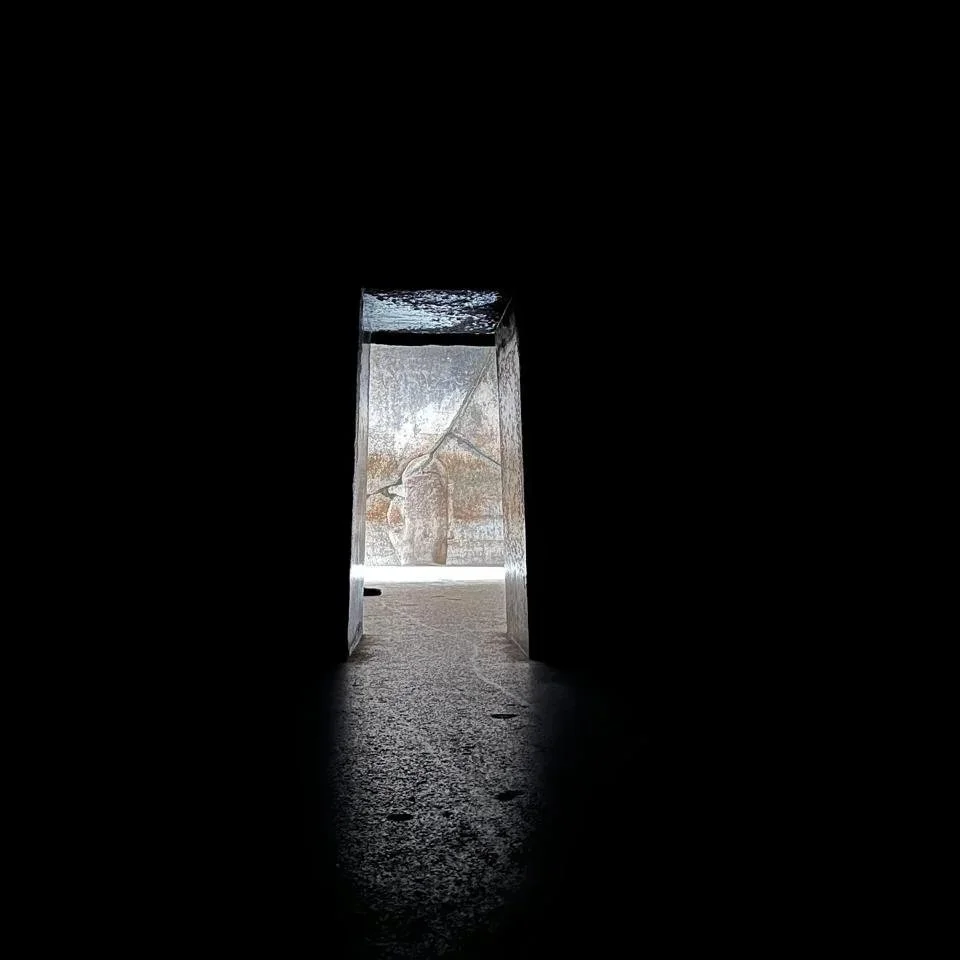
While little is guessed, from the outside, of the interior polishing of the first three hollowed volumes, the plastic organization differs for the fourth: we borrow a wide and high entrance airlock, seeming to take both the step and the light, a rectangle parallelepiped drawn with a line, with impeccable smoothing and finishing, deploying its volume over several meters of depth. The slightest crumb of irregularity is not encountered, whether on the plane of flat surfaces, 90-degree angles, or their polishing.
The interior presents an inverted plastic experience. To the luminous entrance airlock is opposed shadow; to the polishing of stone is opposed a raw aspect, deeply grooved; to angularity is opposed the roundness of a sphere; to the singular volume is opposed the lesser one of a bubble, as if detached. Bubble of void, as if disengaged from the full. Not extracted. To think, as has been said, that this last "cave" is not finished is an error: it makes work, proof, as much as an Igloo by Mario Merz can make work. Moreover, simply imagining, given the considerable amount of work, and the associated risks, that one could have started with the entrance airlock with a view to later completion of the interior would be to suggest that the designers of Barabar were putting the cart before the horse. The stakes, evidently, are elsewhere. A few hundred meters from the other three, and as if hidden apart, what could have been the role of the fourth volume in relation to the first three? Matrix? Warning? Unless extension by plastic inversion and conceptual deployment? But also: sentinel. Or withdrawn, and as if absent? Simple play of counterpoint?
Then the third hollowed volume, also said to be unfinished. From the plastic point of view, the most beautiful, the most moving. The most cosmic but the most incarnate. The softest but the boldest. The maddest. Druidic dada experience.
Mysterious like the black monolith of 2001 A Space Odyssey, but fitted like a Chanel suit, carnal like old granite polished with wax, about as lunar as a Salvador Dali painting, as silent as a sadhu perched high in his mountain, as soft as daisy pistil, as fresh as an equine from Lascaux or Chauvet cave.
The system of the second hollowed volume is close to the third, although of reduced proportions, down to the very mysterious dome, centered, accessible by a small airlock, hidden in the darkness of its depth, in the fold of volumes, in their breast. One could say chapel, igloo, inner ear with plastic all in roundness, overflowing from the common. Its walls are entirely, perfectly and evenly polished up to the ceiling.
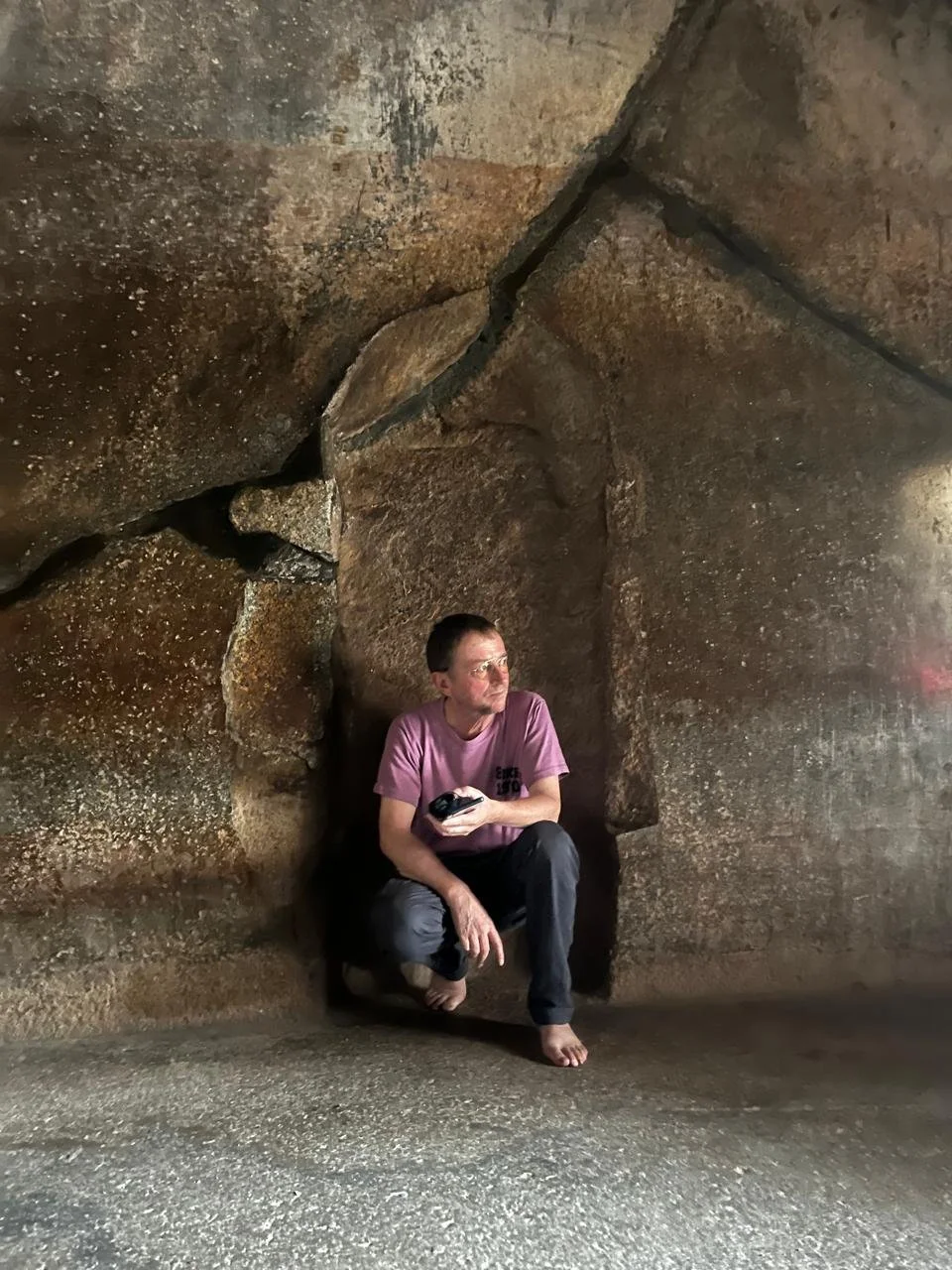
To the right of the entrance airlock, in the center of the lateral wall facing the access to the dome at the other end, a raw and vertical recess seems hewn with ax strokes, without regard for the precious polishing of the whole, without regard for the goldsmith's plastic. One inhabits this volume just with one's body, which disappears with back pressed to stone while the lips of the mouth protrude, flush with the void. The lower you play with your voice, the more the volumes respond to you, the sound sometimes going so far as to diffract into symmetrical notes.
There is in this raw aspect of the niche a sort of signature. Those seeking beauty, hypnotized by fine craftsmanship, will understand nothing.
The first hollowed volume is no less disconcerting, with lesser volumes and the absence of internal dome. On the right lateral edge, centered, is the formidable stone, minimal parallelepiped of orthogonal planes with precise angles—is it a bench, an altar? A bed? A simple counterpart? If one of the four hollowed volumes were an experiment, perhaps it would be this one. Although perfect. But what echo does it give then through its forms, and strange loop, to the fourth volume...?
So curiously: a general sensation of conceptual deployment, approaches to void in four stases, of extreme rigor and sophistication, which would be born spontaneously not from the brain but from the hand. From hand and brain merging. And to Time, as the realization of the whole, as well as the techniques used, of which we have no idea, must not have been done in a day. Or even: four conceptual propositions, the whole of which imposes itself as a fifth.
Back to the Future
Grasping these volumes in their formal deployment is a very singular experience. Let us replay the words: no ornamentation of any kind, no statuary or engraving, no more fresco adorns the interior volumes with clockwork precision. Nothing but emptiness. The Barabar have this particularity that they present themselves in withdrawal. "Nothing" but in withdrawal. This is the salient feature of their radicality. In withdrawal, that is to say inverted in this dynamic of the formidable monuments found in India (many of them carved in rock or mountain, such as Ajanta), as inverted for example from the pyramids of Giza—and the author of these lines, in full consciousness, measures the dubious character of this comparison; similarly, in the same way, let us accentuate the contrasts, inverted from these objects which in their diversity present the genius of the human spirit in manifestation in religious, scientific or technical things, not only an exceeding of common measure, but an idea of projection.
In void. In withdrawal. And who knows fused, for its designer or designers, to infinitude? Fused to cosmos, this word become suspect? The void and the full are of interior experience, while nothing and everything are of the experience of the world. The hollowed volumes of Barabar are of interior experience. This is not self-evident, so imposing are the supports, mountain and granite. This infuses.
In his Principle of Equivalence, Robert Filliou (1926-1987) proposed to readjust in relation to each other the notions of art and life. The sidestep is determining: thus the "well made" neighbors not only the "badly made," but also the "not made." It is tempting to read Barabar by the yardstick of these principles: well made (design, proportions, polishing), badly made (brutalism of the niche), not made (finishes of the third and fourth hollowed volumes). Whatever the case, mentally in the matter, R. Filliou would have loved these caves which present to our state of the world such a percussive denial emerging from the night of time.
Would Donald Judd (1928-1994) and Mario Merz (1925-2003) have, each in their own way, recognized brothers in the designers of Barabar? These polished stone huts-vessels-cells might not have plunged Mario Merz into a distant past but into a near future. Likewise Donald Judd.
One would want to take Donald Judd for a cerebral artist, a bit cold. But Donald Judd, radical practitioner of void, holds the retreat cells of the Navajo Indians, excavated high in the mountain, as one of his referents. Donald Judd is a practitioner of withdrawal: from nothing he extracts a void, from everything he extracts a full. There is something of the alchemist in this poet-researcher, inverted from the conquering artist addressing the cosmos as one addresses the market, or as one addresses the era, to which we have become accustomed, a bit resigned.
And what would Marcel Duchamp (1887-1968) have thought of it? What would the Duchamp of "Can one make works that are not 'art'?" have thought?
Because the most astounding thing is perhaps that in this place nothing precisely appears arrived. Let us understand: finished spaces, turned to the micron, but nevertheless simultaneously placed with all humility and as if in-between.
At Barabar the void is not extracted from the mountain, it is not excavated from granite. It seems mise-en-abyme in the image of a story within another story. There is no "art" at Barabar. As at Combe d'Arc there is art and life (Filliou) indissolubly linked. The caves do not give the impression of having been extracted from the mountain, but that seams in symmetry, in their fineness and transparency, have woven the void there, crossed flows of mathematical energy.
The Fibonacci sequence is a common element in the work of Donald Judd and Mario Merz. We find at Barabar this attraction for mathematical precision in the service of the poetic deployment of volumes. This seizes you slowly and it is very soft, undoubtedly accentuated by this carnal character of the stone, polished, with mirror precision.
However, this mirror effect still contrasts (upper part of the third cave and interior whole of the fourth) with this deep grooving of the stone, evoking the long folds of an interior skin, yes, quite disconcerting as the granite here seems to have been worked in the manner of a soft material as if in the state of world creation, and following the improvisations of the hand. No, the folds of the stone are not unfinished chisel strokes.
Thus again: to the absence of all decorative elements, sculpture, engraving or fresco, and to the general relative darkness responds near each interior cave entrance, when light presents the possibility, stone become mirror, your reflection. While to this reflection responds this imaginary of the fold of skin, of an interior skin but of exterior stone, mountain emanation, cosmos engaged.
Everything is perhaps perfect at Barabar.
It is not surprising that Barabar has remained apart from both pilgrimage and tourist circuits. The void interests little, when it doesn't frighten. Barabar is not recoverable. One can make commerce of nothing, not of void.
India is a great religious and metaphysical country, but neither the Sikhs nor the Jains, neither Islam nor Hinduism, with the exception of a few Buddhists, have been interested in recent history in the Barabar caves. A religion tends toward elevation. But nothing of that at Barabar and even, one could say, nothing but horizontality. The horizontality of the "mountain" like the horizontality of the caves. Or nothing but verticality, but disengaged verticality. The search is metaphysical, interior, secret, silence and of the voice laid imperceptibly.
***
[Original French Text Below:]
de Robert Filliou en Mario Merz : actualité des « grottes » de Barabar (Inde) au regard de l’art contemporain
Il aura fallu les développements de la peinture au XIXè et première partie du XXè siècle, de William Turner à Henri Matisse ou Georges Braque, pour que le regard se libère et que l’on s’autorise à interroger l’art pariétal avec un esprit dénué d’a-priori. De même, faut-il certains développements de l’art à partir du vingtième siècle, particulièrement de sa seconde partie, pour approcher les « grottes » de Barabar en leur singularité, débordant tout cadre référentiel ?
Le vide et le plein, le rien et le tout, le lièvre et le fusil
Ni figuration d’aucune sorte, ni statuaire ou gravure n’orne les volumes intérieurs à la précision horlogère. Rien que du vide. Et de la résonance formelle.
Membrane, cocon, capteur, chrysalide de granite poli au micron à la surface de laquelle votre corps se reflète, mais tout autant plis, ravines. Les grottes de Barabar défient toute interprétation, lesquelles restent contradictoires au-delà de leur possible assimilation à la culture Ajivika (empire Maurya, autour du Vième siècle avant J.-C). On ne trouvera donc dans ce texte d’explication de ce que sont ces grottes, de leur éventuel rôle par le passé, et de la raison de leur réalisation. Les aspects techniques restant par ailleurs un mystère. Mais une tentative de lecture de leur déploiement formel.
Situées dans le nord de l’Inde, en un amas rocheux émergeant d’une plaine aride, à mi-distance de Calcutta à l’est et de Varanasi (Bénares) à l’ouest, à une heure de Boghgaya, le lieu de l’illumination du Bouddha, les grottes de Barabar sont au nombre de quatre. Les trois premières ont été creusées en un long bloc fuselé de plus de cent mètres de long appelé localement le crocodile. La quatrième, de dimension bien moindre, et comme en sentinelle, ou en retrait, et comme absente, ou comme à contrepoint, ou comme par essai, ou comme par hasard, mais comme par prolongement ou inversion plastique (et comme par déploiement conceptuel) se trouve à quelques centaines de mètres.
Rien que du vide.
Mais certainement pas rien. Rappelons avant tout essai de description que l’on confond volontiers le vide et le rien. Le vide s’oppose au plein, lorsque le rien s’oppose au tout. Par pas de côté au vide et au plein, il y a le rien et le tout. Qui sait, si depuis des temps immémoriaux ces deux couples de contraires ne s’opposent comme le lièvre et le fusil. C’est que le vide est peut-être moins une ascèse comme on le croit souvent, qu’un éclaircissement et une révélation. Alors de même, le plein. Recherchant le vide on trouve le plein, non pas que le vide et le plein se confondent, mais que l’un et l’autre relèvent du même paradigme. Le rien et le tout relèvent d’un second paradigme.
Dans l’espoir de centrer notre propos, osons ceci et même, avec les mots de la poésie : le vide serait du royaume du débrayage, de l’absence, du silence, le plein serait du royaume de la forme, c’est-à-dire du verbe, c’est-à-dire du sens ; lorsque le rien serait du royaume de l’apesanteur, que le tout serait du royaume de la projection. Le vide et le plein seraient d’un ordre dépassant le physique ; le rien et le tout seraient de l’urgence et du quotidien. Le vide et le plein seraient donnée immanente ; le rien et le tout seraient (contre toute intuition) donnée transcendante, de la matière humaine et de son organisation horizontale en visée. Le vide et le plein seraient libres d’accès, gratuits comme l’air ; le rien et le tout seraient de l’inquiétude. Le vide et le plein seraient de l’accueil de l’inconnu, le rien et le tout seraient du remplissage, de l’évitement. Le vide et le plein seraient de la consumation, le rien et le tout seraient de la consommation. Le vide et le plein seraient de l’âme et du corps, le rien et le tout seraient de l’âme ou du corps. Le vide et le plein seraient de la science et de l’art, le rien et le tout seraient de la science ou de l’art. Le vide et le plein seraient de la spontanéité et de la gratuité de la recherche, de la curiosité ; le rien et le tout seraient des ouvertures du Progrès, ce dont la prolifération du suffixe isme (marqueur de l’idée de système, de totalité) dans le vocabulaire commun aura témoigné des champs politique et économique aux champs scientifique et culturel tout au long du vingtième siècle. Le vide et le plein seraient du temps long et de l’instant croisés, le rien et le tout seraient du passé, du futur et du présent mêlés à confusion. Le vide et le plein sont du geste délié ; le rien et le tout seraient de programmation ?
À Barabar, rien que du vide. Que de rares visiteurs tentent spontanément d’habiter de lourds et bruyants, appuyés, chants sacrés, ôm rivalisant par débordement égotique à cosmos débrayé. Et que les volumes semblent bientôt rejeter, l’on dirait, les désagrégeant de toute autorité et certaine douceur. Peut-on entendre cela en ces temps arrivés ?
Tout est là. En l’instant : pénétrant en ces lieux, ni Histoire ni passé ni futur n’y sont des référents de quelque validité que ce soit, et pas plus l’idée de présent.
Absence de toute trace d’essai, absence de repentir ; parois et volumes ordonnés selon des proportions mathématiques repoussant l’entendement ; larges, hautes, profondes, à tout le moins éblouissantes symétries millimétriquement parfaites ; qualité de polissage des parois supérieure à celui du verre ; amplitude sonore des principales grottes de 34,4 mh exactement, dépassant de très loin les prouesses des abbayes cisterciennes ; etc.
Ici, ni l’idée de grotte, ou celle de caverne (Platon), ou de chambre, ou de cellule, ne convient. Comment nommer les « grottes » de Barabar ? Volume évidé retiendra notre attention, s’agissant là d’une « espèce d’espace » (Georges Perec) inconnue.
À cette précision et à ses perfections de règlements, mais peut-être connus des maîtres en taille et polissage de pierres précieuses des ateliers de Jaipur, répond non pas tant la beauté des parois, la couleur de la pierre ou la chaleur de la main à la trace pour ainsi dire absente, mais pourtant certaine, que celle échevelée du cœur. Ainsi est le génie du lieu : parfaitement vide, infiniment vide, parfaitement plein, infiniment plein.
Infiniment lié : à la masse de la « montagne », à la matière très certaine du granite, à laquelle répond la certitude du vide. De même qu’à l’inscription en paysage naturel répond l’effacement, et comme une forme de disparition en culture, l’on serait tenté de dire : en idéalité. Cependant nulle utopie anti-spectaculaire. Tout est là, et comme de toute éternité ici et maintenant, la nature immuable, sa mise-en-abime en ces imparables volumes. Cette impression non pas que le vide soit extrait du granite, ou même extrait de la montagne, mais débrayé du cosmos. Pas tant une affaire d’extraction que de débrayage (c’est pourquoi les « coutures » se doivent d’être parfaites). Rien n’est opposé (à vide rien n’est opposé). Tout est débrayé (à tout, plein est débrayé).
En ces matières doit-on considérer le réel comme une vérité, une preuve, une vertu ou comme une forme ? En cette forme faut-il agir ? En additif ou en actif ? En communion ? Pro actif du corps et du cerveau sans principe de précaution ; ou agissant sentant avec le cœur aussi, sans principe de séparation ?
De 4 en 1
Lorsque peu se devine, de l’extérieur, du polissage intérieur des trois premiers volumes évidés, l’organisation plastique diffère pour le quatrième : nous empruntons un large et haut sas d’entrée, semblant prendre le pas autant que la lumière, parallélépipède rectangle tracé au cordeau, aux lissage et finissage impeccables, déployant son volume sur plusieurs mètres de profondeur. La moindre miette d’irrégularité ne se rencontre tant sur le plan des aplats que des angles à 90° ou de leur polissage.
L’intérieur présente une expérience plastique inversée. À sas d’entrée lumineux s’oppose une ombre ; au polissage de la pierre s’oppose un aspect brut, profondément rainuré ; à l’angularité s’oppose l’arrondi d’une sphère ; au volume singulier s’oppose celui moindre d’une bulle, comme détachée. Bulle de vide, comme débrayée du plein. Non pas extraite. Penser, comme on a pu le dire, que cette dernière « grotte » n’est pas finie est une erreur : elle fait œuvre, preuve, autant qu’un Igloo de Mario Merz peut faire œuvre. De plus, simplement imaginer, vu la somme de travail considérable, et les risques associés, que l’on ait pu commencer par le sas d’entrée en vue d’un achèvement ultérieur de l’intérieur serait donner à penser que les concepteurs de Barabar mettaient la charrue avant les boeufs. C’est que les enjeux, d’évidence, sont ailleurs. À quelques centaines de mètres des trois autres, et comme caché à l’écart, quel a pu être le rôle du quatrième volume en regard des trois premiers ? Matrice ? Avertissement ? À moins que prolongement par inversion plastique et déploiement conceptuel ? Mais encore : sentinelle. Ou en retrait, et comme absente ? Simple jeu de contrepoint ?
Alors le troisième volume évidé, dit non achevé lui aussi. Du point de vue plastique, le plus beau, le plus émouvant. Le plus cosmique mais le plus incarné. Le plus doux mais le plus osé. Le plus fol. Expérience dada druidique.
Mystérieux comme le monolithe noir de 2001 l’Odyssée de l’espace, mais ajusté comme un tailleur Chanel, charnel comme un vieux granite passé à l’encaustique, à peu près aussi lunaire qu’un tableau de Salvador Dali, aussi silencieux qu’un saddhu haut perché dans sa montagne, aussi doux que du pistil de marguerite, aussi frais qu’un équidé de chez Lascaux ou de chez grotte Chauvet.
Le système du second volume évidé est proche du troisième, bien que de proportions réduites, jusque la bien mystérieuse coupole, centrée, accessible par un petit sas, cachée en l’obscurité de son fond, en repli des volumes, en leur sein. L’on pourrait dire chapelle, igloo, oreille interne à la plastique toute en rondeur, débordant du commun. Ses parois sont entièrement, parfaitement et uniment polies jusqu’au plafond.
À droite du sas d’entrée, au centre de la paroi latérale faisant face à l’accès à la coupole à l’autre bout, un renfoncement brut et vertical semble taillé à coups de hache, sans égard pour le précieux polissage de l’ensemble, sans égard pour la plastique d’orfèvre. On habite ce volume juste de son corps, lequel disparait le dos collé à la pierre cependant que les lèvres de la bouche ressortent, affleurent au vide. Plus vous jouez bas de la voix, plus les volumes vous répondent, le son allant parfois jusqu’à se diffractant en notes symétriques.
Il est en cet aspect brut de la niche une sorte de signature. N’y entendront rien ceux cherchant le beau, hypnotisés par la belle facture.
Le premier volume évidé n’est pas moins déconcertant, aux volumes moindres et à l’absence de coupole interne. Sur le bord latéral droit, centrée, la formidable pierre, parallélépipède minimal de plans orthogonaux aux angulaires précises, est-elle un banc, un autel ? Un lit ? Un simple pendant ? Si un des quatre volumes évidés était un essai, peut-être serait-ce celui-là. Bien que parfait. Mais quel écho donne-t-il alors de par ses formes, et drôle de boucle, au quatrième volume…?
Si curieusement : une sensation générale de déploiement conceptuel, approches du vide en quatre stases, d’une extrême rigueur et sophistication, qui naîtrait spontanément non du cerveau mais de la main. De la main et du cerveau fusionnant. Et au Temps, tant la réalisation de l’ensemble, de même que les techniques utilisées, dont on n’a idée, n’a dû se faire en un jour. Ou même : quatre propositions conceptuelles, dont l’ensemble s’impose comme une cinquième.
Retour vers le futur
Saisir ces volumes dans leur déploiement formel est une expérience bien singulière. Rejouons les mots : ni ornementation d’aucune sorte, ni statuaire ou gravure, pas plus de fresque n’orne les volumes intérieurs à la précision horlogère. Rien que du vide. Les Barabar ont ceci de particulier qu’elles se présentent en retrait. « Rien » qu’en retrait. C’est là le trait saillant de leur radicalité. En retrait, soit à l’envers en cette dynamique des formidables monuments que l’on trouve en Inde (nombre d’entre eux taillés en la roche ou la montagne, tel Ajanta), comme à l’envers par exemple des pyramides de Giseh - et l’auteur de ces lignes, en pleine conscience, mesure le caractère douteux de ce rapprochement ; de même, au même titre, accentuons les contrastes, à l’envers de ces objets qui en leur diversité présentent du génie de l’esprit humain en la manifestation en les choses religieuses, scientifiques ou techniques, non pas seulement un dépassement de la mesure commune, mais une idée de projection.
En vide. À retrait. Et qui sait fondues, pour son ou ses concepteurs, à infinitude ? Fondues à cosmos, ce mot devenu suspect ? C’est que le vide et le plein sont de l’expérience intérieure, lorsque le rien et le tout sont de l’expérience du monde. Les volumes évidés de Barabar sont de l’expérience intérieure. Cela ne s’impose pas d’évidence, tant les supports en imposent, montagne et granite. Cela infuse.
Dans son Principe d’équivalence, Robert Filliou (1926-1987) proposait de ré-ajuster en regard l’une de l’autre les notions d’art et de vie. Le pas de côté y est déterminant : ainsi le « bien fait » y côtoie non pas seulement le "mal fait », mais encore le « pas fait ». Il est tentant de lire Barabar à l’aune de ces principes : bien fait (dessin, proportions, polissage), mal fait (brutalisme de la niche), pas fait (finitions des troisième et quatrième volumes évidés). Quoi qu’il en soit, mental en la matière, R. Filliou aurait aimé ces grottes qui présentent à notre état du monde une si percussive dénégation sortant de la nuit du temps.
Donald Judd (1928-1994) et Mario Merz (1925-2003) auraient-ils, chacun à leur manière, reconnu des frères en les concepteurs de Barabar ? Ces cabanes-vaisseaux-cellules de pierre polie n’auraient peut-être pas plongé Mario Merz en un passé reculé mais en un futur proche. De même Donald Judd.
On voudrait prendre Donald Judd pour un artiste cérébral, un peu froid. Mais Donald Judd, radical praticien du vide, tient les cellules de retraite des indiens Navajo, excavées haut dans la montagne, pour un de ses référents. Donald Judd est un praticien du retrait : d’un rien il extrait un vide, d’un tout il extrait un plein. Il y a de l’alchimiste en ce chercheur poète, à l’envers de l’artiste conquérant à tutoyer le cosmos comme on tutoie le marché, ou comme on tutoie l’époque, à laquelle nous nous sommes habitués, un peu résignés.
Et qu’en aurait pensé Marcel Duchamp (1887-1968) ? Qu’en aurait pensé le Duchamp de : Peut-on faire des œuvres qui ne soient pas « d’art » ?
Car le plus ébouriffant est peut-être qu’en ce lieu rien justement n’apparaît arrivé. Comprenons : espaces finis, tournés au micron, mais pourtant simultanément posés de toute humilité et comme d’un entre-deux.
À Barabar le vide n'est pas extrait de la montagne, il n’est pas excavé du granite. Il semble mis-en-abime à l'image d'un récit en un autre récit. Il n’y a pas d’« art » à Barabar. Comme à la Combe d’Arc il y a de l’art et de la vie (Filliou) indissolublement liés. Les grottes ne donnent pas l'impression d'avoir été extraites de la montagne, mais que des coutures en symétrie, dans leur finesse et transparence, y ont tissé le vide, croisé des flux d’énergie mathématique.
La suite de Fibonacci est un élément commun au travail de Donald Judd et de Mario Merz. On retrouve à Barabar cet attrait pour la précision mathématique au service du déploiement poétique des volumes. Cela vous saisit lentement et c’est très doux, sans doute accentué par ce caractère charnel de la pierre, polie, à la précision du miroir.
Cependant que cet effet miroir contraste encore (partie supérieure de la troisième grotte et ensemble intérieur de la quatrième) à ce profond rainurage de la pierre, évoquant les longs plis d’une peau intérieure, oui, assez déconcertants tant le granit semble ici avoir été travaillé à la manière d’une matière tendre comme en état de création du monde, et suivant les improvisations de la main. Non les plis de la pierre ne sont pas des coups de pic non finis.
Ainsi encore : à l’absence de tout élément de décor, sculpture, gravure ou fresque, et à la relative obscurité générale répond à proximité de chaque entrée intérieure de grotte, lorsque la lumière en présente la possibilité, la pierre devenue miroir, votre reflet. Pendant qu’à ce reflet répond cet imaginaire du pli de la peau, d’une peau intérieure mais d’extérieur pierre, émanation montagne, embrayée cosmos.
Tout est peut-être parfait à Barabar.
Il n’est pas surprenant que Barabar soit resté à l’écart des circuits tant de pèlerinages que touristiques. Le vide n’intéresse guère, lorsqu’il n’effraie pas. Barabar n’est pas récupérable. On peut faire commerce de rien, pas de vide.
L’Inde est un grand pays religieux et métaphysique, mais ni les sikhs ni les jaïns, ni l’islam ni l’hindouisme, à l’exception de quelques bouddhistes ne se sont intéressés dans l’histoire récente aux grottes de Barabar. Une religion tend vers l’élévation. Mais rien de cela à Barabar et même, pourrait-on dire, rien que de l’horizontalité. L’horizontalité de la « montagne » comme l’horizontalité des grottes. Ou rien que de la verticalité, mais de la verticalité débrayée. C’est que la recherche est métaphysique, d’intérieur, secrète, silence et de la voix posée imperceptiblement