
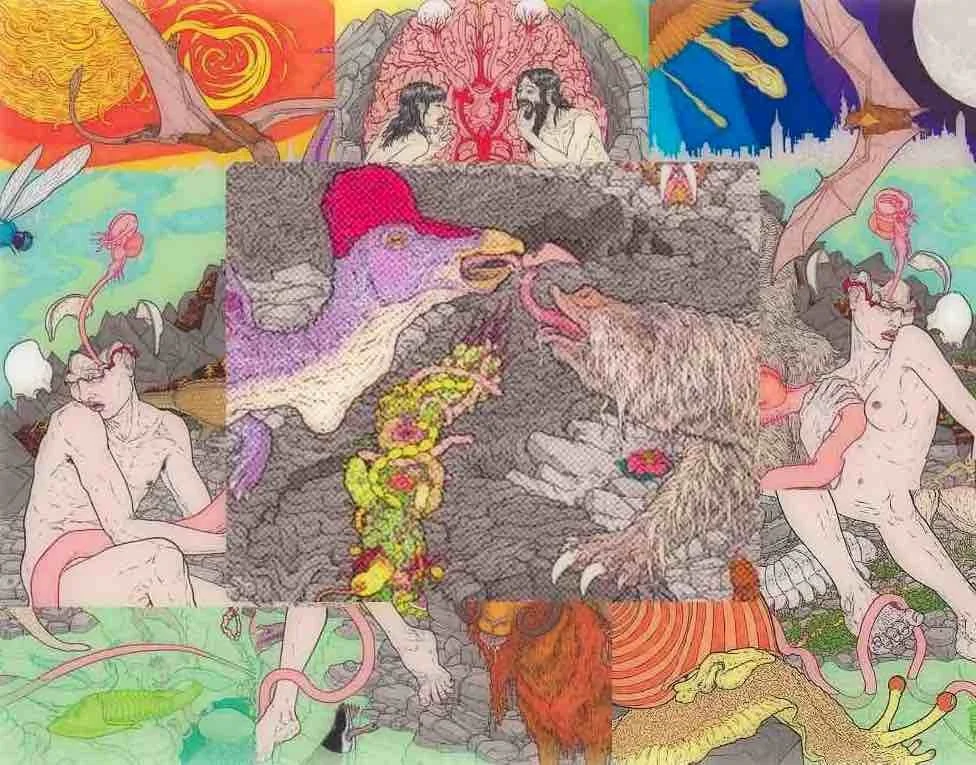
In Thomas Ligotti’s The Conspiracy Against the Human Race puppets, and more specifically meat-puppets, are a common occurrence. In it, he declares consciousness a cruel mistake of nature—the work’s fundamental premise—and furthermore, that if we were to pause for a moment and reflect on ourselves, we would find that we are neither gods nor apes but… puppets. With this treatise, Ligotti, more known for his horror fiction than as a philosopher, has created a powerful polemic against existence. Throughout his arguments marches the single refrain that we’d do well to end not just ourselves but the entire human race, that continuing to exist as a species is a cruel joke foisted on our descendants. He calls his position, the philosophy of pessimism.
Ligotti’s extremism is uniquely his. The authors he references are almost all obscure (except perhaps the famously pessimistic Schopenhauer) but Ligotti is not only the world’s pre-eminent pessimist, he is also the man who “modernized the weird tale” as Jeff Vandermeer succinctly declared.[1] More than any other writer, Ligotti created the possibility of what would become the New Weird.
New Weird presented itself not as a “movement” but a “moment” that captured a certain stylistic tendency that exists between, is a genre beyond genre. It declared itself specifically as a trend without manifestoes, and Ligotti’s extreme pessimism would not sit well with many (if not most) who fill the ranks of this aforementioned literary moment but all the same I would argue that Ligotti’s treatise lurks in the background of its sitting rooms. Not because his ideas are shared but because their audaciousness comes from a similar openness to the impossible and uncomfortable that defines New Weird writings. These are writings that exist not just beyond genre but beyond the boundaries of the knowable, some more than others. There are those in the lower atmospheres of the New Weird that utilize their weirdness as a seductive and hypnotic style and there are those who search to bake the weirdness deep within themselves until we cannot say whether these are truly books in the sense that we’ve known them.
On the former end of that spectrum come the most notable and recognizable New Weird titles—China Miéville’s Perdido Street Station that was the catalyst that bought New Weird into the public and Jeff Vandermeer’s Southern Reach trilogy (now qaudrilogy) was like New Weird’s atom bomb, ensuring its place in history—while the latter achieved its most distinctive heights through the work of Michael Cisco, whose work is genuinely unsettling in a way I have not seen before.
Not so much his earliest writings. The Divinity Student, with its dream logic and allegorical horror, vivid descriptions and gothic shamanism, was quite nearly a known entity. From there, we get the fairy tale physics of The Narrator juxtaposed against what is otherwise a very gritty war narrative, creating an experience that was like Kafka churned through Norman Mailer. Then there’s Animal Money.
It’s a book that skirts something approximating realism while also waxing philosophical. It’s bold and audacious, meanders like a first draft and has no consistency, but that’s part of what makes it so wonderful. It reads like a source text, like a vision literature for the end times and the conceit is timely, powerful, and true. At its best, this is some of the most brilliant writing I’ve read.
Animal Money is about a new form of living money. It reads like an incantation trying to find its voice. At first more a parody of realist literature than anything else—5 economists at a conference in a fictional Latin American city discussing the idea of animal money—like Pynchon and PKD and maybe a touch of Bolaño—I immediately thought of 2666 and its Oscar Amalfitano’s comment about Supply + Demand + Magic—Animal Money—written with nib half-cocked as the most outlandish audacities are teased into ever greater heights. I found myself deceived by this play-pretend realism. When I first started reading, I thought, “Oh, I like this. Might have been good to drop the ritual scarring of the economists though. It’s a bit much. Feels very 60s retro sci fi.” But, as I continued to read, it was like the familiarity in the opening pages had been a dupe and those elements that had felt a bit ‘off’ at first were in fact nothing but premonitions of what’s to come.
“Straining against his bewilderment, the second Professor Long describes an exchange he witnessed between two squirrels in his back yard a few days before he left for this ill-starred conference. He had tucked it away in his memory, thinking it might “cute up” (sic) a lecture one day, and had not thought of it since. Two squirrels facing each other in the grass of his lawn. One reaches inside its mouth and pulls out something deep blue, like a sequin, round and flat, and hands it to the other. The other squirrel receives this thing, puts it in its mouth, goes to one corner of the garden, digs up an acorn, returns to the first squirrel, removes the acorn from its jaws with its paws, places the acorn in the open paws of the first squirrel. The first squirrel then puts the acorn in its mouth and goes “arching away.” Was that one squirrel buying an acorn off the other? But, then again, the second Professor Long says a moment later, he supposes he might have dreamt it. For that matter, he goes on, he can not be sure he is not making things up. But it turns out we all have such stories.”[2]
But throughout the book, Animal Money appropriately evolves, and the reader—at least this particular reader—is desperate to know what it will evolve into. As in, for the first time in I don’t know when I really thought perhaps this book held the answer, an answer that we desperately need, and I still do.
Cisco’s work always feels like a dream, and in this case, the dream is focused on late capitalism in its death throes. This is not a story that’s been mapped for your amusement but a place to inhabit. It doesn’t function like other stories because it’s not concerned with consistency or character as much as the world itself turned character and what wonders can be found upon the shifting contours of these worlds.
*
“A tiny white line in the sky, he keeps his body straight and slants up at the clouds. The cloud ceiling doesn’t budge, muddy and silver, refusing to come closer. He charges at it with all his might; he attacks the clouds and strikes straight to the heart, with air running over him pushing oil into rivulets along his back and sides; he blinks it out of his eyes. With all his might he pushes himself up, scarcely thinking about what he’s doing, everything fades, and he loses himself in the effort, and then moments later he remembers that he’s flying and it overwhelms him, nearly sending him toppling headlong out of the sky. Finally after an eternity of struggling, vapor closes around him like curtains of water, boding rest—he’s been holding his breath, now he lets it out in humid air and breaks through. The cloud comes up beneath to support him and he falls to his knees, disgorges clear, sweet gelatin from the exertion of flying.”[3]
The Divinity Student opens with the main character dying in an a supernatural adjacent occurrence during a walk through a green canyon in a downpour. “The cloud opens a moment and reaches down, pulling him off his feet.” Then he falls to his death, only to be stuffed with papers, revived, turned into a mystical golem, and sent to San Veneficio for an undisclosed mission that he will only very slowly grasp, a mission that will eventually consume him. The book is both more straightforward structurally (the book has few side stories, between himself and Miss Woodwind, the butcher, Ollimer, all of them tied to his mission in some way) and already showcases Cisco’s linguistic skill—how he describes the slits appearing in the divinity student’s back as they begin to breathe with the night air while he is reclining on a hammock strung between two buildings and high above the city only to then float upwards—or how he describes the priest Magellan and his jars of embalmed animals and him flicking the broth of formaldehyde from a particular jar in the face of some devotee to conjure visions and the eyes painted over the lids of Magellan’s eyes—or the butcher splicing a fly in two.
In this first book the sense of book as dream is very much front and center, but by the time we get to The Narrator, Cisco seems to have begun to toy with a kind of hybrid realism and dream. There are moments in this book that have the jarring immediacy of the Real, most specifically the battle sequences, and moments when a Lovecraftian horror manifests upon the page as an everyday reality the characters are nonchalantly marching through.
“Winter comes so swiftly in the mountains that the leaves are frozen green on the trees, the grass in the meadows. The foliage never turns color or falls, but hibernates in clear ice casings until the spring thaw restores their interrupted life again. So the winter landscape is tinkling green, dazzling with flakes of light, crisp through the snow. The many rock-lipped streams freeze clear as well, and the fish are suspended in place like spangles of precious metal until spring. I walked to the small cluster of administrative buildings, a clutch of cottages and shops connected by a tangle of gravel paths and baffled from sight like an embarrassment by several echelons of yew hedges. I passed through these under boughs of cherry trees, the scarlet cherries still on the branches, glowing like embers through the ice that outlined every leaf and twig in shining white thread, and I saw myself endlessly multiplied in all that pure ice, even on the yew branches, their deep green almost black, and webs of gossamer ice in the recesses of the hedges. A dark, bulbous, top-heavy figure loomed in and out of them as I passed, arms anxiously swinging.”[4]
It was while reading The Narrator that I first thought of Henry Corbin and his Mundus Imaginalis, an essay that explicates Ishraqi philosophy, as in Suhrawardi and the Illuminationist School of 12th century Persia. In it, Corbin explores the imagination as Na-koja-abad or the place that is nowhere, as in not nonexistent but a place that exists nowhere. Corbin argues, along with Suhrawardi, that the imagination is a means to perceive the invisible world and uses as his source texts, Sufi mystic literature and its exploration of “beyond Mount Qâf,” explicitly choosing the term ‘imaginal’ to free the experiences of the mind from the usual Western prejudice towards nonreality of the imagined.
“Mount Qâf is the cosmic mountain, which, summit after summit and valley after valley, is built up of celestial spheres, all enveloping one another. Where then is the road that leads out of it? What is the distance? ‘However far you may journey,’ it is said, ‘you will always come back to the point of departure,’ just as the needle of the compass always swerves back to the magnetic point. Does this simply mean that you leave yourself to come back to yourself? Not quite, because, in the meantime a very important event will have changed everything. The self one finds yonder, beyond Mount Qâf, is a higher self, the self experienced as a ‘Thou.’ Like Khezr (or Khadir, the mysterious prophet, the eternal wanderer Elijah or his double), the traveller has to bathe in the Spring of Life.”[5]
Using Sufi mystic literature as his source material, Corbin claims that these vision states all explore the same geography. They describe the same place and therefore could then be said to genuinely exist, and with The Narrator, Cisco presents us with a similar credulousness concerning his own creation. The book reads more as memoir of imaginal realism than fantasy novel, a vision realism of the post-apocalyptic, both intentionally anachronistic and intentionally ignorant of traditional narrative framings and mechanisms, the effect of which can be stunning and extraordinarily affecting but also occasionally frustrating for the reader, but that’s just it. This book doesn’t exist as anything but as document of itself.
In terms of tone and structure, the book reads as vaguely 19th century or earlier despite its science fiction elements—ships that move like giant metal grasshoppers, suits made of lighter-than-air metal such that the soldiers skin through the air. Even so, it was Stendhal’s The Red and the Black that came to mind while reading, or perhaps even more so, Simplicius Simplicissimus—possibly because the picaresque structure—a protagonist moving through a landscape of total war that has no coherent moral geography, that’s stopped making any kind of sense; in Cisco’s The Narrator, the fantastical elements aren’t departures from reality, but one kind of horror among the larger landscape of horrors both realistic and impossible. But even more than this, Cisco’s work has a quality of inverted or evacuated transcendence.
Corbin is describing a mystical experience that shares certain geographical markers along its devotional topography, while the topography Cisco’s works inhabit, by dint of their genreless fantasy, are mystical adjacent, a hedonist’s mysticism, a mysticism with no object. At its best an undead divinity is infused in the descriptions, at worst the lack of any extra numinous element in what otherwise reads as vision literature can make the book feel empty. Which in part is also why it works at least in so far as it captures the sense of pointlessness that goes with war narratives à la Mailer, Hemingway, and Heller. It is a perfectly realized text that at points sings through the skull and at points seems simply and absolutely alien but again that may very well be the point.
And Animal Money?
Again. Pynchon. The paranoid network, the sense that everything connects to everything else, the mixing of high seriousness and low comedy, the encyclopedic ambition. But Pynchon’s paranoid systems, for all their audacious impossibility, have a baroque totality to them, a magnificent, intricate, almost aesthetic quality, and in Cisco that totality is always out of reach. While the economists in Cisco’s Animal Money move through a world that has the structural logic of a Pynchon novel—hidden connections, systems operating beneath legibility, value as a force that distorts reality—the end result is different. Pynchon’s imagination is ultimately a baroque imagination—it accumulates and elaborates—while Cisco’s is—one again and always—imaginal; it perceives a very real-in-itself vision rather than constructing narrative.
As Mary Douglas famously pointed out in Purity and Danger, the Taboo and the Holy are two sides of the same coin, both iterations of what the religion of healthy-mindedness, according to William James, would describe as “diseased, inferior, and excrementitious stuff,” i.e. the indefinable places, between dead and living (zombie), between fluid and solid (snot), and the world of weird fiction inhabits this exact space. The weird text is one where the form and the content are both slightly wrong simultaneously, and the interaction between those two wrongnesses is what produces the sensation. In Cisco’s work (and New Weird more generally) estranged content (not of this world) is combined with estrangement of form (the genre I thought I was reading doesn’t quite contain this), which leads to an entire genre of “diseased, inferior, and excrementitious stuff.” It is the dark opposite of the mystical, not unlike cosmic horror but not exactly the same either; this same inverted mysticality can be found in certain absurdist comedy and the erotic can turn mystical at its most extreme. Examples abound of mystics going full Penthouse Forum.
Ultimately, it is this confusion over what Cisco is and what he’s doing that ends up aggravating the reader. I never have the sense that I’ve fully grasped Cisco’s universe, his purpose, the characters, but only because what I am being presented with is not a constructed narrative; it’s a glimpse into a wild and real (albeit a real that “exists nowhere”) world, metaphorical in nature but no less actual for that. What makes Animal Money in particular stand out in this regard is its living philosophy of living money. Cisco is presenting an idea that can then grow like the money in the book and theoretically, hopefully, work to unseat our very fallen world. The economists in Animal Money are witnesses to something they can’t fully see, that we also will never fully see. This is Pynchon with the authorial god-trick removed.
Instead of making the invisible system visible and therefore manageable, Cisco is challenging us to find the invisible system it only partially reveals, to create animal money ourselves.
*
In The Conspiracy against the Human Race, Ligotti circles round again and again to a criticism of what James’ religion of healthy-mindedness. He criticizes both the mystical turn of Rudolph Otto and the Buddhist turn of egoless enlightenment in a general send up of the world of suffering and us as its innocent victims—all of this to convince an indifferent audience. Stop making any more innocent victims and let the species die out.
But what starts out as a philosophy as much inspired by early “pessimists” with similar ideas, Mainländer and Zapffe evolves into a very different kettle of fish, a treatise on “atmosphere,” meaning the atmosphere achieved in great writings of the macabre and uncanny, by Lovecraft and the best of supernatural horror in general. For Ligotti, it seems that the atmosphere and the pessimistic philosophy are two sides of a very laconic coin, and this philosophically-charged atmosphere, that taps into a pulp fiction predating the pulps, going back to Poe of course but also Arthur Madchen and his terrifying tales, The Great God Pan and The White People, this mood and its accompanying mindset infects Weird Fiction. It is also why the New Weird is the appropriate fiction for our age. It perfectly reifies the unnameable terror that percolates through this apocalyptic age.
New Weird authors work to make a kind of uberpulp comprising near hallucinatory level detail, often dreamlike but also realist, and many tend to political radicalism—Miéville himself is Marxist, Vandermeer is very focused on ecology—but at its most extreme, the New Weird exists at the plane Ligotti himself is inhabiting, where consciousness becomes the enemy and nonexistence is the only happy outcome.
But—why is the New Weird specifically the literature of the post-progress shooting-off-the-cliff apocalyptical times we’re living in? In The Great Derangement, Amitav Ghosh points out that contemporary realist fiction, the literature of the everyday, was not built to address something as monumental and improbable as the climate crisis. It exists beyond the scope of our literature. From its birthplace in fairy tale and the fantastical stories of The Arabian Nights, a realism is born in the synthesis of Greek detail and Hebraic subtext, and increasingly nature moves into the background to become nothing but a set piece for human affairs, but now, with the climate crisis, the set pieces have started eating the stage. “It is as though our earth had become a literary critic and were laughing at Flaubert.” Or as George Marshall writes: “Climate change is inherently uncanny.” Climate change is the ghost of human activity “returning to haunt us in unthinkable shapes and forms.” Enter the New Weird.[6]
The New Weird came about because the world was turning weird. In fact, it’s been turning weird for so long now that we’ve started thinking of it as normal, when there’s nothing normal about any of it. There was a moment around the turn of the millennium when everyone was commenting about how the world was turning sci fi—in fact, in the seminal chat concerning whether to adopt the title New Weird, What is the New Weird, one of the authors made this exact comment, The world is turning Sci Fi. But we too quickly forgot that sense of strangeness that had been one of the defining attributes of post-Cold War 90s and then the pivot to terrorism after 9/11, with the mapping of the genome and the appearance of Smartphones, with the rise of China and the aforementioned general unraveling of the world as it crescendos into a political, economic, and ultimately absolute collapse of civilization. The old paradigms have been coming apart for some time, but even wonder gets old if you face it day in day out, and instead our narratives always seem to linger in the normalcy from before: WWII as the great and final fight against evil, liberal democracies and capitalism as going hand in hand and inevitable, Enlightenment progress will return if we just try hard enough, individualism is an absolute human right that we will cling to even as whole swaths of the population go up in flames as a result of this consumer-oriented individualism.
Ligotti’s pessimism feels right to me—not because consciousness is a mistake of nature but because of the mindless optimism that undermines even the most supposedly pragmatic of worldviews—Time to die is never a good policy position—because the global regulatory response to the climate crisis was never going to work, and the nationalist and populist response to it was never going to work, and revolution against those nationalist and populist movements was never going to work—but all the same, I still need hope, and the only place where hope can still realistically exist is in the post-apocalypse, and when it does arrive, this hope will be spiritual. In our secular age—this of course is different for everyone, but this is my own personal perspective—I find that journey through pulp, through fiction, and the New Weird is part of that. How? The New Weird mimics the numinous.
But what is weirdness? What are we seeing when we see the weird?
Mark Fisher distinguishes between The Weird, which happens at thresholds, and The Eerie, which requires agency, either something “extra” or a lack of something that should be there. As Fisher points out, in his ‘Notes on Weird Fiction,’ Lovecraft writes of “vague, elusive, fragmentary impressions of wonder, beauty, and adventurous expectancy,” as the feelings his stories evoke, that the emphasis on horror is a consequence of the stories’ encounter with the unknown. In what ways could “the unknown” in this sense be differentiated from mystical? Or is it?
Of course, if you read enough of the weird fiction inspiring the New Weird, you might find, as some of the authors themselves did, that the distinction seems a bit arbitrary. You can find stories by Jean Ray or de la Mare that feel similarly uncategorizable or hallucinatory. John Harrison appears to have been writing something like New Weird fiction twenty years earlier. He also of course was very much involved in the discussion of what New Weird was and whether it was at all in the wake of Perdido Street Station, and reading his story, The New Rays (1982)—in which a woman gets an experimental treatment that creates unnerving and mysterious blue blobs—gives you exactly the sense of what distinguishes the New Weird. It wants to retain itself as pulp but in a world that is freed from the constraints of pulp, to sincerely inhabit its dark roots rather than ironically exploit them, but to do so in a literary landscape where all the constraints and rules are gone so that it can grow in any direction it wants, a pulp that’s escaped the rules of gravity that bound it to itself.
From this starting point, different authors arrive at different places. Some find themselves more on the surreal side of the equation, while others will develop a pulp realism and then there’s Cisco. His fiction is a manifestation of Godless numen, a trance state text that is more than automatic writing but less than divine vision, a text that feels living from the simple fact that it doesn’t always seem to know what it’s doing even as it does it. Like any great author, Cisco has created something that has a life of its own, but in his case, it’s not a character, it’s the text itself.
In Weird Fiction: A Genre Study, Michael Cisco does a lot of things. He distinguishes between major weird fiction (that defends the normal) and minor weird fiction (that warns against it). He talks about use value versus exchange value. He argues that the supernatural in weird fiction is not a category, but instead in weird fiction supernatural events “weirdly fail to belong to any category,” a “kind of infinite experience that challenges the nature of reality,” a place beyond the “plotted out, predictable and stable.” He brings in Spinoza: “Wonder is the conception (imagination) of anything, wherein the mind comes to a stand, because the particular concept in question has no connection with other concepts.” The weird tale is “a dream, not an atrocity. Atrocities fill us with fear that something of the kind might happen to us, but the weird tale is already something happening to us.” He distinguishes between prophecy (major—the will of God, deterministic, closes experience) and omens (minor—disconnected signs that warn but don’t determine, that throw identity into question rather than confirming it). The mark of destiny doesn’t tell you where you’ll end up; it tells you that you will no longer be who you are. “It is your destiny to stop being who you are now.” Cisco writes that “Destiny is a genre. Weird fiction is the destiny-genre that treats the virtuality of the invisible form as something bizarre. Destiny in weird fiction is this self-writing phenomenon read back from the point of view not of the writer but of a character living the story for the first time.”[7]
When critics or readers complain that Cisco’s characters aren’t psychologically realistic, that his scenes shift without transition, that his prose isn’t dynamic—they’re identifying formal features and measuring them against the wrong standard. They’re applying the conventions of literary realism (rounded characters, causal scene transitions, kinetic prose) to a text that is deliberately producing the weird sensation through formal failure relative to those conventions. The formal features critics call flaws are the mechanism by which the text produces its effect.
Weird fiction has always emphasized atmosphere over character, presenting their strange landscapes through anonymous narrators we can inhabit all the more fully for their stripped down simplicity. But Cisco’s fiction is not traditional weird fiction and his characters can feel unfinished as a result, sometimes tending more towards the pulp vehicle-of-reader-experience and sometimes something more like something more literary and lifelike. These characters are enactments of a world in which subjectivity itself is unstable. In vision literature logic, psychological realism makes no sense.
The abrupt scene transitions, the prose that isn’t dynamic in the market sense—all of it functions according to a different principle, in a text that we swim through, in which story is a growth and a question, a text that is doing the one thing we need right now—trying for something new.
Reading and enjoying Cisco requires the trance. His books are on the one hand full of tantalizing questions that lurk behind the scenery of their descriptions but on the other will not play nicely with the rules of narrative and will not coddle and soothe you into the meat of the tale. In fact, these are tales wearing their stories as a chameleon wears its skin. These are weird tales that truly conceal the weird beneath them as opposed to facsimiles and put-on weirdnesses. Just as you don’t read Hildegard’s visions for their plot.
Weird fiction is what vision literature becomes after both God and utopia have vacated the premises, leaving only the machinery running.
*
So—what is animal money?
“The second Professor Long postulates that the exchange of animal money does double all risked values after all, and more, it also doubles the parties. While he was never able to present this idea clearly enough for my satisfaction, he seems to believe that there is a doubling of the roles of the participants, which idea has some plausibility in its favor at least. However, at other times he seems to be saying that spectral participants are drawn into an animal money exchange, absconding with the values to another dimension. My response to this theory is as follows: if each participant in an animal money exchange is doubled by the exchange, then that could explain the escape of the values to an extent, but in the longer view this explanation only begs the more urgent question, which is: what exactly is the status of the missing value? This status is the most important aspect of the entire model, in my opinion, as the state the missing value is the manner or condition by which it will reappear in circulation. If the value is not destroyed, then it must return. The second Professor Long asserts the return, but does not account for the mechanism of that return. Or, if he does, he accounts for it in unacceptable, occult terms.”[8]
Cisco’s exploration of quantitative value against qualitative value is illuminating and a good starting point for what animal money could be. In his very insightful article on Animal Money, Gnostic Pulp author Jacob Austin, suggests we look to Pierre Klossowski’s[9] Living Currency for an answer, and specifically Klossowski’s claim that, “The real producer and consumer is not the purely fictional unity of the individual, but rather his impulsive phantasms.” According to Klossowski, the industrial economy is a mode of expressing impulses—a person being a constellation of impulses, that create their own repression in order to function as a coherent subject—impulses that lead to the manufacture of utensils and simulacra, the useful tool and the useless artwork. At one end of the spectrum is the market of useful utensils and at the other end, the creation of useless artwork. The useful utensil serves to maintain the unity of the subject, while a simulacrum, by contrast, comes into being at the expense of the subject’s unity and I fall apart in the making of the thing. The chamber pots collect under the piano as Beethoven scratches out pages of notes in search of the single most natural next note. In creating a simulacrum, the phantasm uses up the individual rather than the individual using the phantasm. The aesthetic is not opposed to the ethical but lives next door to the impossible and the miraculous and the true. This is our living currency. Become possessed by a phantasm that demands expression and you will sacrifice yourself in the service of the unreal. This is how a new world is born in the embers of the dying one we occupy.
When Cisco uses the Marxist terms use value v. exchange value in Weird Fiction: A Genre Study, his use is slightly different than Marx’s. Whereas Marx is referring to use value as in ‘this hammer is valuable because of the use I can get out of it,’ versus exchange value, as in, ‘this hammer is valuable because of what I can exchange it for,’ Cisco is more interpreting value in relation to desire through the vehicle of narrative product. Weird fiction written with exchange value in mind create products that respond to existing desires and therefore have a clear market. Weird fiction written with use value in mind can produce something else, something like an experience of the infinity of experience—opening the reader to an experience that wasn’t there before.
With Animal Money, Cisco is both possessed by a phantasm that demands expression and creating a new experience through his use value understanding of the product itself, but more than this, these ideas define and illuminate the larger—phantasmagorical and infinite—project Animal Money is drawing us into. Rather than units of expenditure—dollars, gold, coal—rather than a world where currency is not only divorced from any gold standard but one in which value as a concept, of the good, useful, and so on, is secondary to a thing’s quantitative value—what good or use does a data center provide for everyday people—an economy in denial, a populace held hostage, a market is a pyramid scheme of preppers and con men—instead to upend the pyramid and the populace, awaken the economy and revert back to an emphasis on qualitative rather than quantitative value—to the flow—of impulse, water, life—where expenditure is infinite, communal, and ephemeral. Is this a bit of a stretch? Maybe. But I think at the very least, Cisco’s also stretching in this direction.
The first step is always going to be acknowledging that you have a problem. Qualitative value is obscured through negative hallucination; social construct is solidified through negative hallucination; individual identity is only possible due to negative hallucination. With the introduction of the Internet to the world of commerce, economies of fantasy have been replacing traditional economic forces, where the product is the consumer in a totalitarian capitalist project based on a new capital, algorithms geared towards behavior modification, rather than the traditional means of production. This neo-totalitarian state is based on carrots rather than sticks, and you too could be a winner if you just puck your back into the pyramid’s construction. No need to worry about being carried off to the gulag—we bring the gulag straight to your home. This is a neo-totalitarianism built on hyper-individualism.
The recurrent theme of animals using money throughout Animal Money only showcases the silliness of money in the natural world, a silliness that reflects back on our human world and its dollars and cents. And once we begin to think of the human through this lens of the animal, it all starts to look similarly nonsensical. Religion allows for politics allows for technology allows for money, and in the brief blip from settled agriculture through feudalism to the modern financial system and its noble lie of progress and the historicized and earthbound heaven at the end of it all, a lie which was never going to manifest because it’s based on another lie, of infinite growth, and as the economic machinery begins to break down with the unmooring of climate and the rising panic, the lielike nature of it all becomes increasingly apparent, and as the various populations of the world try to grapple with this unmooring and that lielike nature of their religion and their politics, with it comes a rise in violent and fear-based tribalism—a similar example of a metaphor come alive—the barest and desperate dream of a time when we could rely on others and could build a community as a result of relying on others—turned political tribalism when what’s needed is more literal tribes, communities working to support and maintain their constituents.
Marcel Gauchet’s The Disenchantment of the World traces the progressive withdrawal of the sacred from the world—from the immanent sacred of primeval or primitive religion to the emergence of the state, from animism to pantheism, and ultimately with the cultivation of Christianity and messianic religion, messianism then logically leading to atheism. Money fits into this system as the successor of the sacred. The ritual currency of the ancients evolves into money as numen stripped of meaning. The reality of the divine is turned to metaphor. The metaphor of exchange is made into dollars that have a greater reality than the things they denote. This is the alchemy history has performed upon us. In a slight of hand, God was replaced and at the same time meaningfulness was replaced by meaninglessness. The holy becomes taboo and the taboo becomes holy. But in all of this, the “diseased, inferior, and excrementitious stuff,” remains diseased, inferior, and excrementitious. In short, that which cannot be categorized also cannot be captured in this sleight of hand that replaces mystery with quantity. Money’s power comes from fear and desire and is built upon a mirage when the essential reality is untouched by this mirage, the reality of people connected to people because ultimately the “diseased, inferior, and excrementitious stuff,” is us. We are the thing through which money lives.
Animal Money suggests a living money, that breeds, a money where when I give to you, I retain it as well. Qualitative value. When I play a beautiful melody, it is not something owned by one but by all who hear it. This is what communism leans towards but still within a quantitative paradigm. If you speak of ownership, then you are existing in the quantitative. Beyond public ownership, we should be talking about the unowned. Use the unowned as an example for how best to realign the social contract back towards the most fundamental of all social contracts, the contract of the family. In this kind of contract, your role is your worth, and your connection to others is your insurance, and these are all very fluid and navigable depending on situation and need. This is what we’ve forgotten and why the billionaires have all the cards. The cards they have are meaningless if we refuse to play their game.
On the one hand, there’s the idea of conjuring up a “living money” and on the other the idea that our concept of money is itself a Wetiko mind virus that “lives” in us through the societies we construct and the negative hallucinations that shape us into individuals removed from our communities, thereby making us completely dependent on the larger financial universe we’ve accepted as true and real when it is nothing more than a metaphor come to life.
As Negarestani says in his truly weird demonology of oil, Cyclopedia, “Capitalism was here even before human existence, waiting for a host.”
*
In the introduction to her famous vision, Scivias, Hildegard von Bingen writes, “But the visions I saw I did not perceive in dreams, or sleep, or delirium, or by the eyes of the body, or by the ears of the outer self, or in hidden places; but I received them while awake and seeing with a pure mind and the eyes and ears of the inner self, in open places, as God willed it. How this might be is hard for mortal flesh to understand.”[10] These visions derive from a living light that goes beyond the viewer’s ability to contain it. It would appear as if she is treating the imagination as Suhrawardi does, as an organ for perceiving a literal invisible realm, a place that exists nowhere, that is not imaginary but imaginal, a place where the cultural reality she inhabits is made manifest, just as the reality of the Muslim mystic exists beyond Mount Qâf, and the New Weird reality Cisco plumbs exists in a genre beyond genre.
These are places that reason cannot access, that to see we need to shut reason off, to “write with the left hand” as Lars von Trier said. Specifically von Trier was talking about Twin Peaks. “I watched Twin Peaks and I was thrilled, I must say. It struck me that he had very much used his left hand.”[11] He would go on to create his legendary series, The Kingdom, which famously was never completed because strange happenings and deaths led to a pause in production before the series could complete its narrative ark.
As Dante announced in the opening passages of the Comedy’s third book, Paradiso, “For as our intellect draws near its goal / it opens to such depths of understanding / as memory cannot plumb within the soul.”[12] I.e. to see with the mind, you must let go of everything you think you know, to see the “depths of understanding” is to see a thing irreconcilable with anything we could have previously experienced.
In The Divinity Student, we also get a similar reference to “winged saints who are my eyes and ears,” this same notion of perceiving through the divine, which of course fits with the theme of the book but also fits with his larger understanding of reading as trance. But there was another medium working with the same vocabulary of the vision, in a very different context but with sometimes similar and unsettling results, an unacknowledged trend at the end of the century when several of the so-called great filmmakers of the age, most notably Polanski and Kubrick, were exploring film as dream through blatant and extreme artifice—as in, revealing the fakery of film to show the Real.
With films like The Ninth Gate, Eyes Wide Shut, Mullholand Dr—these directors were showcasing contemporary capitalist death culture as “alien” and “weird” and only properly dealt with as such. We all know this. We just pay ourselves not to.
The Ninth Gate is specifically about a man who approaches a text only to be transformed by it, a text that operates in a qualitative economy which doesn’t require the reader’s conscious consent or belief—a “vision literature” complete with its own guide—The Girl—the imaginal figure who exists within the visionary space the book creates and who accompanies the genuine reader. The world she inhabits is the mundus imaginalis, a place where arriving through the right door is synonymous with entering with the right intention, where what you see is entirely dependent on how you look. It’s a book that’s intentionally stiff and boring because it operates in the same register as Cisco—as manual as opposed to entertainment—in both cases this is a manual is not fully revealed even to itself—a manual you have to live to grasp.
Eyes Wide Shut on the other hand is more graspable. It is more blatantly a performance of itself. The artifice is tied into the story, the false world we inhabit and its power and secret societies. (I’m sure there are endless Reddit threads proliferating about Kubrik and his ties to Epstein as we speak.) It will undoubtedly be remembered as an early iteration of the “occult as late capitalist fantasy,” perhaps even its foundational fairy tale but it does no more than name. Jarring as it was at the time, the illuminations since have gone further and explored deeper.
Lynch is more formal and explicitly otherworldly in his framing than the other two. If we think of Cisco’s major and minor weird on a spectrum, then Eyes Wide Shut is at least nominally major. It ends with Nicole Kidman declaring they need to fuck. How normal can you get? On the far other side of the spectrum is Inland Empire, which quite literally inhabits its vision. The film is a maze and there’s no way out. Time is not what it seems. The living are actually dead. Hollywood is Russia. Beauty is ugly. Success is death.
The difference between Lynch and the other two directors is again one of existence. How much credence to they give to their own stories? Both The Ninth Gate and Eyes Wide Shut are parables presented in dream form, whereas Mulholland Dr and even more so Inland Empire are explorations into dream. There are no boundaries to Lynch’s maps, and the same can be said for Cisco, most especially Animal Money.
Like Lynch, Cisco is writing “with the left hand” which is to say through vision to explore the unknown rather than to explicate the known and by so doing to find those depths that “memory cannot plumb within the soul” and it is for this reason that the rules of his narratological game are always changing. The five economists that open the book vanish at one point and a character they believed to be a fiction of their own making finds herself first on a spaceship when her ghost father fails to retrieve her body floating just beyond Earth’s atmosphere, and then on an alien colony, ultimately and increasingly reaching back into the earlier part of the story to alter and shift events. It is an ourobouros of a story. A story, like Inland Empire, where before and after become increasingly intertwined, convoluted, and arbitrary. By the end of the book, you no longer know what is and what is not, the why, the who or the how and certainly not what animal money ever was in the first place.
*
Perhaps now is a good time to step back and remind ourselves that the New Weird is many things, and that we have been focusing on one iteration of it, a specific author and a specific book by that author. Books declaring themselves as belonging to the New Weird always defied definition but could very often function as traditional books. In fact, the most well-known examples of the New Weird very much do. Miéville and Vandermeer both, the former as the gateway through which it emerged and the latter as a kind of concluding point, the moment of catharsis when the New Weird came to be defined for the world as the Southern Reach trilogy and everything beyond that became academic and unnecessary to your everyday Joe. For many of its founding authors, the New Weird was defined as much by the hallucinatory nature of its prose as by any proto-mystical techniques or grandiose political progroms. It was always first and foremost a genreless genre that leaned heavily into its pulp roots and body horror. (Brian Evenson’s The Last Days is perhaps the most unsettling example of this.)
One thing that ties all New Weird together though is the supernatural and specifically a supernatural that is ungovernable. It doesn’t belong to the community or have folk roots. It arrives from outside any inherited framework and dismantles the categories through which the community understands itself. The weird entity doesn’t grow from the soil of a place, it erupts through it.
Where Magical Realism produces a sense of deep time—the supernatural as what has always been here, embedded in landscape and ancestry—New Weird produces a sense of catastrophic nowness, the sudden arrival of something for which no tradition has prepared you. Magical Realism tends toward a kind of tragic acceptance—the supernatural confirms the world’s fundamental indifference to human plans, but it does so in a recognizable moral universe. The Buendía family is cursed but the curse is meaningful—it has a beginning, middle and end. New Weird’s supernatural doesn’t confirm a moral universe or even a meaningfully immoral one. It simply exceeds.
As Ligotti says in The Conspiracy Against the Human Race, “The supernatural crept into life only when the door of consciousness was opened in our heads. The moment we stepped through that door, we walked out on nature.” And more directly: “Absent us there is nothing of the supernatural in the universe.” According to Ligotti, the supernatural is a mirror through which we can see ourselves as abominations of consciousness, not a means through which we can connect to our natural roots, as it is in Magical Realism.
Magical Realism emerged from a specific historical moment—postcolonial Latin America in the mid-20th century, writers working through the encounter between European rationalism, indigenous cosmologies, and African spiritual traditions that colonialism had violently forced into proximity. The “magic” in Magical Realism is the manifestation of that collision—the folk traditions and animist frameworks that not only thread through the rationalist and globalized worldview of the West but act as counterpoint to it. García Márquez, Carpentier, Rulfo—they’re all writing from inside societies where multiple ontological frameworks coexist uneasily because history forced them to. It’s a literature of syncretism—of different worldviews having to find a way to inhabit the same space, producing a kind of narrative that holds them in tension without resolving them into each other. The magical is what the European rational framework cannot fully account for and what the indigenous can only allude to. It is an understanding that was never fully forgotten but also that “memory cannot plumb within the soul.”
New Weird by contrast stems from no underground of meaning or unrepresented culture. No community of understanding exists that could domesticate the supernatural specifically because the supernatural exists due to our own domestication. The weird entities in the New Weird can’t be accommodated—they are beyond folk traditions, beyond any and all shared cosmologies—and instead inhabit a world of the uncanny and inhuman, of secret societies and private knowledge systems. Which is exactly what we find in Our Share of Night.
Enriquez is working in a Marquezian landscape—the Argentine dictatorship, the disappeared, the Latin American gothic—but she’s replaced Magical Realism’s folk logic with an explicitly demonological one. Like Vandermeer, she is taking the New Weird into recognizable literary territory, but whereas Vandermeer incorporated his “genreless genre” into a literary commercial setting, Enriquez has colonized Magical Realism with The Darkness—an aristocratic secret, held by a self-selecting international elite, accessible only through violent initiation. Where Magical Realism’s supernatural belongs to the people (or to the land, which amounts to the same thing), Enriquez’s supernatural belongs to the Order—a transnational cult of the wealthy who have privatized access to the beyond. What Enriquez is describing is the occult as late capitalism’s ultimate commodity: the privatization of transcendence itself. Which connects directly back to The Ninth Gate.
Our Share of Night is more connected to Perdido Street Station than the Southern Reach trilogy, maintaining that sense of the biological grotesque, the macabre, unfiltered biological reality, its morbid sense of a futile world, while also, like Animal Money and Cyclonopedia, it is fully engaged in its political reality. Early discussions on what is the New Weird often clashed over this very question of whether there was something more to it or whether it was a simple stylistic stance. In the end however, it has consistently been the parables that are both fully weird and alien and cast a light on political reality (invariably in a jarring way with extreme and revolutionary ideas underpinning them) that have had the most staying power. It’s what makes Perdido Street Station and The Southern Reach continue to ring out and is central to the power of both Animal Money and Our Share of Night.
The dictatorship dimension in Our Share of Night: the Argentine junta and the Order are the same structure. Both are self-selecting elites who have decided that ordinary people are raw material for their projects, that the living and the dead alike are resources to be managed. The supernatural thriller and the political thriller are the same thriller. This is what Magical Realism can’t quite do—García Márquez can connect the supernatural to political violence, but the magic retains a folk dignity that resists total capture by the system. Enriquez’s supernatural has no such protection; it has already been colonized.
In this sense, Enriquez gives the reader a political purchase on which to grapple with their reality that Márquez does not. The weird in Enriquez has stakes that Cisco’s weird, for all its formal radicalism, doesn’t quite have—not because Cisco is apolitical but because his politics operate at the level of the economy of reading rather than the economy of survival, but that having been said, both are looking at the world honestly, even if through a glass darkly.
Cisco represents the purest formal statement of the weird as a different value system, a qualitative economy of reading without God or telos. Enriquez represents the weird entering history—taking that same formal apparatus and directing it at the specific atrocities that the quantitative economy actually produces. If weird fiction started as a literature of cosmic indifference (Lovecraft) and matured into a literature of formal resistance to commodity culture (Cisco), it may be moving toward something harder—a literature that uses the weird’s tools to name what the system does to actual bodies in actual places. The fracturing you identify isn’t just epistemological. It’s political. The secret societies are real and so is the body count.
*
So where does all this leave us?
To be clear, this essay is not being written by an academic. Nor is it published in any kind of journal. It exists on the web site that showcases the work of a minuscule community of writers and artists and written by the manager of that web site. So, it should come as no surprise that it has its own, distinct agenda.
We here at Mutable have in the past made the case that we are living in the Apocalyptic Age, that the vast majority of writers and artists living today are playacting the 20th Century in the 21st, that with the collapse of the paradigm of progress and the general sense of impending doom, a new kind of literature is needed, a literature that speaks not to the blind present but to the post-apocalyptic future, and that this trend is already emerging largely in a literature for the dead. (The crassest version of this might be Saunders’ Lincoln in the Bardo, but there are myriad unknown and outsider examples of this.) Throughout this article, when exploring the New Weird, the unspoken case I was making was that the New Weird precisely presents us with a literature that fits with our own vision of what literature should be, something that is exactly right for our Apocalyptic Age. However, here at the end of our analysis, a specific area of divergence needs to be explored—the question of meaning, God, the unknown.
In other contexts, we have referenced Buddhist logic as a key factor in how to exist as the world comes apart. (Quick reminder, as opposed to Aristotelian logic, which divides everything between True and False, Buddhist logic consists of four corners: True (corner 1), False (corner 2), Both True and False (corner 3), Neither True or False (corner 4), the idea being that a flower both has existence in a common sense understanding but also at the same time has no inherent reality, and corner 4 is devoted to nonsensical statements, like “the son of a barren woman.”) We have stated the specific and necessary element lacking in our cultural conversation when facing annihilation of at the very least our civilization and very possibly our species—not to mention the mass die-offs of other species that are ongoing—is one the secular society cannot produce and traditional religions are also incapable of, a sense of belief with no object, an atheist’s godliness and a messianic futility, a cynical hope that something might continue when everything else is gone, and that despite the futility of it, we must do something if for nothing just to show that we tried. We here at Mutable believe in a world where both God is dead and we need to believe in this dead God.
Which brings us to Cyclonopedia: “…the dead god rediscovers its supposedly secular corpus as a pestilential but love-saturated communion with the sacred. Through descent, the god commits a crime at once secular and sacred: It opens itself by eating and infecting the human, and opens the human by turning itself into a corpse. The necrotized carcass of god is a more palpable manifestation of its body, a cold meat which is chewed, scavenged and touched by everything on the earth, then exhumed for love-making: a necrophilic mess. When it comes to communication with humans, the god can expose itself by putting its corpse at the disposal of humans. Nothing is more beneficial to gods than the necrotization of their own body; for them, the cosmogenesis of decay promises far more than divinity.”[13]
This description from Negarestani’s Cyclonopedia summarized the situation nicely. God can never be removed. There is no such thing as a world without God but there is such thing as a world left with nothing but dead gods. Even dead gods though are in some sense living. They are ‘undead’ and a god exists as the source of belief as long as it could potentially be believed in—like a language without speakers, it still could manifest on the tongue.
Cyclonopedia is a terrifying reading experience by the way, a pseudo-academic work on the demonology of petrol and the secret life of Iran in particular and the Middle East in general, but the demonology is nothing new. As long as the world has been made new, there have been those who fetishize and those who demonize the unknown and as-of-yet-not-understood technology. Looking back into the early days of the industrial revolution, we have poems to machines “infusing into forms of wood, iron, and brass an intelligent agency,” or even more audaciously, “A machine is a slave that neither brings nor bears degradation: it is a being endowed with the greatest degree of energy and acting under the greatest degree of excitement, yet free at the same time from all passion and emotion. It is therefore not only a slave, but a supernatural slave.” As long as new technologies have been there to exploit, they have had their devotees and demonologists.[14]
Cyclonopedia’s demands upon its readers are frightening, but when we get to the passage concerning an undead god, near the back of the book, suddenly we find something between Nietzsche and Frankenstein and it’s as if all of the New Weird has suddenly been put into perspective. This is the deity they worship, the one we killed in our frenzy to industrialize, the one caught in the grave of the secular, the one screaming to be freed. It is a new Jesus, a zombie Jesus calling out to us to announce, “Brothers, come and feast yourselves on my brains.”
The Weird and the Uncanny it could be argued has always been tied up with the scientific and technological world spawned by the Enlightenment. Superstition was never defeated, it just went underground. But it may also show us a way out of the nightmare the Enlightenment has spawned upon us. Perhaps visionary literature is a first step towards a wider imaginary universe, one in which we can see beyond the end of civilization, the end of ourselves, and into what comes next.
________________________________________
Jeff VanderMeer, "The Legacy of Thomas Ligotti," jeffvandermeer.com, October 5, 2015. [https://www.jeffvandermeer.com/blog/2015/10/05/the-legacy-of-thomas-ligotti]
Michael Cisco, Animal Money (Portland: Lazy Fascist Press, 2015)
Michael Cisco, The Divinity Student (Tallahassee: Buzz City Press, 1999), p. 28-29.
Michael Cisco, The Narrator (Portland: Lazy Fascist Press, 2015)
Henry Corbin, “Mundus Imaginalis, or the Imaginary and the Imaginal,” translated by Ruth Horine, Spring: A Journal of Archetype and Culture (1972), p. 2.
Amitav Ghosh, The Great Derangement: Climate Change and the Unthinkable (Chicago: University of Chicago Press, 2016), pp. 25, 29, 30.
Michael Cisco, Weird Fiction: A Genre Study (London: Palgrave Macmillan, 2021)
Michael Cisco, Animal Money (Portland: Lazy Fascist Press, 2015)
Pierre Klossowski (1905–2001), French writer, translator and artist most famous for his novel trilogy The Laws of Hospitality (Roberte Ce Soir, The Revocation of the Edict of Nantes, and The Baphomet) and his book Nietzsche’s Vicious Circle.
Hildegard von Bingen, Scivias, translated by Columba Hart and Jane Bishop (New York: Paulist Press, 1990), p. 60.
Lars Von Trier, In Lars Von Trier’s Kingdom (Mubi, 2024)
Dante Alleghieri, Paradiso, Trans by John Ciardi (Signet Classics, 1970), p. 24.
Reza Negarestani, Cyclonopedia: Complicity with Anonymous Materials (Melbourne: re.press, 2008), p. 205.
Both these quotes were found in Chapter 9 of Andreas Malm’s remarkable Fossil Capital, the first is by Andrew Ure and is from his book, Philosophy of Manufactures (1835), and the second from the novel, Coningsby (1844), by Benjamin Disraeli.
[Due to the fact that I live in the Vietnamese jungle, I couldn’t get my hand on the physical copies of these books, which is why some books do not have page numbers for quotes. My apologies. As soon as I get back to civilization (which may be a while, I plan on being in Vietnam at least for another ten months) I will try to remedy the citation situation.]

Gabriel Boyer has been making up stories about himself for as long as he can remember. There was never a time he was not fully seated in his various delusions. He continues to delude himself daily. His latest release is below. You can read more about him here.
